Return of residents to the Chernobyl exclusion zone
Voices from ChernobylThe return of residents to the Chernobyl exclusion zone was not a single authorized homecoming but a recurring, contested effort to reclaim houses and village life after evacuation. Soldiers and police tried to keep people out, yet some came back through the forest at night, repaired stripped homes, and stayed despite threats of prosecution. In these accounts, return is at once practical and intimate: a stove put back together, a garden waiting for harvest, a grave revisited, and a household refusing to leave its Cats behind.
Evacuation and the decision to return
Residents recalled evacuation as a military operation. Soldiers arrived with heavy all-terrain vehicles, aircraft and helicopters, trucks and trailers; one speaker initially thought a war had begun. The abrupt order to leave collided with the ordinary work of village life. A woman remembered worrying that the potatoes had not been dug up, then joining neighbors who cursed the kolkhoz chairman and insisted that they would not go. Another account describes an old man already on the ground, dying, who wanted to walk to the cemetery himself. The loss was not only of a house: residents asked what payment could compensate for the beauty of the place they had been made to leave.
For some, departure carried the weight of abandoning the dead. One resident took earth from her mother’s grave in a small sack, knelt to ask forgiveness for leaving, and went to the grave at night. Others wrote names on house walls, fences, and asphalt. These gestures made clear that evacuation did not sever the ties binding people to their homes and burial places; it made those ties visible as something they had to carry away.
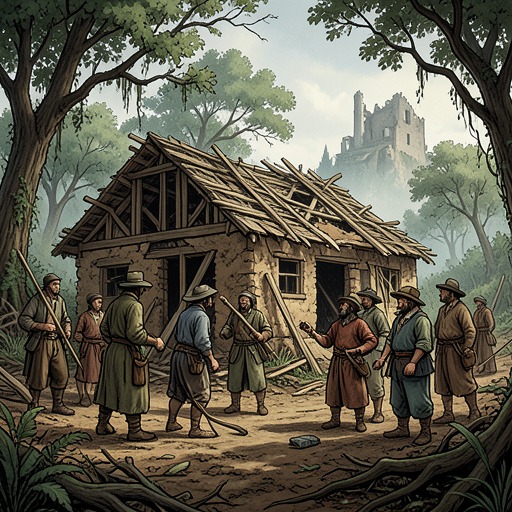
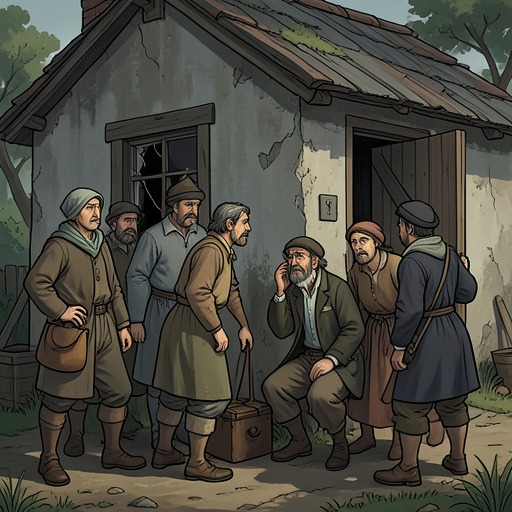
The return followed the same intimate geography in reverse, but without official permission. Some residents said they came back together with their Cats and Dogs, slipping through the forest at night like partisans because riot troops would not let them pass. One account describes three families returning together. Their houses had been looted: stoves smashed, windows and doors removed, and lamps, switches, and electrical outlets taken. The returning residents rebuilt what they could with their own hands. The work of repair was an answer to the physical damage and to the presumption that an evacuated home had ceased to belong to its former occupants.
Everyday life against the restrictions
Residents described their demands as modest: they wanted the authorities to leave them alone. They were willing to walk twenty kilometers for bread and said they did not need a store or a bus. That independence did not mean the return was easy. Police arrived in cars, and residents ran into the forest to avoid them. When a prosecutor threatened one returnee with a year in prison under Article 10, he said he would serve the sentence and come back. He remembered his medal as the kolkhoz’s best harvester and rejected the idea that the threat could cancel his claim to his home.
The struggle could involve direct destruction as well as intimidation. One resident said police came twice, broke her stove, and took her away on a tractor, but she returned again. She contrasted the dead, who could return to their villages through memory and burial, with the living, who could enter only at night through the forest. For residents who had been displaced across a wide area, the ban turned an ordinary journey home into a clandestine act.
The conflict was also visible to those assigned to enforce the exclusion. One soldier recalled setting up roadblocks and observation posts to prevent former inhabitants from entering evacuated villages. Residents asked to retrieve ordinary things—a bucket, pitcher, saw, or axe—or to harvest crops, and the soldiers had to refuse. The soldier described the contradiction: guards kept people off one side of the road while cows grazed on the other, harvesters worked, and grain was shipped away. A woman might milk a cow only to be ordered to pour the milk onto the ground; eggs had to be buried, and potatoes raised by farmers were also destined for burial. To the soldier, the land looked beautiful, making the prohibition and destruction harder to comprehend, not easier.
Homes, memory, and the living landscape
For the returnees, a house remained a place to live, not merely a contaminated object under state control. Residents dreamed repeatedly of coming home to dig in the garden or make a bed; even finding a shoe or a little chick in the dream brought happiness. In waking life, the sight of a solid roof and the return of seasonal signs—the wild geese announcing spring and the time to sow—stood beside empty houses and fields they could not freely use. The longing for home was tied to work and to the expectation of harvest, not only to memory.
Homecoming also reopened relations with the dead. Residents imagined people returning first to the cemetery, then to their yards, where they would cry, pray, and leave candles on fences or a white towel at a gate. At cemetery meals, families called deceased relatives to join them. This practice echoed the returned resident who sat with her mother, husband, and daughter in the cemetery and spoke with the dead as she did with the living. The graves were not separate from the village’s inhabited world: both remained places to which the displaced felt responsible and attached.
The absence of former neighbors made return incomplete. Anna Sushko, a mute woman who had lived alone in Kozhushki, was put into an ambulance during the transfer and taken somewhere unknown. Because she could not read, her neighbors received no letters and did not know where she had been placed. They remembered the care they had shared—chopping wood, bringing milk, and sitting with her in the evenings—and asked that she be found and brought back. Her house, they said, still stood; its roof and windows remained, and they could repair what had been broken or stolen. The plea shows that return meant more than reclaiming property: it also meant trying to restore a community whose most vulnerable members had been dispersed without a trace.
Animals and the limits of human return
The returning families’ insistence on bringing their Cats and Dogs makes the homecoming a shared, more-than-human one. In another account, a filmmaker entered an apparently empty house and found a real cat on the windowsill; it had eaten the geraniums. Notes left on houses asked visitors not to beat or kill the animals, and a child pleaded for the family’s cat to be spared. Such traces complicate the idea of an evacuated village as empty: human departures left animals inside homes, while returning people encountered lives that had endured without them.
The same witnesses recognized the limits of any plan to evacuate all living things. A proposed removal of animals raised questions about creatures underground and birds in the sky, beyond the reach of human instructions and resettlement schemes. One filmmaker later showed Chernobyl films to children. A boy asked why no one had helped the animals, and the filmmaker said he could not answer. The question extended the meaning of return beyond the human claim to a house: the disaster had divided people from homes and animals from the human care on which some depended, while leaving other forms of life outside the terms of official policy.
The accounts do not resolve the tension between returning and the danger associated with the zone. Instead, they show how it was lived: as a contest between military orders and household acts, between barriers and paths through the forest, and between the classification of a place as evacuated and the residents’ continuing recognition of it as home. The return persists in the work of rebuilding, the effort to find a missing neighbor, the walk back to a grave, and the decision to come again after being driven away.