Soviet Armed Forces
Voices from ChernobylThe Soviet Armed Forces occupy an unsettled place in the testimonies of the Chernobyl disaster: soldiers arrive to remove people from their homes, guard contaminated territory, and perform hazardous work, yet they are also young men operating within orders and knowledge they do not always understand. Their presence makes the disaster visible in military vehicles, checkpoints, uniforms, and instruments; the danger itself remains difficult to see or explain. The book does not offer a single institutional portrait so much as a series of encounters in which military authority meets civilian grief, improvised labor, and uncertainty.
Evacuation and Military Presence
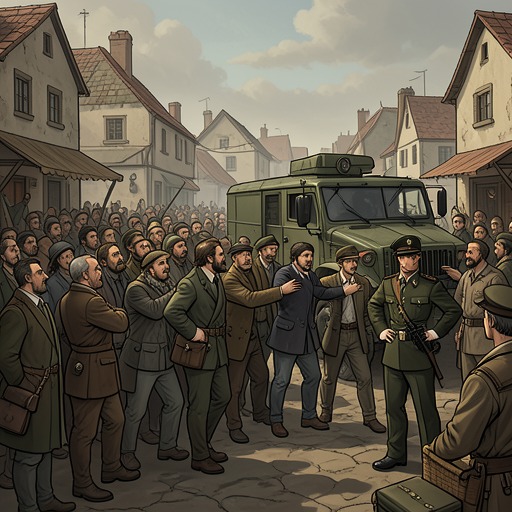
During evacuations, soldiers entered villages amid APCs, large trucks covered with green canvas, and even tanks. For residents who had lived through war, the sight of people leaving their homes under military guard revived the atmosphere of an earlier conflict. Some initially blamed the Russians, then the Communists, while others could make no sense of the catastrophe at all. The military scene was legible; the radiation that had made the evacuation necessary was not.
The evacuation of one village is remembered through its sounds and its interruption. Aircraft flew low toward the reactor, while livestock moaned and children cried. People hid in their houses as soldiers went from door to door asking whether they had packed. One woman stayed inside and refused to be taken, confronting the young soldiers rather than leaving voluntarily. Elsewhere, old women crawled or knelt in front of their homes and begged to remain; soldiers lifted them under the arms and carried them to vehicles. The account places the soldiers’ youth beside the coercive nature of the operation: they were described as children themselves, but were acting with the authority to remove residents from their houses.
The army also evacuated children at night, an effort to keep the catastrophe from becoming known that did not prevent people from finding out. Villagers brought milk cans and baked pies for the children boarding buses, giving the departure the familiar gestures of wartime care. A separate account describes a helicopter entering the contaminated zone with a properly equipped team. The protective clothing included a cheap cotton raincoat, a defensive outer layer, mittens, and gauze masks, with instruments hanging from the workers. From the air they saw boys playing naked in sand, one with a rock in his mouth and another with a tree branch. The team had orders not to panic the population. Their equipment marked a danger the children’s ordinary play could not register, while the order constrained what the visitors could tell those at risk.
Checkpoints and the Contradictions of Control
After evacuation, military personnel and other assigned workers guarded the roads and observation posts to prevent former inhabitants from returning to evacuated villages. Residents could not retrieve so much as a bucket, pitcher, saw, or axe, and could not harvest their crops. At the same time, across the road from the guards, cows grazed, harvesting machines worked, and grain was shipped. The testimony emphasizes the contradiction not as an abstract policy but as a daily scene: soldiers barred villagers from their possessions while agricultural activity continued nearby.
The rules also demanded the destruction of food that the residents had produced. A woman might milk her cow beside a soldier whose task was to ensure that she poured the milk onto the ground; eggs had to be buried, and potatoes raised by farmers were also destined for burial. The guard could thus find himself enforcing a procedure that turned familiar acts of tending animals and growing food into acts that had to be undone. Villagers brought eggs, bacon, and homemade vodka as they pleaded to enter their own homes and land. The account describes both sides as bewildered, with faces that looked crazed, and presents the soldier as an intermediary between an order and people who could not accept what it required of them.
Military instruments also shaped the limits of public knowledge. On a helicopter mission, personnel were instructed not to alarm residents; on television, military dosimeters were used to measure food and fish in scenes presented as proof that all was well. The narrator explains that the instruments then in use by the armed forces were designed to measure background radiation, not individual products. The distinction is crucial: a reading could be made to reassure viewers without answering whether the food on a plate was safe. In these accounts, military equipment is neither inherently self-explanatory nor sufficient to make danger publicly legible; its meaning depends on how it is used and presented.
Cleanup, Labor, and Exposure
Military personnel also worked in the contaminated countryside, where the duties could combine technical instructions with the continuing demands of ordinary administration. One long assignment involved the Krasnopolsk Region. To reduce the washing of radionuclides from fields into rivers, workers were instructed to plow double furrows at intervals and inspect the small rivers. The planned agricultural operations, however, had not been changed: peas were harvested despite their capacity to absorb radiation, and some places registered forty curies or more. Meanwhile, kindergartens had lost their cooks and nurses, children were hungry, and a patient needing an appendectomy had to be driven sixty kilometers to another region because the surgeons had left. The field assignment and the collapse of local services appear together, showing how military-directed work proceeded amid needs that the plan did not address.
The person carrying out this work was given an armored vehicle and crew, ultimately an armored exploratory vehicle with a mounted machine gun. The vehicle’s radio calls and its passage through familiar forests and roads made the work seem romantic to the narrator, but women watched from their fences and cried because the sight reminded them of war. A tractor intended to lay the furrows had a hermetically sealed cabin, yet its driver was resting outside with a sweatshirt over his head. The protective design and the worker’s improvised disregard of it expose a gap between official precautions and practical understanding. People had repeatedly been frightened about nuclear war, the account observes, but not about Chernobyl.
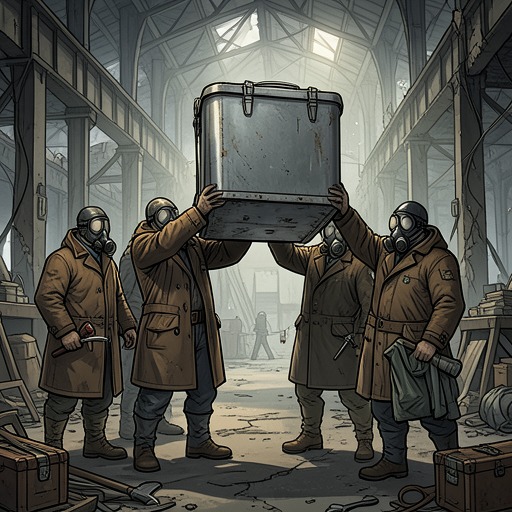
Another testimony describes the living conditions of a military work unit stationed near the reactor. After two months, dosimetrists discovered that the cafeteria stood in a place with higher radiation than the workers’ job site. The cafeteria consisted of posts with boards nailed across them at chest height; meals were eaten standing, washing was done with water from barrels, and the toilet was a long pit in an open field. The reactor was nearby. When members of the unit began to argue that two months was enough and that replacements should arrive, Major-General Antoshkin told them that bringing in a new shift would be expensive and complicated: the unit had already received three sets of clothing, and its members knew the place. The men were simultaneously praised as heroes, including through weekly certificates for especially effective digging. Heroism, in this account, did not displace the calculation of expense or the decision to keep experienced men in place.
Secrecy, Recognition, and the Testimonies’ Significance
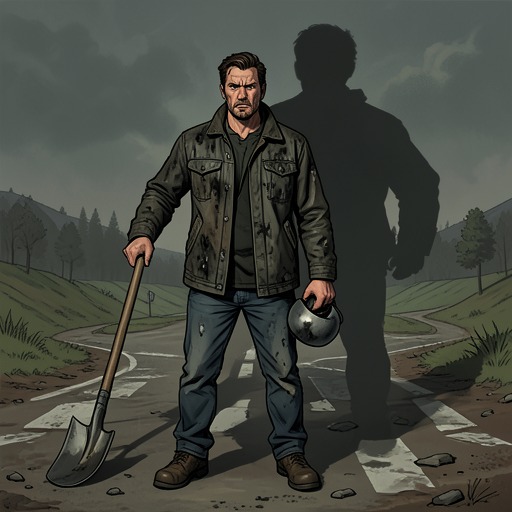
A young serviceman’s account makes the costs of this labor personal. He says that the men were made to sign non-disclosure forms and that he remained silent. He had become a second-group invalid immediately after leaving the army, at the age of twenty-two. His unit carried buckets of graphite from the reactor and shoveled it with ordinary shovels, changing masks as many as thirty times in a shift. The work contributed to the construction of the Chernobyl sarcophagus, described as a giant grave for Valery Khodemchuk, the senior operator trapped beneath the ruins in the first minutes after the explosion. Even after the unit returned, its members were not given replacement clothing; they continued to wear the same trousers and boots they had worn at the reactor until demobilization.
Afterward, the worker found that his experience was difficult to communicate or make count. At a factory, his boss threatened to reduce his work because of his sickness. He protested that he was a Chernobylite who had saved and protected others, but the director answered that the factory had not sent him there. The exchange sets public language about sacrifice against the refusal of a later employer to accept responsibility for it. The account does not treat military service as a guarantee of recognition: secrecy had silenced the worker during the operation, and his claim to have served the wider public carried little weight in civilian employment.
Taken together, the testimonies show the Soviet Armed Forces performing several connected but conflicting functions: removing residents, controlling access, measuring radiation, directing or conducting cleanup, and supplying the personnel through whom official orders reached the village and field. Soldiers could be the visible face of a system whose reasons remained unclear to the people affected, while they themselves were exposed to danger and sometimes lacked a reliable grasp of it. The recurring comparison with war expresses both the familiarity of military mobilization and the inadequacy of war as an explanation: Chernobyl brought uniforms, vehicles, evacuation, and discipline, but its invisible contamination unsettled the ordinary meanings of battlefield, protection, and victory.