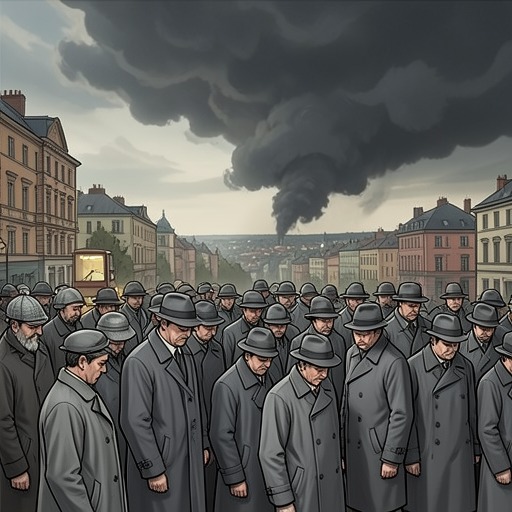
Soviet authorities' information blackout on the Chernobyl disaster
Voices from ChernobylThe Soviet authorities' information blackout on the Chernobyl disaster was a coordinated failure of public disclosure and a political system for controlling what counted as knowledge. Through secret reports, reassuring television segments, censored journalism, and blocked warnings, the authorities represented an unfolding radioactive emergency as manageable while residents, scientists, and camera crews encountered evidence that contradicted that message. The accounts show not only information withheld, but the consequences of a public trained to trust official assurances even when measurements and lived experience pointed elsewhere.
Secrecy and the official vocabulary
The blackout began with restricted access to basic facts. One account describes stacks of documents marked top secret: reports of the accident, medical observations, and radioactive exposure among personnel involved in the cleanup. In the absence of public explanations, information circulated as rumor: someone had read something in a newspaper, heard something from another person, or listened to broadcasts from the West. Even reports that reactor firefighters were handling dangerous material reached people in uncertain, fragmentary form. The contrast was stark: the state could classify detailed reports, while citizens had to assemble a picture of the danger from scraps.
Public language worked to close down inquiry. A journalist’s notebook records the radio repeating that the situation was stabilizing, while his editor rejected alarm and demanded stories about heroes. The editor’s demand, “I don’t need alarmists on this paper. Write me up something about heroes,” makes the permitted frame explicit: danger could be described as courage, but not as a reason to challenge official accounts. Political officers reinforced that frame with headlines such as “Chernobyl—A Place of Achievement,” “The Reactor Has Been Defeated!” and “Life Goes On.” The language turned an unresolved catastrophe into a process of victory and prescribed how the public should interpret it.
The associated rhetoric also redirected suspicion toward foreign enemies. A notebook entry describes the return of Stalin-era phrases about Western agents and enemies of socialism, while iodine protection went unmentioned. Unofficial information became suspect as foreign ideology. This displaced attention from practical questions—what people should take, eat, or avoid—to the political question of who was supposedly spreading panic. The enemy, one witness observes, was in fact invisible and everywhere: radiation could not be made harmless by treating warnings about it as hostile propaganda.
Reassurance against measurement
Television offered a particularly vivid version of the official story. Viewers saw an old woman milk a cow, a reporter measure the milk with a military dosimeter, and a commentator declare that all was well despite the nearby reactor. Other segments showed people swimming and sunbathing by the Pripyat River, with smoke visible above the reactor, and dosimeter readings taken from fish, chocolate, and pancakes. The apparent demonstrations of safety were themselves misleading: the military instruments being used were designed to measure background radiation, not contamination in individual products.
Measurements made by specialists conveyed a different picture. During one expedition, radiation in the forest measured five to six times higher than on roads or fields; in some villages, thyroid activity in adults and children reached one hundred to three hundred times the allowable level. Investigators found radioactive breast milk and food exposed in village shops beside clothing. Their account describes testing salami and an egg and concluding that they were radioactive byproducts, not food. These findings sharpen the contrast between the carefully staged television tests and the broader, more alarming work of measurement. A single reassuring reading could be made to stand for safety even when the instruments, sampling, and surrounding evidence did not justify that conclusion.
The same conflict reached the laboratories and offices that were supposed to respond. Scientists asked supervisors what to do and were told to take measurements and watch television. One engineer, with two decades of experience and knowledge of physics, understood that living things should leave the area, at least temporarily; nevertheless, he and his colleagues continued to measure and watch, shaped by a longstanding faith in the system. They prepared reports and explanatory notes but did not publicly sound the alarm. Their account links that silence to Party discipline and to the belief that the state acted fairly and placed human beings first. The eventual collapse of that faith, he says, contributed to heart attacks and suicides.
Blocked warnings and withheld action
A senior nuclear-energy specialist describes trying to warn the leadership in Minsk. Calls made over a government line were interrupted as soon as he began discussing the accident. After roughly two hours, he reached Nikolai Slyunkov and warned that the radioactive cloud was moving toward Belarus. He urged immediate iodine prophylaxis and evacuation of people and animals within one hundred kilometers of the station. Slyunkov answered that he had already received reports, and that the fire had been put out. When the specialist later met him, the official cited reassuring advice from Moscow, a government commission, the prosecutor’s office, and the deployment of the army.
The disagreement was not over an abstract possibility. The specialist invoked civil-defense instructions that called for iodine prophylaxis in the event of a nuclear threat. He says the area was registering three thousand micro-roentgen per hour and that the city held seven hundred kilograms of iodine concentrate for this purpose. Yet the iodine remained unused. He argued that authorities could have added iodine to freshwater reservoirs or milk without public announcements that might cause panic. In his account, concern for authority displaced concern for residents, and subordinates waited for orders rather than acting on the danger they could measure.
The specialist also describes unequal access to protection. He says senior officials were quietly taking iodine, moving their children out of the area, and using gas masks and special clothing unavailable to the general population. He reports that officials had access to specially monitored cattle and protected agricultural land. His accusation is that the public reassurance did not reflect how the authorities themselves behaved: privileged precautions suggested that those with access to information understood more than they admitted publicly.
After officials stopped receiving him, he sent formal reports and maps through the chain of command. He made two copies of four folders, each containing 250 pages of factual material, keeping one set at the Institute and hiding another at home. When he returned from a trip and found the office copies gone, he continued writing and speaking out. His institute had produced the first map of contaminated areas, with the whole south marked red. The account ends this effort not with acknowledgment but with the confiscation of the institute’s radiation-measuring equipment and threatening calls to his home. The blackout thus reached beyond public messaging: it constrained the production and circulation of evidence itself.
Censorship, spectacle, and the record
The control of information shaped what could be filmed as well as what could be printed. A cameraman recalls being encouraged to find heroes and staging a patriotic scene of bulldozer drivers reading Pravda beside a headline promising that the nation would not abandon those in trouble. Nearby, cattle were being buried in a giant pit; he turned his camera away from the pit and filmed the approved image instead. He also saw a road thick with radioactive dust paved in multiple layers before the arrival of senior officials, who later walked straight along the new asphalt. He had filmed the scene, but left it out of his script. The gap between recorded experience and publishable account was therefore created both by explicit censorship and by the choices made under official expectations.
The museum testimony describes the larger absence left by those controls. Authorities would not allow a chronicle of the disaster to be filmed; footage that was made could be seized and returned ruined. There was no visual record of the evacuation of residents or the movement of livestock, while heroic acts were permitted representation. The museum’s response was to gather surviving footage, insisting on real objects and images rather than plaster casts because so many lies surrounded the disaster. Its fragments include firemen’s blackened faces and a woman walking through dew-covered grass near the station, her legs visibly injured. Such images restore to view what the authorized record excluded: bodies and ordinary life exposed to contamination, not simply a story of organized heroism.
The blackout also altered the meaning of testimony after evacuation. One displaced resident recalls paying three times the usual price for train seats on the way to Minsk, then watching a conductor ask only the evacuees to hand over their tea cups. When they said they came from Chernobyl, other passengers drew away. In another account, a family returning for belongings found that a stain on a blanket continued to register as radioactive after washing and vacuuming; a dry cleaner cut out the glowing patch. These encounters made the hazard tangible even where official explanation was absent, while the label Chernobyl attached suspicion to people as well as objects.
Consequences and historical meaning
The information blackout fostered incompatible realities. Newspapers proclaimed achievement; television presented selective measurements as proof of safety; specialists found contamination in forests, food, and breast milk; and residents relied on rumors, personal observation, or the behavior of officials. The public could see people swimming near the reactor and hear that the situation was normal, while having no reliable way to assess what the images or instruments actually established. Because radiation was invisible, the state’s control over interpretation had special force: uncertainty did not merely accompany the danger but became one of the conditions under which people lived with it.
The testimonies connect concealment to a broader institutional logic of obedience and self-preservation. A physicist describes the leadership as caught in a conspiracy of ignorance and obedience rather than a simple criminal plot: officials feared displeasing superiors and jeopardizing promotion, travel, or a dacha. Journalists were steered toward heroes, experts were told to follow orders, and warnings were treated as threats to authority. The result was not only that facts remained secret, but that official structures repeatedly failed to turn available knowledge into protection.
In retrospect, the blackout is itself part of the disaster’s history. The accounts preserve the mechanisms through which evidence was minimized, redirected, or removed: secret files, blocked calls, censored articles, misleading demonstrations, confiscated instruments, and missing footage. Against the public story that life continued and the reactor had been defeated, they set measurements, contaminated belongings, frightened families, and persistent attempts to document what happened. Their central indictment is that a state capable of measuring danger and possessing means to respond chose, again and again, to guard its authority and its narrative before it guarded the people exposed to the radiation.