Soviet concealment of the Chernobyl disaster
Voices from ChernobylSoviet concealment of the Chernobyl disaster turned an already invisible hazard into an information crisis: people were expected to live, work, travel, and make decisions about food and family while authorities withheld or distorted what they knew. In the testimonies collected by Svetlana Alexievich, concealment is not a single announcement or order but a sequence of assurances, silences, restrictions, and misleading demonstrations. Its consequences unfold at once in public policy and in intimate life, where people could sense that something had changed but could not reliably name the danger or judge its reach.
Assurances and the withheld warning
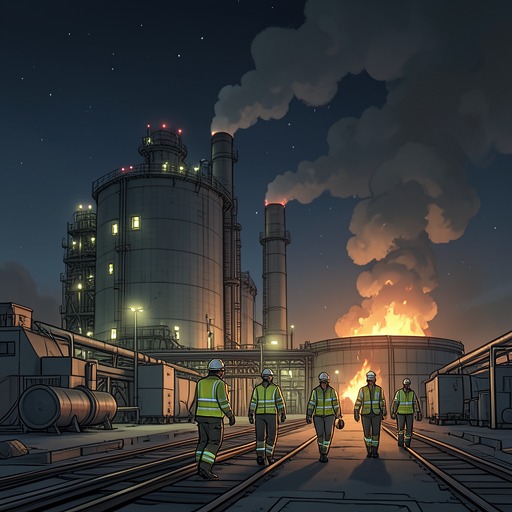
During the first ten days, while the reactor core burned and released radioactive material into the surrounding area, authorities repeatedly claimed that the situation was under control. The testimonies set this reassurance against the lack of timely public information: residents were not told plainly that radiation was the danger, and some were given explanations such as gas poisoning when people became ill. In the town, military vehicles appeared, roads were closed, public transport stopped, and streets were washed with white powder, but these visible interventions did not give residents the knowledge needed to understand what was happening. Military personnel wore masks; people continued carrying uncovered bread from shops and eating food in public.
The evacuation itself could deepen the gap between what authorities knew and what families understood. One account describes residents being told to prepare for a temporary absence of three to five days, with warm clothes for a stay in the forest. Some treated the prospect like a camping trip, packing radios and guitars, while women whose husbands had worked at the reactor were already crying. At the same time, buses gathered for evacuation and fire trucks filled the streets. The contrast between the scale of the preparations and the reassuring explanation left ordinary people to interpret official actions without an honest account of the risk or of how long they would be gone.
Restricted speech and controlled evidence
Concealment operated through direct warnings as well as public silence. A cleanup worker recalls being summoned to speak with a KGB officer before returning home and being strongly cautioned against telling anyone what he had seen. Another group was warned that, in the interests of the State, it would be better not to discuss its observations. Such instructions narrowed the circulation of firsthand knowledge even among people sent into the contaminated area. They did not erase what these workers had witnessed; they made speaking about it a punishable or disloyal act.
The control of information also reached the materials people might use to understand radiation. In one recollection, books on radiation, Hiroshima and Nagasaki, and even X-rays disappeared from the library in the first days. The speaker reports that some people believed this had been ordered from above to prevent panic; the account presents that explanation as a rumor, not as a confirmed order. Medical bulletins and other information were unavailable, while potassium iodide could be obtained only through personal connections. In the absence of dependable guidance, rumors filled the space left by official silence, and individuals improvised responses without knowing whether they were protective or harmful.
The same uncertainty constrained specialists. A measurement team found thyroid activity among adults and children far above allowable levels in some villages, detected radioactive contamination in breast milk, and tested food displayed uncovered beside clothing in village stores. Yet supervisors instructed the team to take measurements and watch television. The specialists compiled reports and explanatory notes, but the speaker says that Party discipline and faith in the system kept them from going out publicly to tell the truth. Their silence was not presented as proof that they lacked evidence: it followed from the collision between what their work showed and the authority they had been trained to trust.
Television assurances and contaminated daily life
Television supplied a particularly vivid form of misdirection. One account describes broadcasts showing an old woman milking a cow while a military dosimeter was used to reassure viewers, as well as people swimming and tanning by the Pripyat River with smoke visible above the reactor. The same broadcasts depicted measurements of fish, chocolate, or pancakes from an open stand. The witness explains why these demonstrations were misleading: the military dosimeters then in use were designed to measure background radiation, not the radioactivity of individual products. A display that looked like verification therefore concealed the limits of the instrument and offered viewers reassurance the readings could not support.
In the affected countryside, the gap between official plans and contamination could be measured in familiar things. A specialist found forest background radiation five to six times higher than on roads or fields, while measurements of thyroid activity in some residents reached one hundred to three hundred times the allowable dosage. Salami and eggs tested as radioactive byproducts; milk was also contaminated. Nevertheless, tractors kept running and farmers worked their plots. In another account, a timber shipment continued because the production plan had not been changed: an instrument registered an extreme reading near brooms from Krasnopol, after other shipments had already gone out. The contamination was not confined to a dramatic scene at the reactor; it traveled through routine production, food, and household goods.
Residents also encountered the hazard in ways that official language could not make manageable. One woman recalls finding colored, irregular chunks in her garden and in a nearby field after rain, then watching them disappear before police arrived. Elsewhere, signs recorded high readings near houses and in streets, while residents were told not to eat potatoes from their gardens, to work in masks and rubber gloves, or to wash their yards and stored textiles. These instructions arrived without a clear explanation that made the danger legible or the recommended actions convincing. The testimonies show how, when radiation could not ordinarily be seen, local observation, rumor, instruments, and official directives competed to define what counted as evidence.
Consequences for displaced families
The withholding of information did not end with evacuation. Families arriving in Minsk found that other passengers avoided them after learning where they came from. A blanket retrieved from an apartment had a mark that did not wash out; at a dry cleaner, the contaminated spot was cut away. The garment could remain physically recognizable as the same blanket or coat, yet its meaning had changed: one evacuee could no longer sleep under the blanket or wear the coat. The account links official failure to explain and contain the danger with the stigma that attached to those displaced from Chernobyl.
That stigma entered childhood and family relationships. In Mogilev, a boy from a displaced family was called radioactive by a classmate, then nicknamed Shiny by other children; he was the only child from Chernobyl in his class. A young woman describes fear that her origins would make marriage and childbearing unacceptable to a partner’s family, even after she and her fiancé had registered their marriage. Her experience gives the public-information failure a future tense: uncertainty about exposure becomes social suspicion about whether survivors should have children, and the person affected is made to carry the unanswered question as a mark of identity.
The conflict between secrecy and response
The testimonies do not portray the authorities as simply doing nothing. In the week after the accident, thousands of men were sent to confront the consequences. Helicopters dropped sand onto the fire; when it stopped, workers cleared radioactive debris from the roof. Machines failed under radiation, while people continued working and later became gravely ill. The same account stresses the contradiction: the authorities could mount a frantic response while refusing to acknowledge publicly how serious the disaster was. Concealment and emergency action therefore coexist, rather than canceling each other out. The effort to limit catastrophe could be real even as the public was denied a candid explanation of the danger and the human cost.
For the specialists, one reason the contradiction endured was inherited political faith. An engineer who believed that everyone living near the disaster should leave nevertheless says that the team continued measuring and watching Mikhail Gorbachev’s reassuring television appearances. The speaker connects that obedience to a postwar generation’s belief that the system served people and that collective discipline was justified. The testimonies describe the eventual collapse of that belief as more than political disappointment: it stripped some people of their sense of purpose. Concealment thus damaged not only public trust but also the moral framework through which trained people had understood their work and their obligations.
The book’s many voices make the concealment legible through accumulated particulars: the unmasked shoppers, the inaccessible books, the misleading instrument readings, the contaminated milk, the warning from a KGB officer, and a child rejected by classmates. Together they show how the disaster’s danger was prolonged by the denial or distortion of knowledge. When reliable information was withheld, those exposed had to decide what to eat, where to live, whether to leave, and whom to trust without a stable account of the risk. The resulting harm was both physical and social: contamination entered ordinary life, while the people who carried its history could be treated as dangerous even when they were seeking answers themselves.