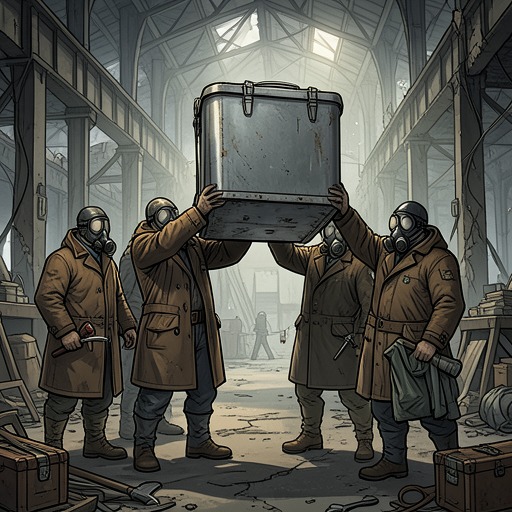
Soviet heroism and the ethic of self-sacrifice
Voices from ChernobylSoviet heroism and the ethic of self-sacrifice shape how people understand duty, danger, and the value of an individual life in the accounts surrounding Chernobyl. The ideal is inherited through family and wartime culture, enacted in hazardous work and acts of rescue, and reinforced by institutions that command service. But the testimonies also reveal its fracture: people who were taught to offer themselves for the collective return with injuries, silence, and the belated insistence that their own lives matter.
An inherited idea of what makes a person
For one narrator, the expectation of sacrifice begins at home. His father wore military clothing despite not serving in the military; in the family’s moral vocabulary, concern with money was bourgeois and attention to one’s own life unpatriotic. Hunger and catastrophe seemed like normal conditions. The older generation had survived a great disaster, he recalls, and the next generation felt it, too, had to pass through disaster in order to become real people. A life of steady work and adequate food could seem not merely unfamiliar but intolerable. Hardship was not only something to endure: it was a test that gave a person a place in a larger story.
That inheritance shaped conduct during the evacuation. A witness describes children being loaded onto buses and adults reaching for gestures learned from war films: a brief farewell, a lone tear, a wave meant to reassure a watching parent that the family would win. The narrator imagines himself making the same gesture to his wife and son if evacuation reached Minsk. Personal fear is translated into a familiar public script of courage. In another account, a Russian teacher sees the same inheritance at work in the curriculum: she had taught literature centered on war, sacrifice, and defense of the motherland. When teachers were told to bring shovels and remove contaminated soil around a school, most went out without protective clothing or respirators. Only two young teachers refused. For the speaker, their refusal marked a generational difference, while the others’ compliance exposed how readily the old lesson could turn danger into duty.
Sacrifice as rescue and spectacle
The ethic takes its starkest form in the account of a possible nuclear catastrophe. Water beneath the reactor threatened, in the speaker’s description, to combine with uranium and graphite into a critical mass. The resulting explosion was estimated at between three and five megatons, with a large part of Europe potentially made uninhabitable. The assigned task was to drain the water by opening a safety valve. Volunteers were sought; men repeatedly dived in and opened the bolt. The account says they were promised cars, apartments, and lifelong aid for their families, but that the promises were not what sent them into the danger. Their unit received 7,000 rubles. The men who performed the task later survived only as names in museum documents. The episode makes sacrifice at once concrete and nearly impossible to measure: a dangerous act may protect millions, while those who perform it disappear into records.
Other accounts place this act within a broader culture of mobilization. A former responder describes being sent to the reactor roof despite having a fuel specialty. Before the work, the commander announced that only volunteers would go up, while the others would speak with the military prosecutor. Some protested that they had already gone and should have been sent home, but eventually agreed to return. The speaker understood the threat of punishment for insubordination and chose not to object. He also recalls a rule under which a soldier who received more than 25 roentgen could expose superiors to imprisonment; he says that no one was recorded as having received more than that amount. In the same account, one man went onto the roof twice in a day and received 500 rubles; another kept working on a hole until it was finished, earning 1,000 rubles. He later became a first-group invalid. Payment and bravery coexist in these memories, but neither cancels the risks or the pressure surrounding the choice.
Obedience, danger, and the people kept outside
The moral cost of the ethic is not confined to the reactor. A soldier assigned to keep former residents out of evacuated villages describes roadblocks and observation posts set up to prevent people from returning. Farmers could not retrieve ordinary possessions or harvest their crops, even as cows grazed and grain was shipped on the other side of the road. Women begged to enter their own homes and brought eggs, bacon, or homemade vodka. Soldiers then had to enforce the destruction of what residents had raised: milk poured onto the ground, eggs buried, potatoes dug up only to be buried. The speaker follows orders, yet the sight overturns the ordinary meaning of service. The landscape is beautiful, the villagers’ faces appear changed by distress, and the soldiers’ faces seem changed as well. Duty protects a boundary while placing those who enforce it directly beside the human losses it creates.
The same speaker distinguishes the desire to serve from material reward. Political speeches, radio, and television helped give the work a heroic frame; some wanted publicity, some treated the assignment as a job, and others believed they were doing heroic work. His pay rose from 400 rubles to 1,000, and later accusations that responders had been enriched hurt because they ignored the work’s heroic dimension. Yet another soldier describes what happened when that service ended. After signing a nondisclosure form, he said nothing about what he had seen. He became a second-group invalid at twenty-two, after carrying buckets of graphite and working with ordinary shovels, changing masks as many as thirty times a shift. He says the unit returned without even a change of clothes and wore the same trousers and boots until demobilization. When he later invoked his service to resist a factory cutback, his director replied that the factory had not sent him. The appeal to sacrifice brought no durable claim on the institutions he believed he had protected.
Silence, recognition, and the return of the individual
A warning before the responders went home advised them not to tell people what they had seen in the interests of the State. One witness gives the resulting silence a paradoxical shape: the men had not understood everything, but they had seen it all, and almost no one else knew what had happened there. The secrecy that enclosed the work also obstructed recognition afterward. One responder says that medical care was difficult without documents recording his exposure, documents he believed were still classified or destroyed. At night he lay awake while his mother asked why he was not speaking. He could not find anyone who understood where he had returned from, and he felt unable to explain it.
The collective ideal also changes meaning when set against another response to the accident. An engineer recalls East German specialists demanding medical attention, dosimeters, and controlled food supplies after learning of the disaster. Their requests were refused, so they prepared to leave and protested through telegrams to their government. Soviet observers mocked them as cowardly and contrasted their concern for safety with men climbing the reactor roof in canvas gloves and children marching with flags. Looking back, the engineer calls this lack of fear for oneself a form of barbarism. The habitual language of collective heroism had made it difficult to say that an individual did not want to die. After Chernobyl, he says, people began paying closer attention to the world around them and learning to speak in the first person: not only as a collective, but as an individual afraid for his life.
The double meaning of heroism
The testimonies do not simply deny the courage or necessity of the work. A reactor worker remembers a kind of freedom at the front line: amid fear and the possibility of death, survival could feel like a contest with danger and authority. But that freedom is lonely, and it does not make an ordinary life ready for war. Another witness observes that responders were trained to perform the impossible, while the culture around them repeatedly called them to do so. The same tradition could furnish purpose and solidarity, or make a person’s safety seem shameful.
The difference between sacrifice freely embraced and sacrifice extracted by institutions remains unresolved in these accounts. The volunteers who opened the valve are remembered as having saved others, while the roof worker’s story includes threat, distorted exposure records, and lasting disability. The soldier at the village roadblock obeys orders while watching residents lose access to their homes and food. After the danger, responders encounter secrecy, missing records, and employers who disclaim responsibility. Heroism therefore appears not as a settled honor but as a demanding and unequal bargain: the individual is asked to give himself for the collective, while the collective may fail to care for him afterward. The movement from the habitual we toward the frightened I marks a change in moral understanding, not the disappearance of courage.