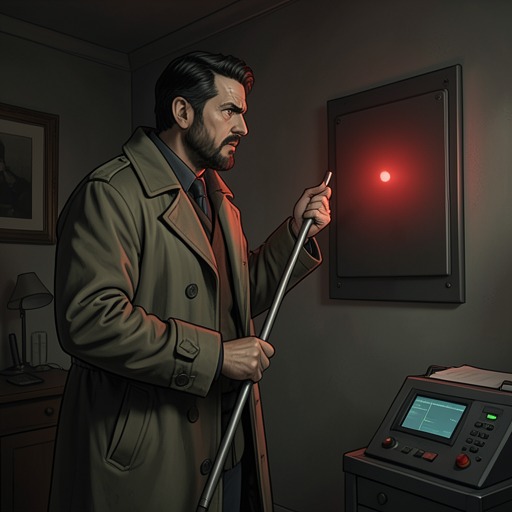
Vasily Nesterenko–Nikolai Slyunkov conflict
Voices from ChernobylThe conflict between Vasily Nesterenko and Nikolai Slyunkov is a struggle over who could define the danger after the Chernobyl accident: the scientist measuring radiation and urging protection, or the political leadership insisting that the situation was under control. In Nesterenko’s recollection, his warnings to the head of the Communist Party leadership in Belarus repeatedly ran into blocked communications, official assurances, and reluctance to act. The dispute continued beyond their first calls: Nesterenko assembled reports and maps, pressed for evacuation, and faced institutional efforts to silence him, while the people he believed were in danger remained exposed.
The warning and the first response
On April 26, 1986, Nesterenko was in Moscow on business when he learned of the accident. He was director of the Institute for Nuclear Energy of the Belarusian Academy of Sciences, a professor, and a corresponding member of the Academy. He tried repeatedly to reach Slyunkov in Minsk, but calls were not connected. After finally reaching Slyunkov’s assistant, Nesterenko explained that the information was urgent and requested a direct conversation. Even on a government line, he found that mentioning the accident caused the connection to go dead; he understood this as evidence that the calls were being monitored and blocked.
It took about two hours for Nesterenko to reach Slyunkov. By then he had spoken with people in Moscow and assessed the likely movement of the radioactive cloud. He warned that it was moving toward Belarus and urged immediate iodine prophylaxis for the population and evacuation of everyone near the station. His proposed exclusion extended to both people and animals within 100 kilometers. Slyunkov replied that he had already received reports: there had been a fire, but it had been put out. The disagreement was immediate and fundamental. Nesterenko argued that graphite burned at roughly five tons per hour, so the reported fire could not be treated as proof that the danger had ended.
The following day, April 27, Nesterenko traveled into Gomel Region to collect measurements himself. In Bragin, about twenty to thirty kilometers from the station, his instruments registered 30,000 micro-roentgen per hour; in Narovlya, they registered 28,000. People were working in the fields, sowing and preparing for Easter, because they had received no orders to leave. Local questions about radiation met not with shared information but with incomprehension: the units of measurement sounded like the language of another planet. For Nesterenko, these observations gave concrete urgency to the warning he had made to Slyunkov. Ordinary work continued while the readings indicated an extraordinary hazard.
The confrontation in Minsk
On April 29, Nesterenko went to Slyunkov’s reception area at eight in the morning and waited until 5:30 in the afternoon. A well-known poet emerged from the office and told him that he and Slyunkov had discussed Belarusian culture. Nesterenko responded that there would be no culture or readers to preserve unless people were evacuated from Chernobyl. The exchange made the competing priorities stark: the symbolic continuity of national culture on one side, the immediate safety of the population on the other.
Nesterenko eventually saw Slyunkov and described what he had observed. He also reported that Ukraine had begun evacuations. Slyunkov challenged the conduct of Nesterenko’s Institute staff, asking why they were moving around town with dosimeters and frightening people. He said he had consulted Moscow and Professor Ilyin, chairman of the Soviet Radiological Protection Board, and had been told that everything was normal. He also cited the government commission at the station and the army’s deployment of equipment. In Nesterenko’s account, these assurances did not answer the measurements or the need to protect the population; they substituted institutional authority for the scientific case he was making.
Nesterenko set the incident within the scale of the contamination as he understood it: thousands of tons of radioactive substances, 450 types of radionuclides, and a release he compared to 350 atomic bombs dropped on Hiroshima. He argued that the response required discussion of physics and its consequences, but that officials were instead preoccupied with enemies and the search for blame. He later characterized the leadership’s failure not simply as a deliberate conspiracy but as a convergence of ignorance and obedience. In his interpretation, Slyunkov’s position as a senior official did not translate into readiness to contradict the hierarchy or act on a warning that could unsettle it.
Authority, delay, and unequal protection
The dispute also concerned what the state already knew how to do. Nesterenko pointed to civil-defense instructions requiring iodine prophylaxis for the population in the event of a nuclear accident or attack. He said that 700 kilograms of iodine concentrate were available in the city but remained unused. He believed protective measures could have been organized without public panic, including adding iodine to freshwater or milk. Instead, he described a system in which people waited for an order and feared superiors more than the atom.
That criticism was sharpened by what Nesterenko said he learned about the officials themselves. He had information that senior figures had received iodine and that their children had been quietly moved out of the area. He said that officials entering contaminated places had gas masks and special protective clothing unavailable to ordinary people, and that a specially monitored herd supplied Minsk. These details are presented as part of his testimony about the unequal distribution of knowledge and protection, not as an exchange between the two men. They deepen the conflict’s central charge: the population was told that conditions were normal while, in Nesterenko’s account, people with access to authority took precautions of their own.
Nesterenko’s professional work reinforced the warning. On his first trip into the Zone, he measured forest background radiation at five to six times the levels on roads or fields; tests in villages found thyroid activity in adults and children as high as two or three hundred times the allowable dosage. His group also detected cesium in breast milk and radiation in food sold in village shops. Yet when he and his colleagues asked supervisors what they should do, they were told to take measurements and watch television. Nesterenko recalled believing official statements that immediate measures had been taken, despite his own technical understanding that living things should leave the area, at least temporarily. He explained the silence of scientists and physicians as the effect of Party discipline and a deeply rooted faith in a system they had been taught to trust.
Reports, retaliation, and the meaning of the conflict
After officials stopped receiving him, Nesterenko sent formal reports, maps, and figures through the chain of command. He assembled four folders, each containing 250 pages of facts, and made two copies: one kept at the Institute and another hidden at home by his wife. When he returned from a trip, the folders in his office had disappeared. His Institute had been the first to produce a map of contaminated areas, with the whole south marked red. The missing records and the map give material form to the conflict: evidence was gathered and circulated, but its availability depended on institutions that could also remove it.
The pressure extended to the instruments and the people producing the measurements. The Institute’s radiation-measuring equipment was confiscated without explanation, and Nesterenko received threatening calls at home warning him to stop frightening people. He wrote to Moscow despite those threats. The president of the Academy of Sciences then told him that the Belarusian people would remember his work, but that writing to Moscow had been a serious mistake and that there were demands to remove him from his post. Nesterenko was threatened with confinement in a mental hospital, a staged car accident, or prosecution; the account concludes that he was taken to court.
The conflict therefore outlasts the face-to-face disagreement over whether the fire had been put out. Slyunkov’s response, as Nesterenko recounts it, became part of a larger apparatus of reassurance and delay; Nesterenko’s reply took the form of measurements, warnings, maps, reports, and continued appeals. His testimony does not reduce the failure to one conversation or one official. It shows how technical knowledge could be acknowledged in principle yet denied practical force when decisions were governed by hierarchy, secrecy, and the preservation of authority. The unanswered question running through the episode is not merely whether the danger was measurable, but why measurement did not compel protection.