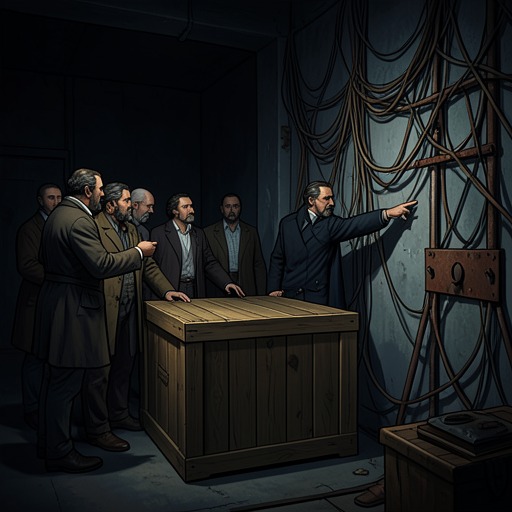
Vasily Nesterenko's Chernobyl warning campaign
Voices from ChernobylVasily Nesterenko's Chernobyl warning campaign was a sustained attempt to turn scientific measurements into public protection while Soviet authorities restricted information and delayed action. Beginning on April 26, 1986, it brought him into conflict with senior officials over the radioactive cloud moving toward Belarus: he called for iodine prophylaxis and evacuation, gathered measurements in endangered towns, sent reports up the chain of command, and continued after his equipment was confiscated and he received threats. His account makes the campaign a struggle not only over what to do, but over who was permitted to define the danger.
The first warning and a blocked channel
On April 26, Nesterenko was in Moscow on business when he learned of the accident at the Chernobyl Nuclear Power Station. He tried repeatedly to reach Nikolai Slyunkov, the head of the Central Committee of the Communist Party of Belarus, in Minsk. The calls would not connect at first; when Nesterenko began speaking about the accident over the government line, the connection went dead. It took about two hours to reach Slyunkov. The interruption mattered: even the director of the Institute for Nuclear Energy of the Belarusian Academy of Sciences, a professor and Academy correspondent member, could not assume that emergency information would travel freely through official channels.
By the time he got through, Nesterenko had spoken with people in Moscow and begun calculating the cloud's direction. He warned that it was moving toward Belarus and urged immediate iodine prophylaxis for the population and evacuation of everyone near the station, arguing that no person or animal should remain within 100 kilometers. Slyunkov told him that a fire had occurred but had been put out. Nesterenko rejected that reassurance, pointing to the continuing danger of burning graphite. He took the first train to Minsk and spent the night awake. At home the next morning, he measured his son's thyroid at 180 micro-roentgen per hour and concluded that the child needed iodine.
Measurements against official reassurance
On April 27, Nesterenko went into Gomel Region, near the border with Ukraine, carrying instruments to measure background radiation. In Bragin he measured 30,000 micro-roentgen per hour; in Narovlya, 28,000. Yet people were sowing, mowing, preparing for Easter, coloring eggs, and baking Easter cakes. They had received no warning or evacuation order. The questions and tasks coming from above concerned the harvest, not radiation. The gap between the readings and ordinary life was stark: the danger was measurable, but many residents had no information that would let them interpret it.
The measurements belonged to a broader body of field evidence. In another account of his first trip, Nesterenko described forest background radiation five to six times higher than on roads or fields, and thyroid activity in some adults and children at one hundred to three hundred times the allowable dosage. The team also found radioactive breast milk and food in village stores, where clothing and uncovered salami and margarine sat side by side. These observations gave urgency to his warning: contamination was not an abstraction confined to the damaged plant, but part of the landscape and the food supply people were still using.
On April 29, he waited from 8 A.M. until 5:30 P.M. in Slyunkov's reception area before finally getting an audience. After a poet emerged from the office saying they had discussed Belarusian culture, Nesterenko protested that there would be no one left to read the books if people were not evacuated. Slyunkov responded that the fire had already been put out. When Nesterenko described what he had seen and said people had to be saved, Slyunkov countered that he had consulted Moscow, cited a radiological authority's reassurance, and pointed to a government commission and the army's involvement. The exchange exposed the campaign's central contest: direct measurements and expert warnings faced official assurances that the emergency was under control.
Reports, resistance, and the cost of persistence
Nesterenko argued that existing civil-defense instructions already required iodine prophylaxis for the entire population when a nuclear accident or attack threatened. He said the city had 700 kilograms of iodine concentrate that could have been introduced into freshwater reservoirs or milk without a public announcement. Instead, the supplies remained unused while people waited for orders. In his account, the obstacle was not a lack of a written procedure or available material, but a political culture in which officials feared superiors and protected state authority before human life.
After officials stopped receiving him, Nesterenko sent letters, official reports, maps, and figures throughout the chain of command. He assembled four folders of 250 pages each, made two copies of everything, kept one at the Institute, and hid the other at home with his wife's help. The precautions reflected his expectation that the evidence might disappear: after one trip, he returned to find that the folders in his office were gone. He continued writing and speaking out, and his Institute kept making field trips and produced the first map of contaminated areas, marking the whole south red.
The authorities then confiscated the Institute's radiation-measuring equipment without explanation. Threatening calls followed at home, warning him to stop frightening people and implying that he could be made to suffer. Pressure also reached the Institute's scientists. Nesterenko wrote to Moscow despite the risks. The president of the Academy of Sciences later told him that the Belarusian people would remember his work, but warned that writing to Moscow had been a serious mistake and that officials were demanding his removal. The warning made clear that persistence could carry a professional penalty as well as personal danger.
Public encounters and the limits of warning
The campaign also took Nesterenko beyond offices and reports. While driving along the Pripyat, he saw families camping, swimming, and sunbathing beneath a radioactive cloud. He was forbidden to speak with them, but approached children and tried to explain the danger. They asked why radio and television had said nothing. A local Party escort watched without intervening; Nesterenko could not know whether the man would report the encounter afterward. In that moment, the campaign's conflict took a human scale: the truth was not simply withheld in documents, but kept from people living directly under the contamination.
Nesterenko's account ends without resolving whether the warning campaign could prevent another failure. He asks what should be done with the truth and fears that, if disaster struck again, the same pattern would recur. The record he insisted on preserving—measurements, maps, reports, and testimony—stands against a system that could interrupt calls, withhold instructions, remove instruments, and punish disclosure. His campaign thus documents both an attempt to protect people in the immediate emergency and the institutional barriers that made scientific knowledge difficult to turn into action.