Walking ashes and talking earth
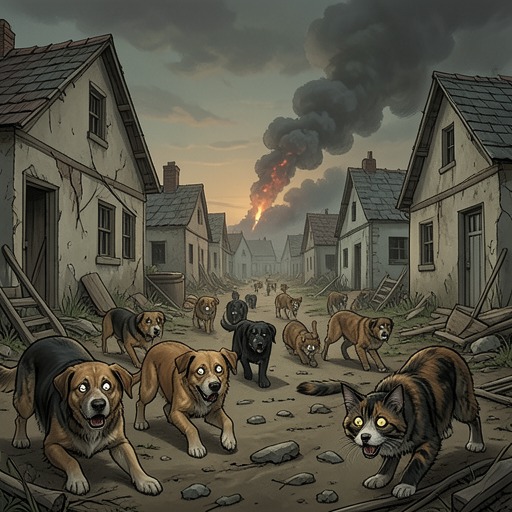
Voices from Chernobyl“Walking ashes and talking earth” is a paired expression for life in the Chernobyl Zone: animals are figured as ash that still walks, while people are earth that speaks because they eat the earth and are made from it. The phrase holds a contradiction in view. The living world is marked by catastrophe, yet it remains active; human speech can describe that world, but does not automatically grant its other inhabitants care or protection.
The phrase and its contrast
The expression comes from a story told by a hunter about a man he had encountered in the Zone, a former philosophy student who had been imprisoned and who rarely told others the truth about himself. When drunk, the man lectured people; he said Chernobyl had happened so that philosophers could be made, then called animals “walking ashes” and people “talking earth.” His explanation makes the image material: people talk because they consume earth and are built from it. The phrase does not set humanity outside nature. It places human bodies within the same ground from which the disaster’s consequences emerge.
The two halves nevertheless describe unequal ways of being. People interpret, explain, and narrate; animals simply live. The hunter repeats the contrast later as “Walking ashes,” then insists that every living creature, even an insect, has a soul. In his account of a wounded doe, its look seems almost human: it might express hatred, or a plea to live. That uncertainty matters. The animal cannot explain its experience in human language, but its visible vulnerability makes indifference difficult to sustain.
Encounters with living creatures
The phrase gains force from the accounts of animals that persist amid abandonment and deliberate harm. One hunter recalls killing a fox as a child and later killing a doe, after which he swore never to kill another; the doe’s eyes had seemed so expressive. Another hunter describes the suffering involved in killing: horses cried when they were taken to be shot, and a wounded doe appeared to understand what was happening. The metaphor’s “ashes” therefore do not make animal life inert. It points instead to lives exposed to death, while the hunters’ testimony records the difficulty—and failure—of fully looking away.
An abandoned house offers a quieter version of that encounter. A visitor initially mistakes the cat on its windowsill for a clay figure, then discovers it is real and has eaten the geraniums inside. Notes left by departing residents ask that the house not be trashed and that the cat not be beaten or killed; one child writes that the cat is good. The visitor later says the image of opening an apparently empty house and finding the animal inside, along with the children’s notes, is what stayed in his memory. In a landscape defined by people leaving, the cat is not merely a remnant of domestic life: it is a living creature whose survival depends on what people do after abandoning their homes.
Speech, silence, and responsibility
The book also complicates the distinction between speaking people and voiceless animals. Anna Sushko, a woman who was mute from birth and could not read, was taken away by ambulance during the transfer from her village. Her neighbors did not know where she had been sent. They had cared for her together, bringing milk and firewood and staying with her in the evenings; after they returned, they wanted her address so they could bring her home. When something hurt, she sang without words. Her voice does not make her experience identical to that of an animal, but it unsettles any simple equation between speech and the capacity to suffer or be heard.
A filmmaker’s own change in attention makes the ethical question explicit. He says that an old woman refusing to leave her cat, together with an apple tree that had no smell, was when he began his work; afterward, he filmed only animals. When he showed his Chernobyl films to children, one boy asked, “Why couldn’t anyone help the animals?” The filmmaker could not answer. He observes that art is usually concerned with human suffering and love, not with the suffering of animals, plants, and the rest of the living world. The phrase gives that neglected world a place in the record, even when its inhabitants cannot speak in human terms.
The earth as witness
The expression’s ground is more than a metaphorical source of human life. A woman living alone recalls seeing chunks of cesium in her yard and nearby gardens: black material after rain, and pieces she described as blue and red, roughly the size of her kerchief. She and other women searched about two hectares of gardens and field and found several large chunks; after rain, they disappeared before the police arrived. Her testimony makes the earth both the medium of contamination and the limit of what can be proved: the pieces were gone, leaving only what the witnesses could say.
Other accounts give the ground a social and intimate meaning. During departure, one resident took earth from her mother’s grave in a small sack and knelt to ask forgiveness for leaving. A deserted village is also remembered through its bugs, spiders, and leeches, which were buried along with the earth; the witness calls them part of a separate world. Together, these details deepen “talking earth”: people speak from a physical ground they carry, leave, bury, and struggle to describe, while the nonhuman lives caught in the same catastrophe remain easy to overlook. “Walking ashes and talking earth” is therefore not simply a metaphor for ruined nature. It is a challenge to human accounts that register disaster only when human beings are its subjects.