Wild boars
Voices from ChernobylWild boars appear in the testimonies as inhabitants of a landscape humans have abandoned but cannot fully evacuate. They dig in a garden and burst from an empty school; near the reactor, they move slowly through grass. These brief sightings give the animals a presence beyond metaphor: they are living within the disaster’s altered terrain, even as people debate what can be moved, rescued, or left behind.
In the Abandoned Landscape
One witness looks out into a garden and sees Wild boars digging. The detail is plain and domestic: the animals have entered a cultivated space, once shaped by village life, and are turning its soil over. In the same account, cuckoos call, magpies chatter, and roe deer run. The witness wonders whether the animals will reproduce, a question that makes the aftermath more than a matter of empty houses. The future of other species is uncertain too.
Elsewhere, a driver describes the village street, field, and highway as empty of people. Electricity lines lead nowhere; houses and public buildings have become animal territory. A Wild boar suddenly jumps out of a school building at the passing group. The startling encounter reverses the expected order of the place: a building associated with human gathering now shelters wildlife, and the animal appears where a person might have been. The school is not simply abandoned scenery. It has become part of a habitat formed by human absence.
Exposure and Unequal Mobility
A witness flying by helicopter near the reactor sees roe deer and Wild boars below. They appear thin and sleepy, moving as if in slow motion while eating the grass. The account stresses their inability to understand that they should leave with the people. That contrast is central to the animals’ situation: humans can receive orders, board vehicles, and be relocated, while the creatures encountered from above remain among the vegetation and places from which people are being removed.
The testimonies do not establish what radiation dose the Wild boars received or what happened to these particular animals afterward. Their image nevertheless makes exposure difficult to treat as an abstract human problem. They feed on the ground near the reactor, in a region where the danger is described as invisible and hard to comprehend. The scene records what the witness can see—their bodies, their slow movement, their feeding—against what neither the animals nor the observer can readily know about the consequences.
Evacuation, Culling, and Human Priorities
One resident argues that people can be resettled but elk and Wild boars cannot. The statement distinguishes human evacuation from the wider movement of life through a landscape. Water, the same speaker observes, does not respect borders; it travels over and under the earth. The animals belong to this account of connected terrain, not to a human map that can be cleared simply by moving residents away.
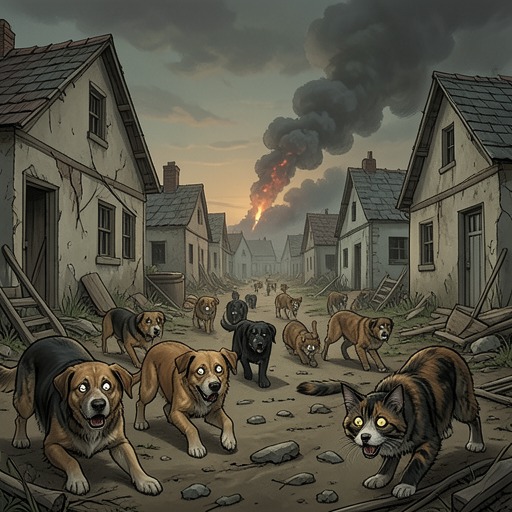
Other testimonies describe direct interventions in animal life, though not specifically in the lives of Wild boars. In one account, crews enter evacuated villages to kill abandoned dogs and cats; in another, hunters describe surrounding a village as dogs flee and cats hide in houses. The distinction matters: these accounts show the measures taken against domestic animals, not a stated policy toward Wild boars. Read alongside the sightings of boars in gardens, schools, and fields, they reveal different human responses to the animals left in the zone—some are encountered as wild inhabitants, while others are treated as a problem to be removed.
A Challenge to Human-Centered Witness
The boars’ brief appearances belong to a larger reconsideration of whose suffering counts. A witness who later films animals recalls a child asking why no one could help them. The question unsettles a culture of storytelling centered on human loves and losses, and prompts the speaker to recognize how little attention is given to animals and plants as lives in their own right. The witness also recalls being struck by insects and other small creatures entombed with earth during burial work, evidence of a world affected by human cleanup as well as by the initial disaster.
Wild boars are not developed as individual characters, and the accounts do not follow a single animal from the accident through its aftermath. Their force comes instead from recurrence across separate testimonies: digging in a garden, emerging from a school, feeding near the reactor. Each appearance brings the human story into contact with lives that cannot be addressed through evacuation plans alone. The animals remain visible, but their fate is largely unknown; that gap is part of what the book’s witnesses ask readers to face.