Wolves
Voices from ChernobylWolves recur in the accounts as living presences in and around abandoned homes, not merely as emblems of wilderness. A wolf appears at a solitary resident’s yard at night, its eyes shining like headlights; elsewhere, a wolf and a she-wolf have taken up residence in a school until a man drives them out. Another speaker meets a wolf on a road and describes a brief, wordless standoff before it steps aside and she runs. These encounters place the animals close to the spaces people have left behind, while preserving their own distance and agency.
Encounters in abandoned places
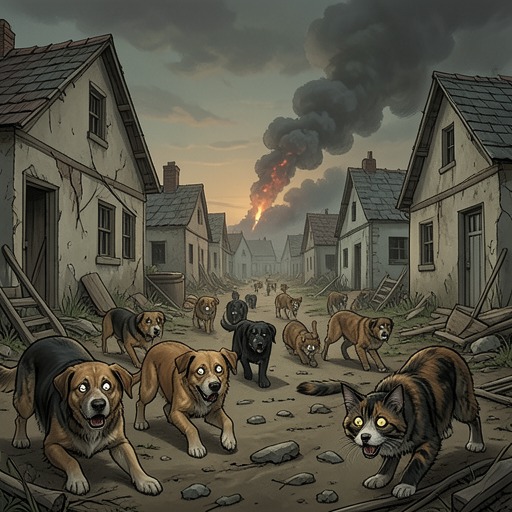
One resident describes looking out at night to find a wolf in the yard, its eyes bright in the darkness. By then, he says, he has become used to everything. He has lived alone for seven years since the people left, passing nights in thought and waiting for morning. The wolf’s visit belongs to that altered routine: a wild animal now appears at the edge of a domestic space, while human company has disappeared. The account does not describe an attack. Its force lies in the startling visibility of the animal at the window and in the speaker’s matter-of-fact admission that even this has become familiar.
A different account places wolves inside a public building. A solitary man says he chased a wolf and a she-wolf out of a school where they had been living. The detail makes abandonment tangible: the school is no longer only a human institution but shelter occupied by animals. The man’s action is direct, yet he elsewhere describes birds, trees, and ants as closer to him than before, and says he does not set traps or shoot animals. His account thus holds together intervention and restraint: he drives the wolves from the building, but does not present them as targets for killing.
A meeting at the roadside
A woman recalls meeting a wolf while traveling. It stopped; she stopped. They looked at one another. The wolf moved to the side of the road, and she ran, so frightened that her hat lifted from her head. The encounter is brief and reciprocal in its staging: both remain still, and the animal’s movement opens the way for the woman to flee. The fear is unmistakable, but the wolf is not described as pursuing her.
The same speaker generalizes that animals fear people and will walk around them if left alone. She contrasts that expectation with the changed behavior of people, who now hide from one another, and says she would rather not meet a person in the forest. The wolf encounter therefore sits inside a reversal in the human world: a close encounter with an animal ends without violence, while human presence has become a source of apprehension. The statement is the speaker’s understanding of animal behavior, not a claim that every encounter is safe; the account’s particular wolf simply steps aside.
Animals as neighbors, not scenery
Across these testimonies, wolves occupy places structured by human departure: a yard, a road, a school. The accounts do not explain why particular wolves enter those places or describe their wider movements. Instead, they preserve what witnesses can report—a luminous gaze in the night, two animals living in a school, a pause on the road, and the decision to run. That limited, concrete record keeps the wolves from becoming a generalized symbol detached from encounter.
The contrast between wolves and people is especially sharp in the solitary man’s reflection that he fears human beings but still wants to meet a good person. He describes the isolated area as a place where looters and people like himself remain, and elsewhere recalls chasing wolves from the school without describing them as enemies. The animal is frightening at close range, but the human world carries its own danger and uncertainty. In this testimony, the wolves belong to a changed community of life in which abandoned human structures have become possible animal shelter and where fear does not belong to people alone.
Narrative significance
The accounts give the wolves no human speech or stated motives. Their presence is conveyed through the witnesses’ attention to movement, eyes, distance, and shared space. That perspective resists turning the animals into simple proof of either nature’s recovery or human peril: the wolf in the yard unsettles a lonely resident, the pair in the school must be driven out, and the roadside animal yields space. Each episode ends differently, but none supplies a single meaning for the species.
Instead, the repeated encounters unsettle the assumed boundary between inhabited and abandoned space. The yard and school remain recognizable human places, yet wolves can appear in them or live within them after people have left. Their presence also sharpens the accounts’ concern with the limits of human-centered attention: these animals are not only metaphors for isolation but creatures whose actions—approaching, sheltering, pausing, moving aside—are witnessed and remembered. The testimony preserves those moments without claiming to know more about the wolves than the encounters reveal.