World War II
Voices from ChernobylWorld War II appears across the book as a many-voiced event, remembered through family loss, childhood witnessing, partisan stories, military service, and the habits of a society formed by catastrophe. Its significance lies not only in what happened during the war but in how those memories later shaped people’s ideas of sacrifice, survival, and the Chernobyl disaster. The testimonies do not settle into one authoritative chronology: they return instead to particular bodies, objects, and scenes, and to the difficulty of making those scenes mean anything beyond themselves.
National Catastrophe and Personal Memory
The scale of wartime devastation in Belarus provides a stark historical frame. The book’s opening account states that Nazi forces destroyed 619 Belarusian villages with their inhabitants during the war. It sets that loss beside the 485 villages and settlements later lost as a result of Chernobyl, 70 of them permanently buried. The comparison gives the two catastrophes a shared national geography of destroyed homes, while keeping their causes distinct. The war is remembered as an armed invasion and a period of mass killing; Chernobyl would become a disaster that seemed to arrive without an attacker or a visible battlefield.
For individual witnesses, however, history begins in small, unprotected spaces. One man recalls his father’s body arriving in a hand-knit sweater, torn by machine-gun fire. The body was laid on the family’s only bed, then buried in heavy clay in front of the house. Battles raged nearby; the street was strewn with dead people and horses. In the same childhood memory, birth and death occupy a disturbing proximity: he had seen kittens born, helped his mother deliver a calf, and witnessed a pregnant woman in the bushes striking herself with a brick. The speaker later understood that she had been made pregnant by an occupying soldier whom the village hated. These memories do not arrange violence into a distant historical tableau. They set it alongside animal birth, domestic work, and the soil where a family buried its dead.
Another account remembers the war through a family’s losses and the shelter of underground bunkers. The family lost seventeen people, including the speaker’s brother and two nephews; the mother’s grief remains part of the testimony. An old woman’s response to that grief—an assertion that a person who gives a life for others is holy—became part of the speaker’s moral inheritance. The same witness says that a teacher could teach children to love others and believe that good would triumph, while drawing a boundary at killing. The memory therefore carries both the pressure of self-sacrifice and an effort to preserve a different ethic within it.
Occupation, Partisan War, and Survival
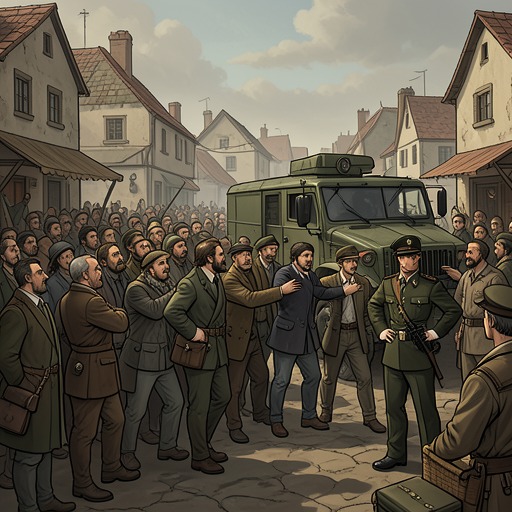
A recollection of village life under occupation turns on suspicion, denunciation, and an irreversible execution. After a rumor that prisoners of war had arrived and might be recognized by local women, some women went to identify men and brought men home. A villager later informed the German commandant that the village had taken in Ukrainians. German soldiers came the next day. Despite the villagers’ pleading, nine men were taken out and shot. The remembered names Vasko and Sashko belong to the account’s emphasis on the victims’ youth and goodness; the scene’s force comes from the ordinary village setting, where an informer’s act made neighborly life inseparable from mortal risk.
A different partisan memory presents a brutal choice made to protect a unit on the move through a swamp. The speaker had heard the story from a neighbor who had been a partisan: her one-month-old baby cried while Germans surrounded the group, and she suffocated the child so that the crying would not reveal their position. The woman recounted the act distantly, as if it had happened to someone else. As a boy, the listener could not reconcile the killing with the apparent purpose of the unit’s escape; the story left him with a lasting moral shock. In this recollection, survival is not a clean triumph. It is bound to an act whose necessity does not make it comprehensible to the child who hears about it.
Other memories register survival through the landscape and the body. One witness remembers nights of gunfire and bombing, a hole dug in the forest, and destruction that reached beyond houses to gardens and cherry trees. Another remembers a winter of hunger during the Siege of Leningrad: residents burned the wooden furniture in their apartment, then books and rags, while people moved so slowly through the streets that some crawled. Those who froze could remain where they fell until the thaw. These details distinguish the remembered wartime threat from the later radiation crisis even as they explain why witnesses reached for war as their measure of extreme danger.
Veterans, Family Legacies, and Sacrifice
The war’s survivors carried its history in both public symbols and private remnants. A former partisan recalls spending a year with the partisans and later reaching the front after the Germans were driven back. He wrote his name on the Reichstag, then returned to the language of a soldier who had given up his overcoat to help build Communism, only to question what had become of that promise. Military victory, political belief, and personal sacrifice coexist in his account without resolving into a single verdict.
A veteran’s recollection of defending Moscow in 1942 is markedly less monumental. Many years later, books and films taught his father that he had participated in a great historical event. His own memory was much smaller: sitting in a trench, firing his rifle, being buried by an explosion, and being dug out half alive. The distance between the later public account and the remembered trench experience shows how an event can become historic in retrospect without becoming grand in the witness’s own recollection.
Military inheritance also shaped the next generation. One speaker remembers a father who wore military clothes despite not serving in the military, and a household in which concern for money was treated as bourgeois while concern for one’s own life could seem unpatriotic. Another father, a career military officer who had fought in the war, was appalled when his son wanted to attend a civilian university; he did not speak to him for months, until the son applied to a military college. The father left little property, but his son kept a field officer’s bag containing his medals and 300 letters from the front, beginning in 1941. In these families, the war did not end with demobilization. It continued as an education in what a person owed to the country and what kinds of life counted as honorable.
The War as a Lens on Chernobyl
The book’s later recollections repeatedly place Chernobyl beside wartime experience, sometimes as a familiar comparison and sometimes as its failure. One witness says that, as a child, the war had seemed the worst thing that could happen; afterward, he believed himself protected. Visiting the Chernobyl Zone overturned that confidence. The old catastrophe no longer supplied answers to the new one, whose danger was not confined to a front line or a visible attack.
The comparison also governs how evacuation is remembered. A witness filming the removal of children from Khoyniki recognizes that the departures resemble scenes from war films: buses carry the children away, and people adopt familiar gestures of farewell. The witness connects this recognition to a childhood shaped by military clothing, patriotic expectations, and the conviction that people had to endure a great catastrophe to become fully formed. In another account, schoolteachers shovel away contaminated soil and find ordinary open shops and purchases strange against the wartime feeling they have acquired; later shortages of bread, salt, and matches make that feeling more familiar. Residents watch soldiers and military vehicles enter villages, and some first blame Russians, then Communists. War supplies a ready-made vocabulary for fear, but the Chernobyl witnesses also recognize that radiation does not behave like gunfire and that a blooming landscape can conceal danger.
An elderly evacuee’s refusal to leave her house makes that mismatch explicit. Her two sons had been killed in the war and lay in a small grave in the village. Now officials ordered her away beneath a bright sky, with apple trees in bloom and no shooting. She could not understand how this could be called a war; those directing the evacuation could not answer her. The scene brings wartime bereavement into the present without making the two events identical. The old woman’s sons are buried in a place she is being made to abandon, while the new threat has neither an assailant to confront nor the visible signs by which she had learned to recognize war.
Across these accounts, World War II is both a lived disaster and an inherited framework for interpreting later ones. Some witnesses use it to explain readiness for danger, obedience, and sacrifice; others recall its most intimate injuries, or expose how a familiar image of war can fail to make an invisible catastrophe intelligible. The memories themselves also remain uneven: one speaker reflects that his father learned the historical importance of his wartime service from books and films long afterward, while the father remembered only the trench and the explosion. The book preserves that gap between public history and the fragments a person carries, allowing the war to remain present as memory rather than reducing it to a finished lesson.