
The Walden Experiment
WaldenThis flow traces Thoreau’s move from dissatisfaction with ordinary life to a deliberate experiment in independence and his eventual return to society.
increasing Bearing strength in each event
 decreasing
Bearing strength in each eventdecreasingA Life Under Burdens
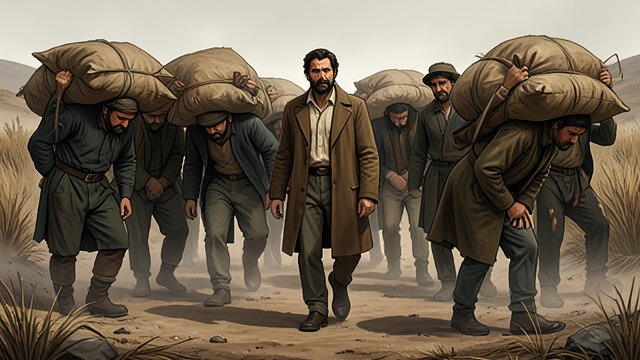
The Inherited Burden
The Problem
Henry David Thoreau begins by describing neighbors bent beneath farms, debt, work, and possessions. He treats these burdens as choices disguised as necessities.
Their labor consumes time that might have gone to reflection and self-direction. The opening establishes the practical question behind his experiment: how much life does conventional living demand?
Significance
The critique is not simply of poverty or labor, but of accepting inherited arrangements without testing them. It prepares the reader for a life organized around deliberate choice.
A Cabin Takes Shape

Building a Small Shelter
Construction
Henry David Thoreau borrows an axe, cuts young pines, buys boards from James Collins’s shanty, and frames a modest house near Walden Pond. He performs most of the work himself.
The construction turns a philosophical proposal into a practical test. Materials, labor, shelter, and cost become things he can examine directly rather than accept on trust.
Significance
The cabin’s small scale challenges the assumption that security requires decades of payment. Its making also gives Thoreau firsthand knowledge of the labor behind an ordinary home.
A Deliberate Household
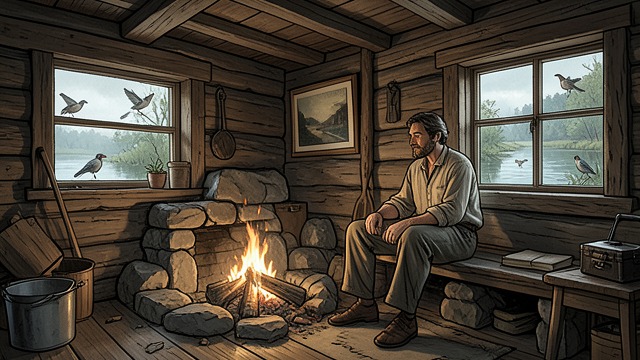
Choosing the Woods
A New Arrangement
On Independence Day, Henry David Thoreau begins living at his unfinished cabin. Its open, rough interior keeps him close to weather, birds, and the pond rather than separating him from them.
He grows beans, works when necessary, and reserves time for observation and thought. Living at Walden becomes an experiment in measuring needs against the life they require.
Significance
The move is not presented as an escape from all society. Thoreau retains visits to the village while testing whether a person can live with fewer dependencies.
Two Years at Walden
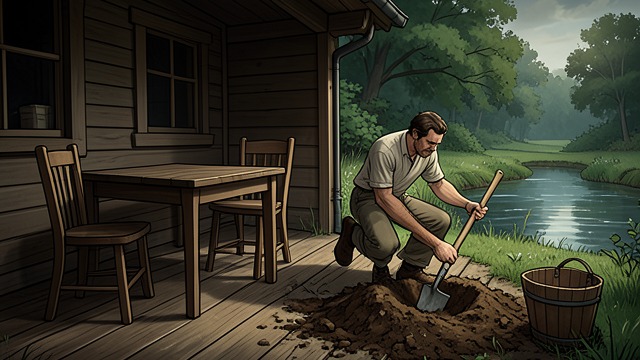
Testing Daily Life
Work and Attention
The cabin’s life follows seasonal tasks: hoeing beans, collecting wood, cooking, reading, and watching Walden Pond. Thoreau records expenses to show how little money his chosen arrangement requires.
The accounting matters because the experiment is both inward and material. Reduced expenditure buys him time, but the central result is a changed attention to nature and daily experience.
Significance
The narrative presents independence as a practice rather than a slogan. Each ordinary task becomes evidence about which needs are genuine and which are socially acquired.
Leaving the Cabin
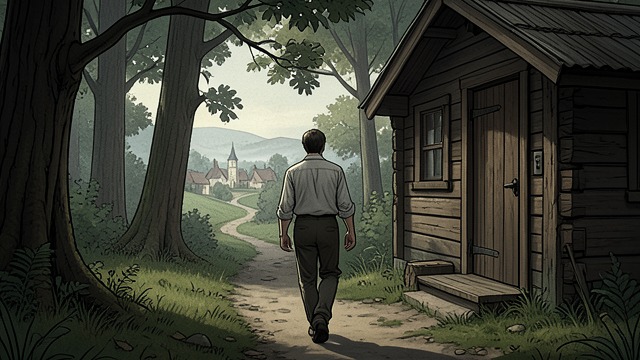
The Experiment Ends
Departure
Henry David Thoreau leaves Walden after two years of living there. He says he departed for reasons as good as those that brought him, because other lives and experiments remained possible.
The ending refuses to make the cabin a permanent ideal. The value lies in what he learned through residence, not in turning a temporary arrangement into a rule for everyone.
Significance
His return to society completes rather than cancels the experiment. The closing argument asks readers to find their own course instead of copying his.
At the opening of “Economy”
Spring 1845, before Independence Day
July 4, 1845, as he begins living at the cabin
From July 1845 through the seasons of 1846
September 6, 1847
