
The Ice Harvest and the Commercial Pond
WaldenThis flow follows the industrial harvest of Walden’s ice and Thoreau’s mixed response to its spectacle, exploitation, and eventual return to water.
increasing Bearing strength in each event
 decreasing
Bearing strength in each eventdecreasingMen on the Frozen Pond
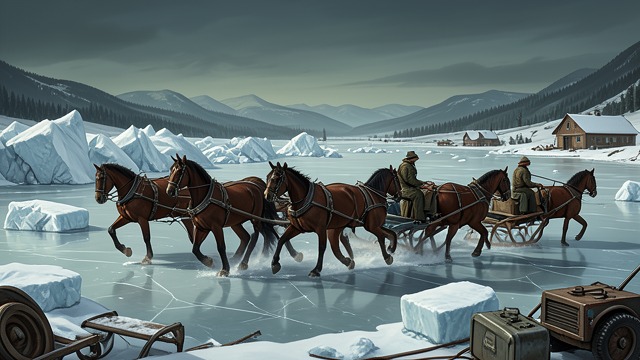
A Worksite on Ice
The Harvest Arrives
During the winter of 1846–1847, a large crew comes to Walden Pond to cut and haul ice. Their tools, sleds, horses, and orderly work transform the frozen surface into an industrial workplace.
Thoreau first watches with wonder, comparing the workers’ activity to farming. He understands that the ice is destined for distant consumers and commercial profit.
Significance
A natural surface becomes a commodity through coordinated labor. The harvest reveals how even an apparently remote pond is connected to a wider market.
The Pond’s Skin Removed
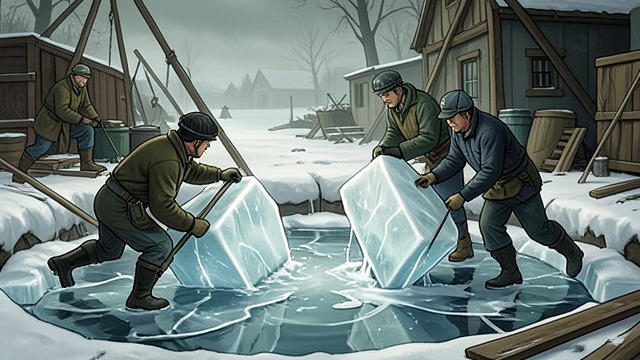
A Surface Taken Away
Cutting the Ice
Workers cut cakes from the pond and raise them into a high stack, removing a great quantity of its winter covering. Thoreau imagines the operation as stripping the pond’s coat and exposing its inner life.
The labor is efficient and impressive, but its scale makes the pond appear vulnerable. The ice is detached from the place that formed it and prepared for distant use.
Significance
The harvest makes the conflict between commercial use and natural integrity visible. Thoreau’s imagery turns a practical trade into a question about the limits of extraction.
An Azure Storehouse
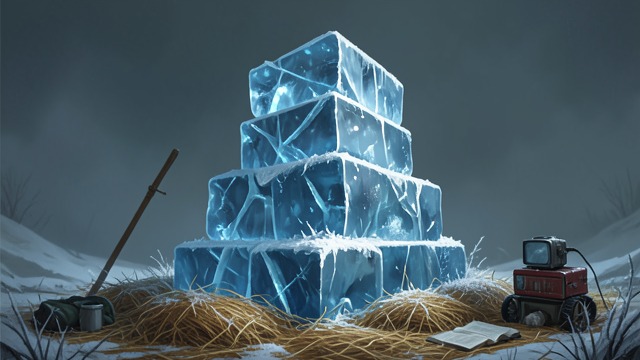
Winter Architecture
A Temporary Monument
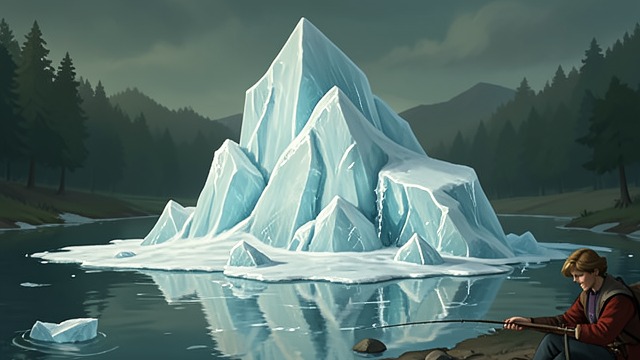
The stacked ice resembles a blue fort or ruined palace, changing as hay and frost gather around it. Thoreau’s description makes the commercial pile seem both magnificent and strange.
The structure’s scale recalls the labor required to store and transport a natural resource. Yet much of the ice is expected to melt or fail to reach its intended destination.
Significance
The beautiful spectacle carries an implicit critique of waste. The market’s effort to preserve ice produces a temporary monument that cannot fully control its material.
Ice on the Road
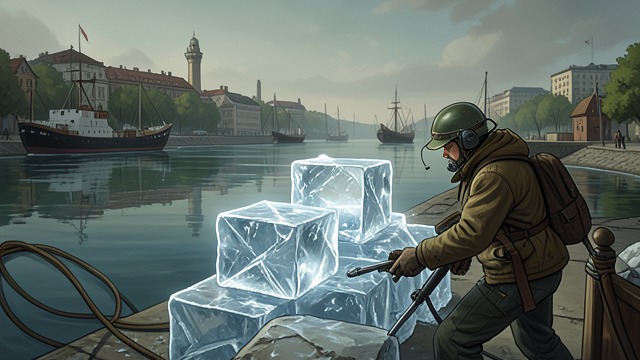
The Pond Goes Elsewhere
Distant Consumers
Thoreau imagines the harvested ice traveling to hot cities and faraway ports. Walden’s water is thus connected to people who will drink from it without seeing the pond.
The journey turns a local resource into a global one, while the pond’s cold purity becomes part of commercial circulation. Nature’s apparent distance from urban life proves misleading.
Significance
The episode expands the scale of Walden’s story. A quiet pond supports far-off consumption and reveals how trade binds distant lives together.
The Ice Returns
Recovery Through Melting
An Unplanned Outcome
A large stack of ice remains beside the pond through summer and another winter, only fully melting by September 1848. Much of the harvest returns to the water rather than reaching the market as planned.
Thoreau sees this as the pond recovering a substantial portion of what was taken. The commercial project’s failure becomes an image of nature exceeding human calculation.
Significance
The episode does not undo the labor or the altered shore, but it complicates the idea of complete control. Walden’s natural processes outlast the market’s timetable.
Winter of 1846–1847
During the middle of the 1846–1847 harvest
While the harvested ice is stacked beside the pond
After the harvested cakes leave Walden
By September 1848
