
The Ant Battle as Human Tragedy
WaldenThis flow traces Thoreau’s observation of two ant armies from a curious encounter into an unsettling meditation on warfare and human conflict.
increasing Bearing strength in each event
 decreasing
Bearing strength in each eventdecreasingCombat on the Woodpile
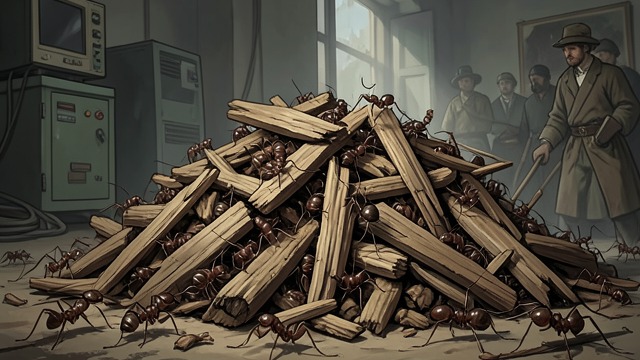
A Fight in the Chips
First Encounter
Thoreau notices a red ant and a larger black ant locked in combat on a piece of wood. Looking farther, he finds the chips crowded with fighting ants and realizes that a larger battle is underway.
The scene begins as a small natural curiosity. Its scale expands as he recognizes opposing groups, casualties, and repeated engagements across the wood yard.
Significance
A familiar worksite becomes an unexpected battlefield. The change in scale prepares Thoreau to interpret insect conflict through human history.
Two Armies Meet
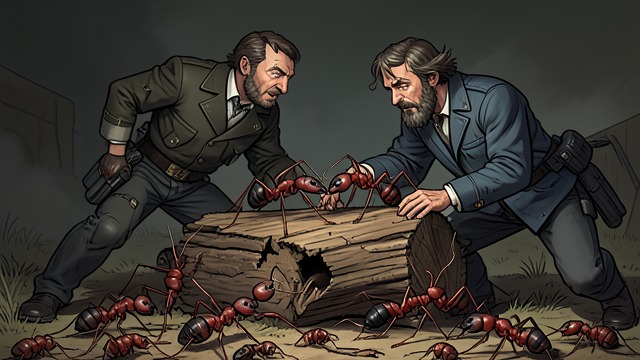
Red Against Black
A War Takes Shape
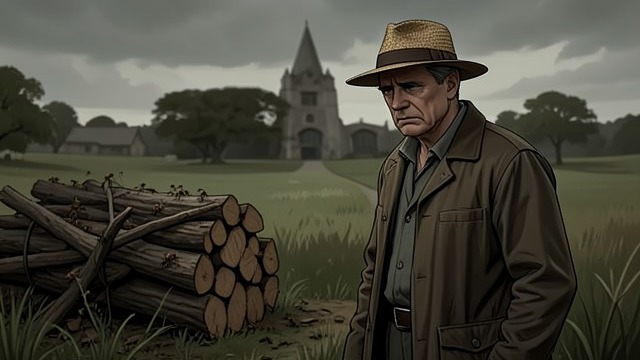
Red and black ants struggle across the woodpile, with the smaller red ants often outnumbered and the black ants much larger. Thoreau imagines the groups as opposing political forces.
The ants show no evident retreat. Dead and wounded bodies remain among the fighting, making the contest seem less like a symbolic game than a destructive battle.
Significance
Thoreau’s human language emphasizes how readily observers recognize conflict across species. The apparent difference in scale does not make the violence seem trivial.
A Champion Joins
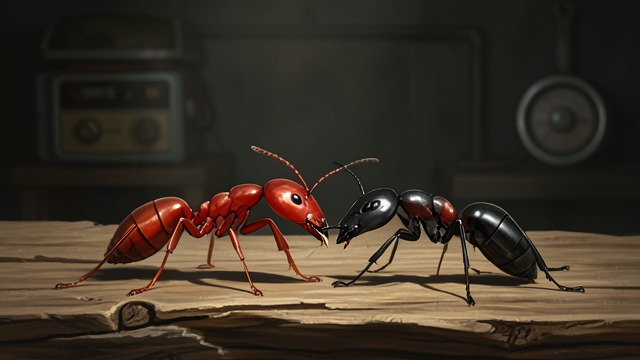
The Third Ant
Intervention
A lone red ant approaches a struggle between a red and a black opponent. Thoreau imagines him as a heroic rescuer or avenger as he joins the combat.
The new arrival makes the fight more dramatic but does not alter its brutality. Three ants become locked together, each continuing the struggle at close quarters.
Significance
The scene resembles epic heroism while also exposing its cost. Thoreau’s literary imagination enlarges the ants’ action without disguising the damage they inflict.
The Battle Under Glass
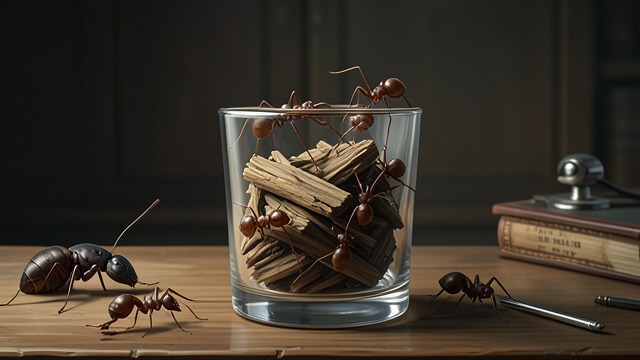
Watching the Outcome
Conflict Contained
Thoreau carries the chip indoors and places it under a tumbler to watch the struggle more closely. Under magnification, he sees the combatants’ bodies torn and their movements increasingly weakened.
The glass confines the battle for observation but does not stop it. The black ant eventually separates itself from the severed heads of its enemies and escapes in a crippled state.
Significance
Thoreau’s curiosity makes him a witness and an intervener, since he relocates and encloses the fighters. The scene raises an uncomfortable question about observing suffering as spectacle.
A Human Measure of War
The Aftermath in Memory
History Reconsidered
Thoreau compares the ants’ battle with human conflicts and considers its casualties and apparent determination. He later dates it against the political events of his own era.
The ant war leaves him emotionally unsettled for the rest of the day. Its scale is tiny, but its ferocity invites comparison with battles people memorialize as great.
Significance
The episode resists the comfort of treating human warfare as unique or noble. It makes the observer reconsider what patriotism and violence look like from another scale.
One day beside Thoreau’s woodpile
As Thoreau watches the combatants spread across the chips
During the central fight among the wood chips
After Thoreau carries the ants indoors
After the ants’ combat ends
