
Industry Against Attention
WaldenThis flow traces Thoreau’s conflict with modern systems that promise speed and convenience while consuming attention, labor, and life.
increasing Bearing strength in each event
 decreasing
Bearing strength in each eventdecreasingThe Promise of Improvement

Progress Put on Trial
Tools and Ends
Thoreau questions whether modern inventions necessarily improve human life. A device can make an old task faster while leaving its purpose unchanged or even distracting people from better aims.
The telegraph and railroad represent speed without guaranteed understanding. Communication and transport may expand while the quality of what people communicate or pursue remains uncertain.
Significance
The conflict concerns the ends served by technology, not invention alone. Thoreau asks whether people have improved their lives or merely their means of continuing familiar habits.
The Railroad Runs on Lives
Human Sleepers
Labor Beneath Progress
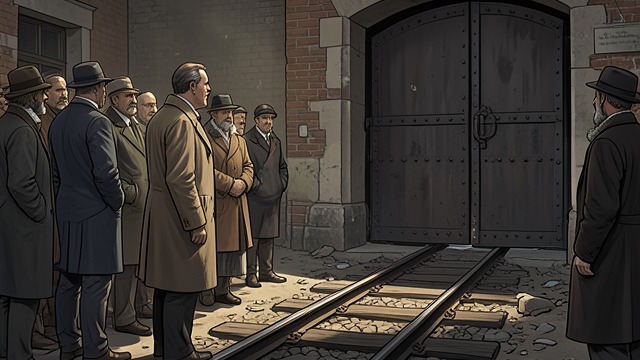
Thoreau describes railroad sleepers as people whose bodies support the track and the passage of others. Workers are buried beneath the system’s smooth motion, then replaced when they are worn down.
The image makes infrastructure’s labor visible in a way that its passengers may ignore. The train’s speed is connected to lives spent building and maintaining its route.
Significance
The metaphor sharpens the conflict between public convenience and human cost. Progress that rides on workers cannot be judged from the passenger’s seat alone.
A Day Divided into Details

Too Many Affairs
The Pressure of Complexity
Thoreau argues that people burden themselves with excessive possessions, schedules, meals, and obligations. Their lives become difficult to navigate because they mistake accumulation for security.
He calls for simplicity, not as a decorative preference but as a means of recovering attention. Fewer demands make room for a more deliberate life.
Significance
The conflict turns inward as well as social. People participate in the machinery of hurry when they accept every new demand as necessary.
The Village Under the Schedule
A Town Timed by Trains
Regularity and Dependence
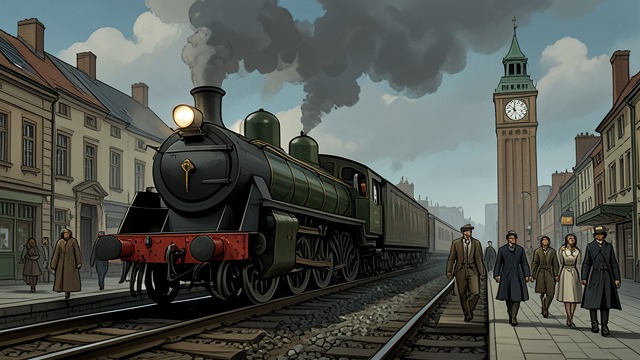
The railroad’s punctual arrivals make villagers set their clocks and shape daily movement around its schedule. Thoreau sees real order in this system, but also a new dependence on mechanical time.
The train warns people to clear its track without pausing to persuade them. Its force resembles fate: a human construction that appears inevitable once built.
Significance
The conflict deepens because efficiency brings both benefit and submission. Regularity can organize life while narrowing the space for independent choice.
Choosing Another Pace
A Different Course
Refusing Automatic Speed
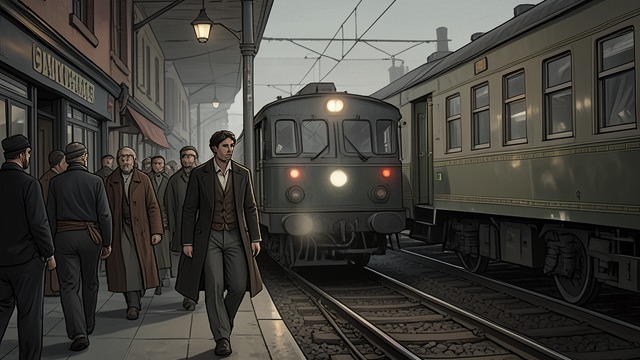
Thoreau recommends that individuals keep to their own track rather than adopt the pace of the crowd. He does not insist that everyone reject the railroad, but asks each person to judge its value independently.
The person who moves slowly or chooses a different goal may not be behind. A life should be measured against its own purpose, not the schedule of companions.
Significance
The conflict resolves as a defense of individual timing. Thoreau’s alternative to industrial haste is attention to the life each person actually wants.
During the discussion of modern inventions
In “Where I Lived, and What I Lived For”
During Thoreau’s call to simplify life
During the account of railroad punctuality
Near the close of “Where I Lived, and What I Lived For”
