
Solitude, Not Loneliness
WaldenThis flow traces how Thoreau’s solitary life changes from a brief test of isolation into an affirmative relationship with nature and thought.
increasing Bearing strength in each event
 decreasing
Bearing strength in each eventdecreasingThe Fear of Being Alone

An Early Doubt
Human Company Questioned
A few weeks into his stay, Thoreau briefly wonders whether human proximity is necessary for a healthy and serene life. For an hour, being alone seems unpleasant.
The doubt arrives during gentle rain, when the sounds around his house suddenly feel welcoming. Each pine needle seems to share in a friendliness that makes human neighborhood less essential.
Significance
Solitude becomes meaningful because it is tested rather than assumed. The episode shows that loneliness can change when a person’s capacity for attention changes.
A Natural Welcome

Society in the Rain
A Wider Companionship
Thoreau finds comfort in raindrops, sounds, and sights around his house. The natural world gives him a sense of kinship even in scenes commonly called wild or dreary.
He realizes that the nearest human presence is not necessarily the most intimate one. This experience makes the woods feel familiar rather than strange.
Significance
Nature becomes an active relationship, not a backdrop. Thoreau’s solitude gains emotional depth through a reciprocal awareness of the world around him.
Distance and the Mind

Solitude Beyond Miles
Inner Separation
Thoreau argues that physical closeness does not bring two minds much nearer. A person can remain solitary in a crowd or find company in a quiet room.
He contrasts social proximity with the deeper source from which life and thought arise. The distance that matters cannot be measured simply by roads or houses.
Significance
The essay moves solitude from geography to consciousness. A person’s inward relation to experience can matter more than the number of people nearby.
The Double Self

Witnessing the Self
Observer and Participant
Thoreau describes a doubleness in which one part of him experiences events while another observes and judges them. This inward spectator can stand at a distance from his own feelings.
The distance provides perspective, but it can also make him a poor neighbor or friend. Reflection does not automatically create intimacy with others.
Significance
Solitude includes the difficult work of meeting the self as both subject and witness. The idea complicates any simple claim that being alone guarantees wisdom.
Solitude as Companion
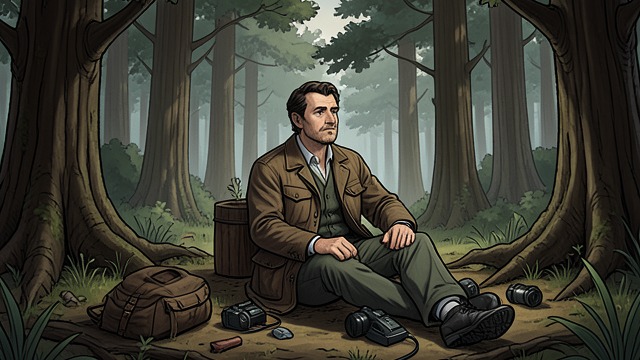
A Chosen Quiet
Life Without Emptiness
Thoreau says he has never found a companion as companionable as solitude. He feels surrounded by natural life and can spend much of his time alone without being lonely.
His claim is compatible with the visitors and friendships he welcomes. Solitude is valuable because it preserves space for thought and makes selected companionship more substantial.
Significance
The thread resolves in a positive account of being alone. Solitude becomes a form of relation—to nature, to thought, and to the world beyond immediate company.
A few weeks after Thoreau arrives at Walden
During the rain that follows his doubt
In the reflection on space between people
During Thoreau’s account of reflective thought
Near the end of “Solitude”
