
The Pond as a Measure of Character
WaldenThis flow traces Thoreau’s use of Walden’s depth, shores, and changing waters to develop an analogy between landscape and human character.
increasing Bearing strength in each event
 decreasing
Bearing strength in each eventdecreasingA Pond with Depth

Depth Made Measurable
Surveying the Bottom
Thoreau sounds Walden Pond and finds a maximum depth of 102 feet, correcting local beliefs that it is bottomless. Its depth is striking for its relatively small area.
The measurement makes the pond more rather than less meaningful. A real, bounded depth offers a stronger image than an untested claim of infinity.
Significance
Thoreau turns observation into the foundation of metaphor. The pond can suggest inward depth because it has first been approached as a physical place.
Shorelines and Lives

Reading the Contours
Circumstance and Character
Thoreau compares a person’s life to the outlines of a pond. The shape of the shore and the surrounding landscape can suggest the depth hidden beneath the surface.
Mountainous circumstances may correspond, in his analogy, to a deeper character, while smooth and low shores suggest shallowness. The comparison is explicitly interpretive, not a scientific measurement of people.
Significance
Character is presented as something shaped by both inward tendencies and surrounding conditions. Thoreau uses landscape to make the unseen dimensions of a life imaginable.
A Line Across the Center

The Rule of Two Diameters
Lines of Convergence
Thoreau notices that the pond’s greatest length and breadth intersect at the point of its greatest depth. He wonders whether a similar principle might reveal the hidden center of a person’s character.
The observation becomes a proposed law of average: a life’s depth may emerge where its major dimensions meet. Thoreau connects daily behavior, circumstance, and inclination in the analogy.
Significance
A geometric observation becomes a tool for thinking about moral character. The metaphor suggests that depth is discovered through the whole shape of a life, not one isolated act.
Inclinations Become Lakes

A Thought Cut Off
Inner Waters
Thoreau compares persistent inclinations to coves that may eventually become separate lakes. A thought can develop its own conditions and become isolated from the larger current of a person’s life.
The image emphasizes how repeated habits shape inward character. A small tendency can become a self-contained world if it is allowed to rise and close itself off.
Significance
The pond’s hydrology becomes a model for moral formation. Character changes through processes that may be slow, local, and difficult to notice until they have become established.
The Depth Within
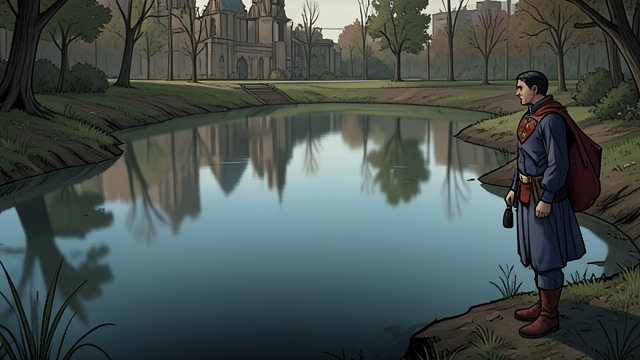
What the Surface Reveals
An Inward Measure
Thoreau’s comparison invites the reader to infer inner depth from the shape and conditions of a life. The pond does not disclose everything at once, but its contours provide clues to what lies below.
The image leaves room for uncertainty: human beings, like landscapes, cannot be fully grasped from a single viewpoint. Judgment must account for the whole pattern rather than a convenient surface impression.
Significance
Walden becomes an enduring figure for self-examination. Its depth reminds readers that character is both shaped by circumstance and concealed beneath appearances.
After Thoreau measures Walden in winter 1846
During the moral interpretation of the pond survey
As Thoreau studies the pond’s measured dimensions
During the extended ethical analogy
Near the close of the pond’s ethical analogy
