
The Story of Walden’s Waters
WaldenThis flow follows Thoreau’s account of Walden’s purity, level changes, neighboring ponds, and uncertain connections to the wider watershed.
increasing Bearing strength in each event
 decreasing
Bearing strength in each eventdecreasingA Spring Without an Outlet
A Self-Contained Lake
Water and Hills
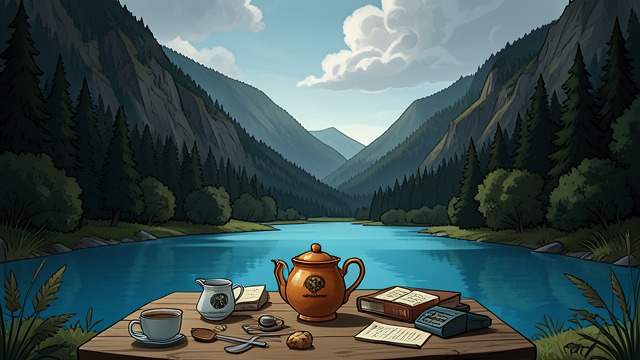
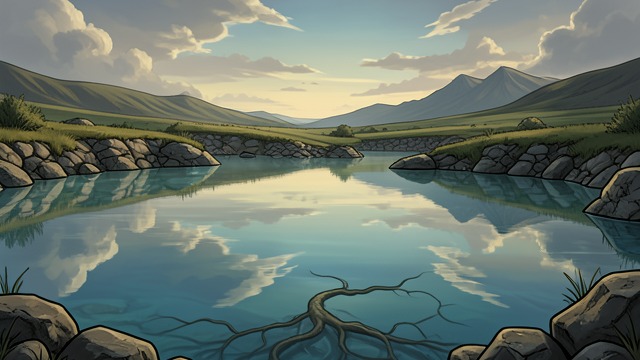
Thoreau describes Walden Pond as a clear, deep lake surrounded by wooded hills, with no visible inlet or outlet except rain, clouds, and evaporation. Its apparent isolation gives it a distinctive character.
The surrounding slopes rise sharply and frame the water. The pond appears both local and strangely complete, a body of water held apart from obvious streams.
Significance
Its visible boundaries invite questions about hidden connections and natural processes. Thoreau’s description begins with observation while leaving room for uncertainty.
Levels Rise and Fall
A Changing Shoreline
Long Fluctuations
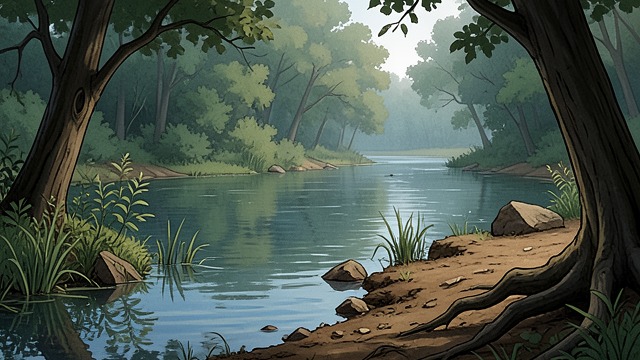
Thoreau remembers Walden at substantially lower and higher levels across different years. The pond’s rise and fall appear to unfold over long intervals and do not correspond simply to local rainfall.
At higher water, trees and shrubs along the edge are killed; as the water recedes, the shore opens again. The fluctuation changes the boundary between land and water.
Significance
The pond is not a fixed object but a changing system. Its slow variations challenge people who assume they can understand nature from a brief observation.
Neighboring Ponds Respond
Waters in Relation
Shared Changes
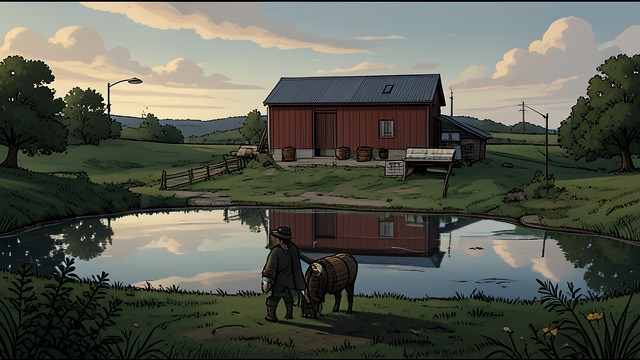
Thoreau observes that Flint’s Pond and other nearby ponds rise and fall in sympathy with Walden. The pattern suggests a connection through deeper water, although the visible routes do not explain it fully.
His observations extend beyond one shoreline. Several bodies of water appear to share a hidden relation that emerges only over time.
Significance
The pond’s apparent solitude may conceal a wider hydrological system. Thoreau uses careful comparison to distinguish what he has observed from what remains conjecture.
A Possible River Route
Hidden Connections
Toward the River
Thoreau considers whether Walden may be indirectly related to the Concord River through chains of ponds and old geological routes. He notes that digging could perhaps create a direct connection, but says that such a project should not be undertaken.
The suggestion remains speculative, shaped by the landscape and the differences in elevation. Walden’s lack of a visible outlet does not prove that it has no deeper relation to other waters.
Significance
The account respects the limits of what can be known from the surface. Hidden connection remains a possibility rather than a fact established by Thoreau’s survey.
A Kinship with White Pond
Similar Waters
Resemblance and Doubt
Thoreau describes White Pond as resembling Walden in its stony shore, clear water, and changing color. Their similarities lead him to wonder whether they may be connected underground.
He offers the possibility cautiously rather than claiming proof. Repeated visits make each pond familiar, but their shared features still leave unanswered questions about their relationship.
Significance
The comparison shows how observation can generate hypotheses without settling them. Walden belongs to a network of places whose affinities may exceed what the eye can verify.
During the first description of Walden Pond
During Thoreau’s observations from the 1820s to the 1850s
During the account of synchronized pond levels
During Thoreau’s discussion of possible outlets
During the comparison with White Pond
