
The Pond’s Changing Face
WaldenThis flow follows Walden Pond from a nearby body of water into a lasting emblem of clarity, depth, and renewal.
increasing Bearing strength in each event
 decreasing
Bearing strength in each eventdecreasingFirst Impressions
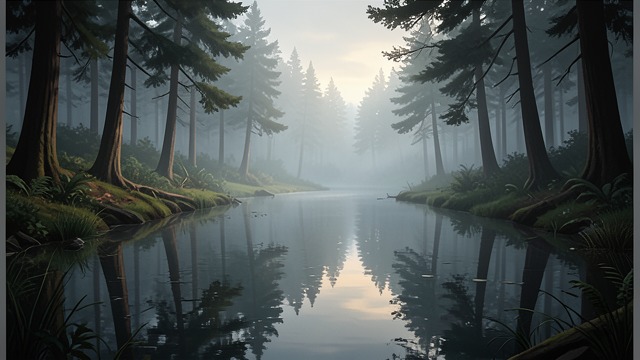
The Pond Appears
A New Horizon
From his cabin, Henry David Thoreau first sees Walden Pond as a secluded mountain tarn. Morning mist withdraws from its surface, making an ordinary local landscape seem remote and newly discovered.
The small scale of the pond does not limit its imaginative reach. Its changing reflections open a sense of distance that the surrounding woods cannot provide.
Significance
The pond becomes a companion to observation rather than a mere resource. Thoreau’s first impressions establish the place as both physical setting and imaginative world.
A Measured Depth
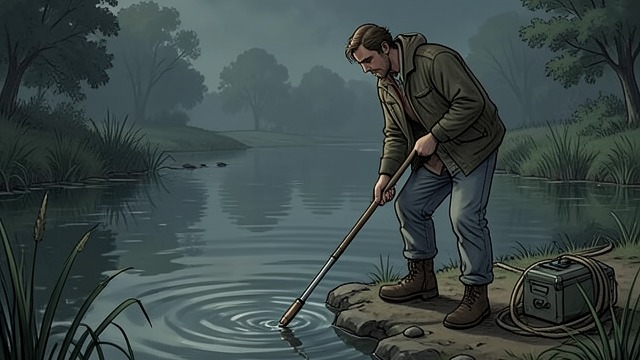
Sounding the Bottom
Measurement
Thoreau surveys Walden Pond with a compass, chain, and sounding line after hearing claims that it has no bottom. He finds a maximum depth of 102 feet, later accounting for a rise in its level.
The survey replaces local marvel with careful observation without destroying the pond’s wonder. Its real dimensions prove remarkable enough to reward precise study.
Significance
Measurement becomes a way to approach mystery, not abolish it. The pond’s depth then supports Thoreau’s comparison between landscape and human character.
Water and Reflection
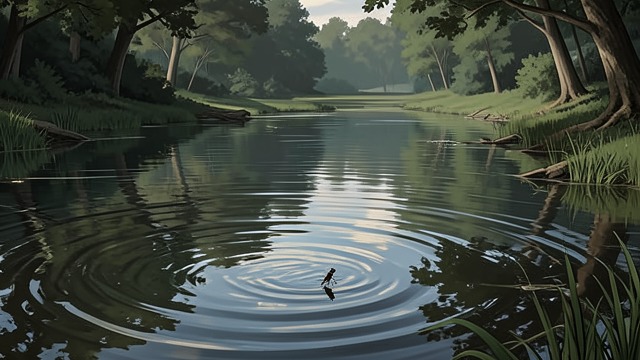
The Forest Mirror
A Changing Surface
In calm autumn weather, Walden Pond reflects sky, trees, insects, fish, and the smallest disturbances. Thoreau watches dimples spread across the water and vanish into smoothness.
The pond appears at once receptive and self-renewing. Each ripple records an event, but the surface soon gathers itself again without keeping a lasting wound.
Significance
Thoreau turns the lake into an image of perception and inner life. Looking at it becomes a way to measure the observer’s own attention.
A Lake Under Pressure
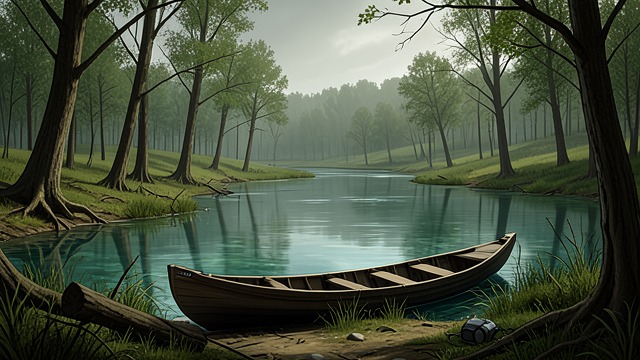
A Place Altered
Human Encroachment
Thoreau recalls that woodcutters, the railroad, and ice harvesters have altered Walden’s shores. He laments the disappearance of the dense woods and the old canoe, while observing that the pond itself remains recognizably clear.
The tension lies between a durable natural place and changing human use. The lake’s apparent resilience does not erase what has been cut away from its edges.
Significance
Walden becomes a measure of loss as well as continuity. Its value cannot be reduced to the commercial water supply or the ice removed from it.
The Pond as Bequest
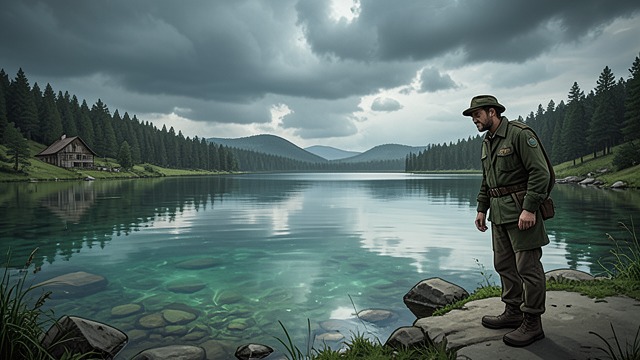
Purity Remembered
A Lasting Presence
After describing environmental change, Thoreau returns to Walden as the same water his younger eyes encountered. He imagines its purity as a gift that can outlast the generations who visit it.
The pond’s continuity is partly physical and partly inward: Thoreau says that the deepest part lies high in thought. Its meaning survives even when the shores change.
Significance
The lake becomes an inheritance that calls for reverence rather than possession. Its enduring image joins personal memory to a broader claim about nature’s value.
During Thoreau’s first week beside the pond
Winter 1846, during the pond survey
In the autumn descriptions of the pond
During the woodcutting and ice trade described after his stay
Near the end of “The Ponds”
