
The Meaning of Work
WaldenThis flow traces Thoreau’s distinction between labor that serves real needs and work that consumes life without producing freedom or purpose.
increasing Bearing strength in each event
 decreasing
Bearing strength in each eventdecreasingA Machine for Living

The Worker’s Condition
Labor and Leisure
Thoreau argues that excessive labor can reduce a person to a machine, leaving little time for integrity, thought, or humane relations. The worker must repeatedly use knowledge simply to keep working.
He questions whether the burdens people accept are truly necessary. A life spent maintaining possessions and obligations may neglect the person those arrangements are meant to serve.
Significance
The value of work depends on what it makes possible in a life. Labor that destroys time and judgment may be economically productive yet humanly impoverishing.
The Student at Work

Learning by Living
Theory and Practice
Thoreau argues that students should not merely study life while the community supports them. They should experience the practical work of living, including how bread is made and how work is earned.
He contrasts a boy who makes a tool from its materials with one who only attends lectures and receives a finished knife. Direct participation gives knowledge a bodily and practical dimension.
Significance
The conflict is between education as formal preparation and learning through active life. Thoreau wants study to deepen experience rather than displace it.
The Day Laborer’s Freedom

Work With an Ending
A Limited Season
Thoreau finds day labor more independent than business because the working day ends at sunset. He believes a small amount of labor can support a modest life and leave time for chosen pursuits.
By contrast, an employer or merchant may remain occupied by speculation throughout the year. More income can bring continuous obligations rather than greater freedom.
Significance
The measure of work is not only earnings but control over time. A person may be better off with less work if it leaves room for a life beyond employment.
The Labor of the Hand
Physical Work and Thought
A Field of Attention
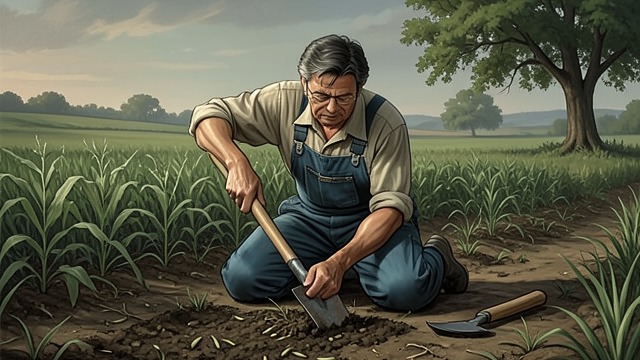
Hoeing beans demands sustained physical effort, but Thoreau finds that even labor close to drudgery can carry a lasting moral meaning. The repeated task brings him into intimate contact with soil and growth.
The work is slow because he uses little mechanical help. Its pace gives him time to notice the field’s creatures, weather, and changing plants.
Significance
Manual work can educate attention when it is not merely a means to accumulation. The bean field demonstrates a form of labor that joins the hand to thought.
Work as a Pastime

Enough to Live
A Changed Relation
Thoreau concludes that maintaining oneself need not be a hardship if life is lived simply and wisely. Work can become a pastime rather than an endless demand for more consumption.
The claim depends on limiting needs and choosing tasks in proportion to them. It is not a promise that all labor is pleasant, but a challenge to make work serve life.
Significance
The thread resolves by reversing the conventional hierarchy: work should sustain a meaningful life, not become its purpose. Freedom begins when labor is measured against genuine need.
Early in “Economy”
During the critique of education at Harvard College
During Thoreau’s account of his own work
During the bean-field season
Near the end of “Economy”
