
The Cabin and Its Making
WaldenThis flow follows Thoreau’s hands-on construction of a home as both a practical achievement and a critique of divided labor.
increasing Bearing strength in each event
 decreasing
Bearing strength in each eventdecreasingBorrowed Tools

Starting with an Axe
First Labor
Henry David Thoreau borrows an axe and begins felling young white pines near Walden Pond. The lender calls it precious, and Thoreau returns it sharpened.
The work starts with borrowed equipment rather than accumulated capital. Cutting and hewing timber brings him into close contact with the material of his future home.
Significance
The beginning establishes self-reliance as practical collaboration, not isolation. A neighbor’s tool enables an experiment that Thoreau then carries forward himself.
The Shanty Bargain
Reusing a House
Salvaged Boards
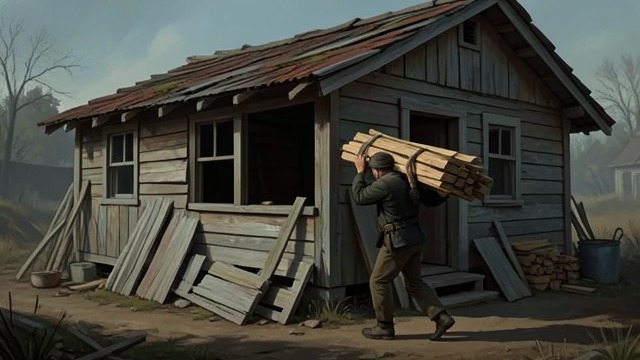
Thoreau buys James Collins’s small railroad-worker shanty for boards and dismantles it the next morning. Its former occupants leave with their few belongings as he carts the lumber toward Walden.
The transaction turns a poor dwelling into material for another shelter. Its narrow cost and plainness sharpen Thoreau’s attention to how little a house must provide.
Significance
Reuse makes the cabin an alternative to expensive construction. The episode also reveals the precarious housing of laborers whose work supports the railroad.
Raising the Frame
Neighbors at Work
A Shared Occasion
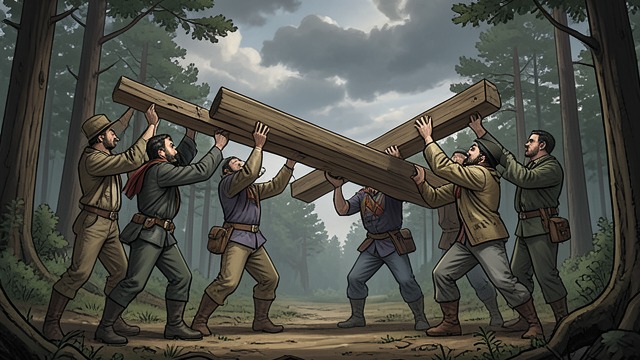
With help from acquaintances, Thoreau raises the frame of his house. He welcomes their assistance less from necessity than from the neighborliness of the occasion.
The house is materially his own, but its construction briefly gathers other people into the project. Independence and community prove compatible when cooperation remains voluntary.
Significance
The raising demonstrates a limited, personal form of mutual aid. It contrasts with the impersonal divisions of labor Thoreau criticizes elsewhere.
Chimney and Shelter
Making the Cabin Livable
Finishing Work
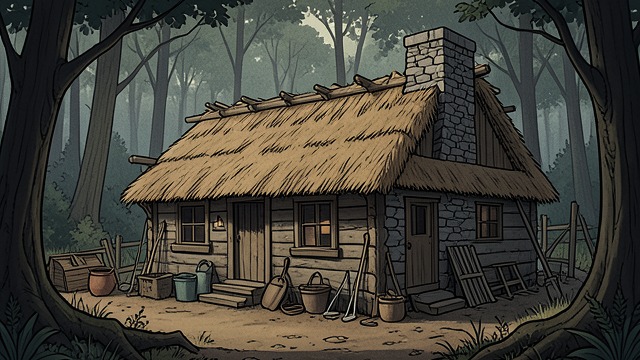
Thoreau boards and roofs the house, then builds a chimney from stones carried up from the pond. Before it is complete, he cooks outside and watches bread bake beneath temporary boards during storms.
The cabin grows from shelter against rain into a place capable of warmth and sustained domestic life. Its unfinished stages keep construction visible as part of living.
Significance
The work gives Thoreau direct knowledge of tools, materials, and necessity. A house gains meaning through its use, not through ornament or cost alone.
A House Made Visible
Building from Within
Form and Character
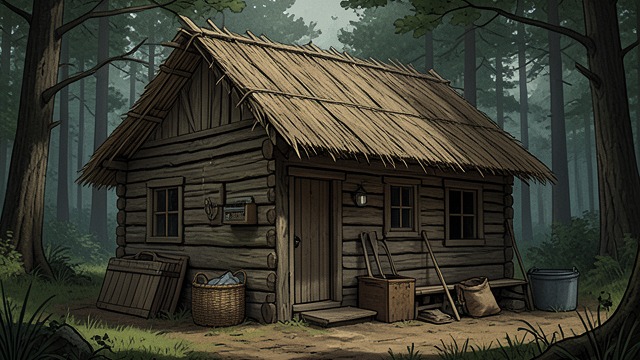
Thoreau argues that a dwelling’s real beauty grows from the character and needs of its inhabitant. Ornament added without truthful living is merely a surface that can be stripped away.
His cabin supplies an example of architecture tied to actual labor and limited needs. Its simplicity does not exclude beauty; it gives beauty a credible foundation.
Significance
The building story becomes a criticism of status architecture and professional dependence. Thoreau asks people to participate in shaping the conditions of their own lives.
Late March 1845
Mid-April 1845
Early May 1845
Before the first winter at Walden
In the architectural reflections after the cabin’s completion
