
The Narrator’s Lasting Search for Belonging
Wann wird es endlich wieder so, wie es nie warThis flow traces Joachim(Jocki)’s movement between family, patients, places, and imagined identities in search of a secure sense of belonging.
increasing Bearing strength in each event
 decreasing
Bearing strength in each eventdecreasingJocki from Hesterberg

Jocki from Hesterberg
A Camp Question
Asked where he lives, Joachim(Jocki) answers “Hesterberg” rather than naming Schleswig. He insists that the place should be called a psychiatric hospital, not an asylum.
Self-Definition
The answer shows how completely the institution belongs to his identity. He is not merely the director’s son; he is a child from that particular world.
Another Self with Ferdinand

Another Self with Ferdinand
Shared Claim
Ferdinand tells Joachim(Jocki) that he is not the person others think he is. The boy answers that he too is another person beneath the identity assigned to him.
A Private Alliance
Their exchange gives the narrator a sense of being understood without explanation. Belonging comes from a shared secret rather than a public category.
A Place in America

A Place in America
A New Household
Joachim(Jocki) lives with a host family in Wyoming and participates in school, sport, and local routines. For a time, he is known simply as a student and guest.
Freedom and Distance
The new setting offers a break from his family’s history, though his brother’s death soon makes distance painful as well as liberating.
The Family After Martin

The Family After Martin
A Changed Household
Joachim(Jocki) returns to live with his grieving parents after his eldest brother has moved away. He is the only child still at home.
Uncertain Place
He is present but emotionally distant, unsure how to share the sorrow that defines the house. His old role as the youngest no longer fits the smaller family.
The Boy in the Old Room
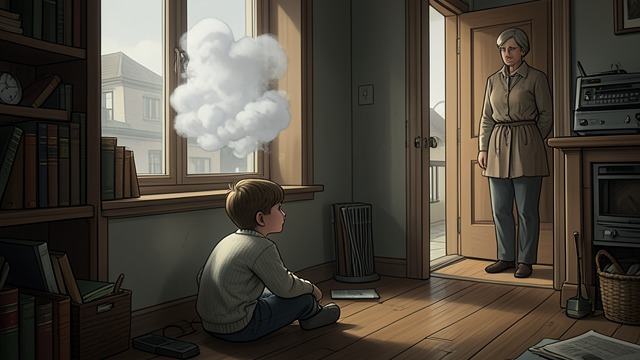
The Boy in the Old Room
A Stranger and a Mirror
Joachim(Jocki) sees a young patient sitting in his former bedroom. The boy’s breath clouds the terrace door, while he looks outward without seeming to see the adult narrator.
Belonging Reimagined
The narrator cannot reclaim the room or the institution. He can only recognize the child’s solitude as something shared across time.
At about age ten
During their basement friendship
During the exchange year
After the narrator returns from the funeral
At the memoir’s ending
