Amsel
Wann wird es endlich wieder so, wie es nie warAmsel is the bird whose fatal collision with the family’s window interrupts the narrator’s father’s birthday breakfast and becomes the occasion for a carefully staged, unruly funeral. First encountered in the bright aftermath of the impact, it is at once a small, apparently ordinary casualty and the focus of the narrator’s intense uncertainty about death, mourning, and what the living owe the dead.
The collision
A bird had struck the living-room windows before, but never during breakfast and never with such a startling crash. In the instant after the noise, the family reacts around the table: the narrator’s father spits out his cigarette, the dog leaps up, and the narrator’s mother and brothers hurry toward the window. The accident breaks into a morning already charged with birthday expectations and the father’s announced intention to change his life.
The second-oldest brother identifies the fallen bird as an Amsel. Outside, the family finds it in the morning sun beside the sliding glass door, its eyes closed and one wing stretched flat. Its black feathers shimmer, while its beak shines yellow-orange. That color has an immediate, uncanny echo inside: the father has just caught the glowing cigarette ash on a damp fingertip and made the ember disappear into his mouth. The narrator notices the exact match between the ember and the bird’s beak, linking the household’s comic shock to the sight of the motionless animal.
The second-oldest brother, who hopes to become a doctor like the father, speculates about a broken neck or spinal shock. The father asks that the bird not be touched and suggests that it has probably broken its neck. The narrator’s mother fetches a shoebox lined with a kitchen towel, and the bird is lifted into it. The narrator already feels that its stillness is final, even as the family’s medical language and the bird’s closed eyes leave room for a child’s hope that it might only be unconscious.
Waiting and the family’s animal dead
By midday, the shoebox stands in the cool entrance hall. Nothing about the bird has changed. Yellow-orange rings mark the area around its eyes, while its feet have stiffened and its body falls silently onto its back when the second-oldest brother turns it with a colored pencil. He tests for a pulse and declares that there is none. The narrator nevertheless asks to wait longer, remembering that birds can look dead without being so. The brother insists that the Amsel must be buried before it begins to smell.
This is not the family’s first animal funeral. Their pet cemetery already holds finches and ornamental fish, a gecko that escaped and was discovered behind a cupboard weeks later, and several birds that had met the same fate against the window. These earlier burials make the Amsel’s death part of a recurring household ritual, but they do not make it impersonal. The narrator still experiences each small body as difficult to surrender: the bird’s apparent weightlessness will later make its absence in his hands feel almost like emptiness.
A funeral, then a burial
The family has settled into distinct roles at animal funerals. The second-oldest brother gives the eulogies; the narrator carries the dead animal on a handkerchief; and the narrator’s eldest brother makes the small wooden crosses. For the Amsel’s service, the second-oldest brother wears a black turtleneck despite the unusual heat. He imagines the bird remaining above ground, free from a cold, damp grave and from being eaten by worms, and proposes burning it so that its light ashes can be scattered on the wind. The plan gives the bird a fittingly airborne farewell, though the family ultimately does not carry it out.
Instead, the brothers gather branches and twigs, and the narrator pulls dry grass from between the terrace stones. Within ten minutes they have built a neat pyre with a hollow in its center. To the narrator, however, the pile resembles a comfortable nest. When the Amsel is placed inside, the second-oldest brother’s eulogy describes the bird’s life in affectionate, idealized terms: its skill at picking worms from the lawn, its songs, and its supposed mischief. The ceremony turns the collision into a story of companionship, even though the narrator wonders whether the brother could truly have known this particular bird.
The cremation gives way to burial in a small grave. The eulogy acknowledges the wish to release the ashes to the air but presents that wish as frustrated; the narrator’s mother answers with a mock blessing for recovery and eternal life in the wet hole. The family’s solemn language and irreverent interruption sit side by side. The narrator’s eldest brother hurries the speech along, while the second-oldest brother makes the funeral itself into a performance—tender, theatrical, and comic without being free of feeling.
Grief and narrative significance
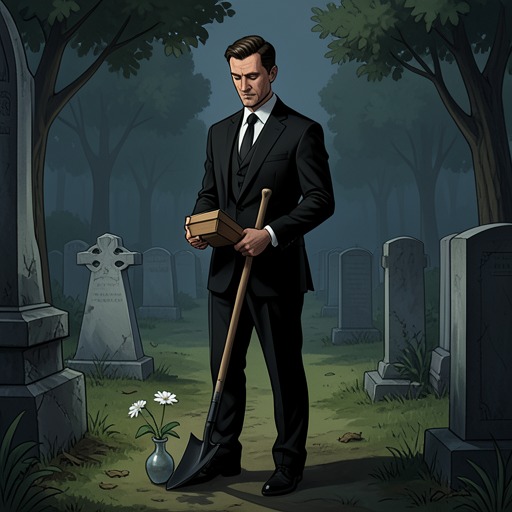
The second-oldest brother’s applause ends the speech. The narrator kneels and lets the Amsel slide from the handkerchief into the grave, then carefully presses the earth down with his hands. He begins to cry despite trying to hold back his tears. To buy time, he keeps patting the mound; the eldest brother mistakes the motion for an offense against the dead and tells him to stop. The narrator discreetly wipes his eyes on his shoulders, and the eldest brother places the wooden cross in the soil. They sing Alle Vögel sind schon da until they can no longer remember how to continue, then return to the house in a mood compared to the uplift after church.
The funeral makes the narrator’s response more than a passing reaction to an injured animal. He has resisted the certainty of death, carried the nearly weightless body, and finally wept as he covered it. Around him, the family converts loss into medical diagnosis, ritual, invention, jokes, and song; none of those responses quite contains his grief. The Amsel’s story therefore holds together the book’s child’s-eye attention to death and its ceremonies: the bird is a real, particular body in the grass, while the family’s attempts to explain and honor its ending expose how much remains beyond explanation.