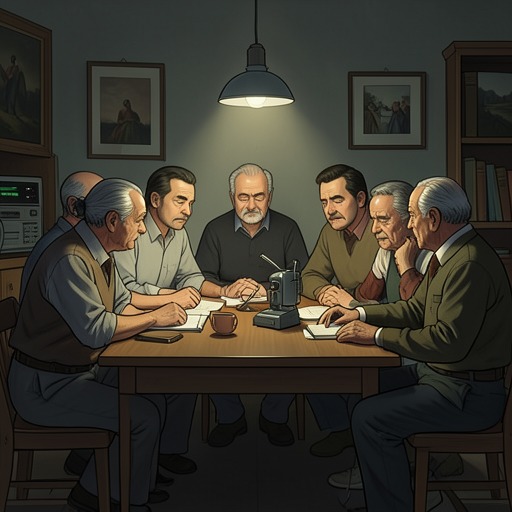
Dietmar
Wann wird es endlich wieder so, wie es nie warDietmar is a psychiatric patient and one of Hermann’s favorite people to treat, remembered as a restless questioner whose curiosity moves faster than conversation can contain. At the family’s birthday gatherings, he appears not as a distant patient but as a familiar guest: he asks, embraces, plays, and draws Hermann and the narrator into his vivid chain of thought.
Identity and Place in the Family Gatherings
For Hermann’s birthday coffee and cake, four psychiatric patients—Margret, Ludwig, Dietmar, and Kimberly—were invited at three o’clock. The group was a longstanding fixture: the same four were the only guests Hermann permitted at these celebrations, despite his wife’s attempts to persuade him to invite other people as well. Dietmar therefore occupies an unusual position in the household’s social world, both a patient of Hermann’s and a regular participant in a family ritual.
Dietmar was about the age of the narrator’s middle brother. Like him, he was driven by an unquenchable thirst for knowledge, though the account emphasizes not orderly study but a mind that leapt from subject to subject. He repeatedly asked who had invented things and pursued each answer into another question, giving his curiosity a quick, associative rhythm.
Questions and Restless Curiosity
At the birthday table, Hermann offered Dietmar a piece of bee-sting cake. Dietmar’s attention moved from the cake’s name to its origin, then to who had invented it; when Hermann said his wife had baked it and that he had paid her nothing, Dietmar immediately asked whether bees ate honey, whether bees stung cake, and whether they stung women. Hermann’s willingness to follow the chain delighted him. The exchange shows Dietmar turning an ordinary piece of cake into a set of connected puzzles, without treating the apparent oddness of the questions as a reason to stop asking.
The same inquisitiveness extended to his own interests. Dietmar announced that he collected stickers and offered to sell some to Hermann, then asked who had invented stickers. His questions often arrived alongside physical movement: he rocked back and forth, tilted his head, and jumped between topics. Hermann was fascinated by these sudden changes of direction and devoted himself to answering and engaging with him.
Affection and Relationship with Hermann
Dietmar’s bond with Hermann is expressed as much through touch as through talk. At the birthday gathering, he suddenly stood, rocked faster, and embraced Hermann closely, pressing his face against Hermann’s neck and placing a hand on his bald head. Hermann wrapped his arms around him in return, and the two swayed together. The moment makes their closeness reciprocal: Dietmar initiates the embrace, and Hermann meets it rather than holding himself apart as a physician.
The account also records that Dietmar could not safely be left alone in the bathroom because he might smear feces on the walls. After this happened once, the bathroom had to be completely renovated rather than merely cleaned. This difficult practical consequence sits beside the birthday scenes without canceling Dietmar’s warmth or Hermann’s affection for him; it presents care as a relationship lived amid both intimacy and substantial demands.
Play, Consolation, and Character
In the garden after the birthday songs, Dietmar played badminton with the narrator under a sun so bright that the shuttlecock disappeared against the glare at the top of its arc. Each point prompted an embrace: Dietmar came to congratulate the narrator when the narrator scored and to console him when Dietmar won. Even during the game, Dietmar kept asking questions—who had invented badminton, why the shuttlecock was called a ball, and whether a ball had feathers. The narrator tried to bring him back to play, but the questions continued alongside it.
Dietmar is drawn through this repeated combination of inquiry and affection. His questions make conversation unpredictable, while his embraces turn competition into a shared occasion rather than a contest to be endured alone. In the narrator’s recollection, Dietmar’s curiosity is not simply a trait but a way of meeting the world: a cake, a collection, or a flying shuttlecock can each open another path of investigation. His scenes also register the warmth with which Hermann receives a patient’s questions and closeness, making Dietmar central to the book’s portrayal of the family home as a place where psychiatric patients are present in ordinary, complicated, and personal ways.