Hesterberg
Wann wird es endlich wieder so, wie es nie warHesterberg is a psychiatric hospital in Schleswig-Holstein and the world in which the narrator grows up: his family home stands at its center, while patients, staff, workshops, and wards shape the ordinary landscape of his childhood. The place embodies a profound contradiction. Its overcrowding and coercive conditions are indefensible, yet its grounds are also the narrator’s home, and their later transformation brings grief alongside recognition that the old institution had to change.
Institution and grounds
Founded in 1817 by Dr. Suadicani, Hesterberg was established as an asylum for people described at the time as among the most unfortunate. Over the following generations, its official names repeatedly changed, each reflecting a different institutional language for mental illness and disability. By the narrator’s childhood it had specialized in children and adolescents. When his father became director, more than 1,500 patients lived there, making it the largest institution of its kind in Schleswig-Holstein.
The hospital’s population extended beyond children and young people. Many older and very old patients remained there rather than being transferred to adult psychiatric facilities, because leaving surroundings familiar to them since early childhood was considered too difficult. The institution thus held people whose lives had become bound to its grounds across generations.
Most of the buildings dated from around the turn of the twentieth century. Their immense, dark brick blocks housed as many as twenty patients in one room. Four-storey bunk beds were reached by ladders; upper bunks could be locked in, making them resemble cages more than beds. These details give physical form to the crowded, custodial conditions that the narrator later recognizes as intolerable.
Hesterberg also operated as a largely self-contained complex. It had a nursery, a large kitchen, a carpentry shop, a tailor’s shop, a steam laundry, a coal-fired heating plant with a red-brick chimney, and a metalworking shop where workers made bars and grilles for windows, beds, and ward gardens. Patients worked in some of these settings under a mixture of occupational therapy and exploitation. The same grounds that sustained a community also organized and enclosed its residents.
A childhood inside the institution
The director’s villa stood deliberately at the center of the grounds. Its placement made the director’s authority visible, but also expressed the idea that he did not stand outside the institutional world. The narrator and his brothers grew up in that house, among the patients. The narrator states plainly that Hesterberg was home.
The hospital was part of his daily route as well as his domestic surroundings: half his walk to school passed through the grounds, where he encountered familiar patients on the same benches and paths. One boy waited for the narrator’s father, who sometimes gave him a cigarette; the boy inhaled it in a single draw until it burned away. Another, Thorsten, repeatedly asked for perfume and blew at objects or scraps of fluff. On one occasion he drank a bottle of perfume the narrator had given him. These encounters belong to the narrator’s unfiltered childhood familiarity with patients, though the recollection also makes clear that familiarity did not mean equal understanding or respectful language.
The narrator and his brothers routinely used demeaning names for patients, and even their parents sometimes used such expressions in private. That casual vocabulary sits uneasily beside the narrator’s recollection of patients’ daily lives. He saw hundreds of children behind smeared windows, where finger-painting could cover whole panes, and noticed that patients rarely played together, even though the grounds had a playground with swings, slides, and a climbing frame shaped like a helicopter. The grounds were full, often overcrowded, but many patients remained absorbed in themselves and alone, even when walking with an attendant.
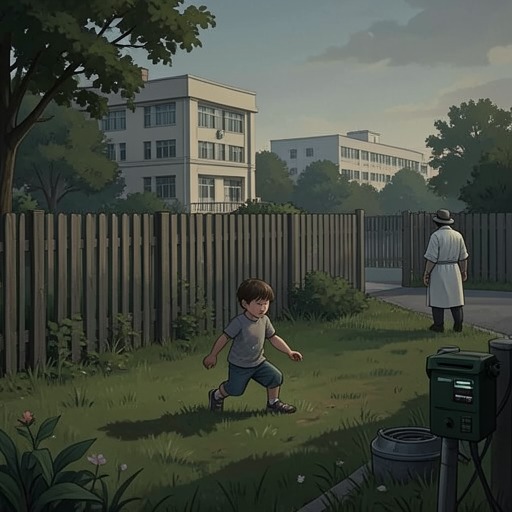
Small acts of contact also marked the place as a lived-in community. Attendants knew the narrator and waved to him; a nurse sometimes passed him a piece of marble cake through a gap in a fence. Elsewhere, he saw a boy unable to reach a stuffed animal lying in the grass and still struggling to retrieve it hours later. The view is intimate but not sentimental: it preserves both the ordinary gestures of care and the visible limits imposed on patients’ lives.
Family life, illness, and return
Hesterberg’s institutional landscape was inseparable from the narrator’s family story. His father’s position as a child and adolescent psychiatrist made the director’s villa both a family residence and the center of the hospital. Years later, after the narrator’s brother died and his parents were left trying to sustain familiar routines, he remained with them in the house on the grounds. When his father became seriously ill, separated from his wife, and then faced further cancer treatment, he eventually returned to the family home, sick and alone in the middle of the hospital.
As his condition worsened, illness entered the house as an everyday reality. His pain spread through his body and, in the narrator’s account, seemed to extend into the rooms around him. Morphine began late, after the pain had become difficult to control; he injected large doses into his swollen abdomen. When cancer reached his spine and spinal cord, he suffered a night of screaming that could be heard through the house, alongside the cries of hospital patients. After paralysis removed his pain below the chest, his parents spent a period together in an unexpected intimacy: his mother cared for him, and the narrator found them again as lovers. Their last weeks were spent in the practical work of dying, a family crisis unfolding within the hospital grounds that had framed their life together.
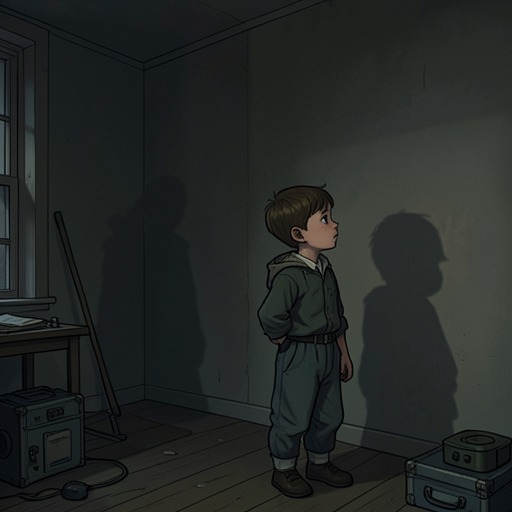
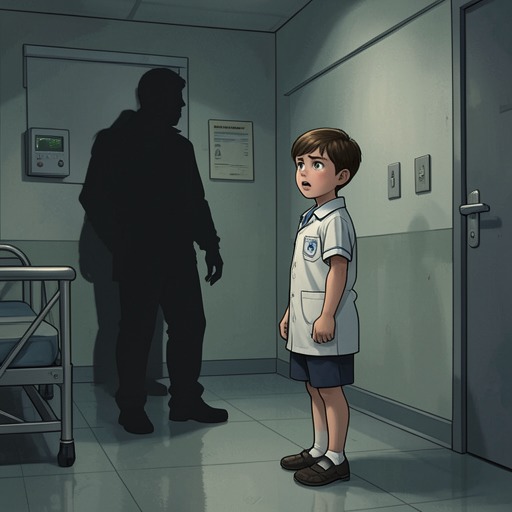
Hesterberg also became the place to which the narrator was taken after a violent breakdown at an officers’ club. He woke on a stretcher and recognized House E, the outpatient-treatment building. In a room with barred windows and no interior door handle, he tried to hide his identity from the doctor. His father arrived in disarray and sat beside him as he began to cry. The episode collapses the distance between the director’s family and the institution: the hospital that had been the narrator’s home and daily landscape was also where he became a patient.
The altered Hesterberg
After a year away, the narrator returned and walked familiar paths, past buildings and fenced gardens. At first, nothing seemed obviously different; then he became certain that something fundamental was missing. He encountered the familiar group of patients coming toward the main gate, recognized some by their gait and posture, and watched them pass. The scene leads to his reunion with Ferdinand, who had mistaken the narrator for his dead brother. Ferdinand’s insistence that the narrator was alive makes the return feel like a recovery from the dead, while also showing how the brother’s death had altered the people who knew the family.
A later visit revealed a more extensive physical transformation. The roughly three-kilometre perimeter wall and both gates were gone, making the transition from town to hospital grounds difficult for an outsider to notice. Houses C, D, and M had been demolished; House K stood empty, with windows smashed up to the top floor. Later buildings remained in use, but meter-high opaque palisades had replaced the fences, blocking the view. The old workshops, including the nursery and metalworking shop, had plywood over their windows. The football field was neatly mown and marked with complete chalk lines, a precision the children had once wished for, but the grounds otherwise seemed deserted, as if evacuated or closed.
The newer clinic presented another bleak image: rust disfigured its façade, and a few patients moved indistinctly behind thick replacement windows. The narrator later learned that only about three hundred patients remained. He recognizes that the former arrangement had been appalling—overcrowded, cramped, medically inadequate, and dependent on the mass use of tranquilizing drugs—and that those still living there had a more appropriate and humane environment. Nevertheless, the transformed grounds seemed to him more hopeless than ever. His grief is not a claim that the old conditions were good; it is grief for a lost world that had been home to him.
Home as memory
The narrator understands the contradiction directly: he mourns a world whose disappearance was not itself a tragedy, and is grateful that the overcrowded institution is gone, yet longs for its unfiltered joy, prolonged embraces, and furious outbursts. He also misses the patients’ unmistakable presence and the sound of their nighttime cries, which once helped him sleep. The remembered hospital is therefore neither simply condemned nor idealized. Its oppressive conditions remain visible even as the narrator mourns the intensity and familiarity of the world they contained.
On a final visit, the family house had become a supported-living ward, identified as House S. Above the door, repainting had not erased the grooves left by the Family dog scratching to be let inside. Around the back, at the windows of the children’s rooms and the narrator’s former terrace door, a patch of breath fogged the glass; behind it, someone sat on the floor of his old bedroom and breathed against the window. The new use of the house and the trace of the dog’s scratches place institutional change and personal memory in the same frame. Hesterberg’s grounds have altered, but the narrator’s return makes their former inhabitants, rooms, and habits present again.