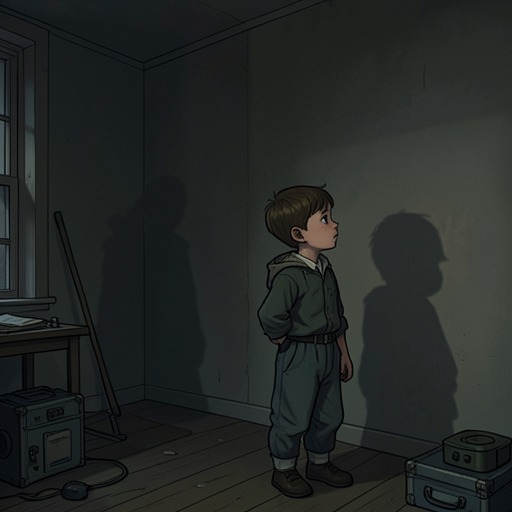
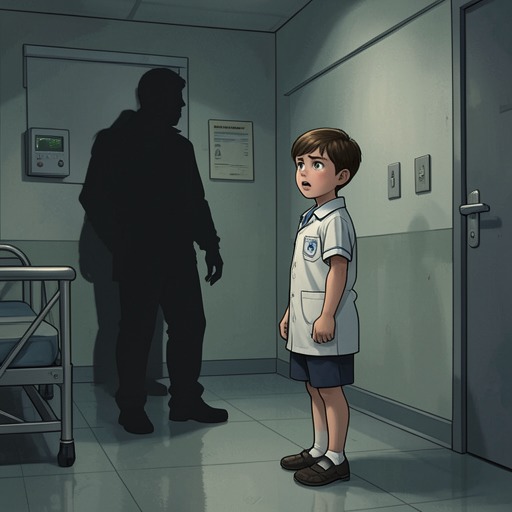
Joachim(Jocki)
Wann wird es endlich wieder so, wie es nie warJoachim(Jocki)is the central autobiographical figure: a boy raised inside Hesterberg psychiatric hospital who learns early that memory, storytelling, and identity are never quite separable. His childhood is marked by startling independence, an imaginative lie about finding a dead man, a close but sometimes volatile family life, and the extraordinary events unfolding around his father’s institution. The adult narrator’s later reflections give those episodes a larger purpose: the past is not simply a settled record but something that must be reopened and reshaped if the future is to remain open.
Identity and Childhood at Hesterberg
At ten, asked where he lived at a holiday camp, Joachim names Hesterberg rather than the nearby town. When another child calls it an asylum, he insists on the word psychiatric hospital and says that he is known as Jocki, not Joachim. The exchange makes visible how thoroughly the institution has become his home and how firmly he claims a name and place of belonging that other children treat as strange. Hesterberg is not merely the setting around his family: it is the world from which he understands himself.
That belonging is bound up with his view of Hermann. As the hospital’s director, his father appears to the child to be not only its leader but its owner, a doctor who is also a king. Joachim wanders the grounds as if they are his own, treating the hospital’s spaces as part of the familiar territory of childhood. Later, at bedtime, Hermann calls him Josse, kisses him goodnight, and leaves his bedroom door ajar. After checking the terrace door, he takes the Family dog by the collar and begins his nightly circuit of the house, securing the windows, both outside doors, and the cellar door. The routine makes care tangible: authority and tenderness share the same figure, and even the habit of leaving a door unlocked or ajar belongs to the family’s particular idea of safety.
The hospital’s sounds also enter the texture of home. At night, patients’ cries carry across the grounds; Joachim knows some of the voices from before he could speak. Their mingled cries—impossible for a child to sort reliably into pain or happiness—are part of the environment in which he sleeps. The institution is simultaneously his family’s workplace, a place of care, and the landscape of his earliest familiarity.
Independence, the Dead Man, and the Making of a Story
A week after turning seven, Joachim is finally permitted to walk to school alone. The change alters the route from a journey conducted at his mother’s hand into a series of decisions he can make for himself. After following the agreed path during his first week, he takes a detour through an allotment-garden settlement, despite Hermann’s explicit warning not to go there. This small act of disobedience belongs to a larger discovery: walking alone makes the world feel newly available to him, and the child begins to experience himself as an individual moving among separate places and things.
The episode becomes the occasion for his first encounter with a dead person, a retired man. His family responds in different ways. The narrator’s mother draws him close and comforts him. Hermann, drawing on his psychological training, places the death in the wider context of life’s transience and suggests that the man suffered a heart attack and probably did not suffer. To Joachim’s relief, his father does not ask why he was in the gardens after being forbidden to enter them. The narrator’s eldest brother and the narrator’s second-oldest brother initially refuse to believe him. Only after Joachim breaks down in a rage, weeps, and swears that he really did find a dead man do they begin to comfort him and question him closely.
Being believed does not satisfy him for long. No police officer contacts him, his discovery does not put him in the newspaper, and there is no finder’s reward. In the following weeks he tells the story repeatedly—to classmates, people at the swimming club, relatives, his brothers, and his parents’ friends—and learns to alter it for different listeners. He adds gruesome details for an audience that wants to be frightened and resolute actions for adults he hopes to impress. For women listeners, he allows himself increasingly ornate, sentimental images. The telling becomes a craft shaped by its audience, not a stable report of what happened.
Joachim knows that he is lying about those embellishments, yet describes the story as if it has acquired a life of its own and he has become responsible for living up to it. He lavishes invented details on the discovery so that the extraordinary event will stay with him and feel at home. This early episode anticipates the adult narrator’s concern with memory: an event may be remembered, retold, and decorated until the teller can no longer treat the story as a neutral container for facts.
Family Intimacy and Frustration
A small moment from Hermann’s fortieth birthday captures the family’s capacity for play. While Hermann studies a garden-furniture advertisement, Joachim approaches to look at its reverse, where a young woman is shown painting a fence bright red. Joachim bends forward; Hermann slowly raises the paper until father and son’s faces meet where the pictured woman had been. They laugh, and Hermann lowers the advertisement again like a magician. The remembered detail is modest, but its physical arrangement—a paper screen lifted between two faces—makes their shared amusement vivid.
Another birthday story turns on a present that never reaches its intended recipient. Joachim had planned to make forty marzipan potatoes for Hermann, one for each year, but the gift goes wrong. That evening Hermann tells him that he had made a present for Joachim too: forty homemade marzipan potatoes. Joachim says he would have loved them, but avoids explaining what happened because recounting it would make him angry and unhappy again. Hermann thanks him for the idea even though he did not receive the gift. Joachim moves close to his father’s leg, hides his face against it, and embraces the Family dog when it pushes its way into the room. The failed exchange does not erase the affection between them; instead, it shows how care can persist around a disappointment the child is not ready to narrate.
Rage is another recurrent feature of Joachim’s childhood, and the narrative presents it through bodily action rather than explanation. During the snow disaster, after an exhausting storm of anger, he repeatedly slams his bedroom door, reopening and throwing it shut until plaster begins to fall from the frame. His mother, brothers, and dog watch from the end of the hall. He imagines that he will never stop, but exhaustion finally defeats the impulse. He collapses on his bed, spits at the wallpaper, and notices that the storm outside has also fallen quiet. The scene places his fury beside an immense change in the weather without claiming that one explains the other: both are experienced as forces that seem, for a time, to exceed control.
The Hospital in Public Crises
Joachim’s childhood perspective also records how Hermann’s work enters family life. At the opening of a new children’s and adolescent psychiatric hospital building, the family waits with hospital staff and patients for the delayed minister-president, Dr. Gerhard Stoltenberg. Rain begins to fall on the patient choir, which has been left outside to sing. Before entering the building, Stoltenberg turns toward the drenched patients and objects to their treatment; Hermann answers that they were caught by the rain. The scene exposes the distance between the ceremony’s public display and the patients’ actual discomfort, even as Hermann presents the new building as a break with custodial psychiatry and a turn toward treatment and patient welfare.
As the visit ends, a voice calls for the minister to raise his hands. The security men throw Stoltenberg to the ground and draw their pistols. Joachim freezes, but he is not chiefly startled by the threat: he recognizes the voice. The speaker is Rudi, a patient whose ambushes on the hospital grounds are already familiar to those gathered. Hermann tries to calm the armed men and identifies Rudi as one of the hospital’s patients. For Joachim, the instant reversal—from formal visit to armed emergency—reveals both the power of a familiar voice and the precarious boundary between the institution’s public order and the unpredictable lives within it.
During the North German snow disaster, Joachim is excited by the catastrophe taking shape outside his window, even as it disrupts the hospital’s operations. The storm and growing snowdrifts transform the garden; the Family dog climbs onto the roof ridge and barks at the unfamiliar view. Inside Hesterberg, power fails in the kitchen, medication is lacking, and many staff cannot reach the hospital. Patients are enlisted to help clear snow, while Hermann moves from ward to ward. The children cheer when Dr. Gerhard Stoltenberg announces on television that the school holidays will be extended by two weeks, a private delight set against a public emergency.
Hermann later returns from a helicopter flight carrying insulin to Michaela Meisner, who is in danger. A television crew has filmed the flight, and the family watches the evening news together. Joachim sees his father on screen explaining that he has already taken a patient to hospital and is now bringing insulin to a girl in life-threatening need. The episode joins the boy’s fascination with a real disaster to his father’s practical responsibilities: the same event that makes the world outside seem astonishing also tests the hospital’s ability to care for its patients.
Loss, Recognition, and the Work of Memory
After his brother dies, Joachim encounters Ferdinand, who has mistaken him for the brother who was also absent. Ferdinand repeats that Joachim is alive, embraces him, and celebrates what he understands as his return from the dead. Only then does Joachim grasp the source of the confusion: Ferdinand has taken him for his dead brother. For a moment, another person’s mistaken recognition makes Joachim experience his own survival as a kind of resurrection. The distinction Ferdinand insists on—this is not the brother; this is Joachim, alive—gives the scene its force without undoing the loss that produced it.
The adult narrator returns to this problem of what can be known about the past. He questions the assumption that what lies behind him is more secure than the future: memories may need to be worked through and shaped rather than simply retrieved as finished records. He imagines that the dead must become living again in memory, but also remain more independent and unfamiliar than he had admitted. That process is not a claim that invention and fact are identical. It is a recognition that recollection involves choices about how experience is arranged and told—a question already dramatized by the seven-year-old who knowingly embellished his story of the dead man.
Joachim’s life therefore links childhood storytelling to adult remembrance. His early tales show how the wish to preserve an extraordinary event can pull a narrator beyond what he knows; his later reflections ask how to face that instability without pretending the past is fixed. By accepting memory as something to be reshaped rather than sealed, the narrator imagines the future not as a predetermined line but as a space in which new decisions can still be made.