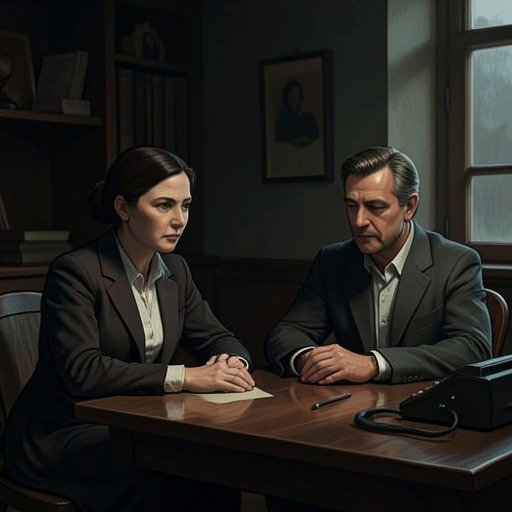
Josse—Marlene
Wann wird es endlich wieder so, wie es nie warJosse’s relationship with Marlene is shaped by fascination, proximity, and the knowledge that her wish to die cannot be explained away. During her eight weeks in his family’s home, he is drawn to her deliberate stillness and watches her closely; years later, after she has died by suicide, Hermann’s account gives that childhood attachment a painful final context.
An Unusual Arrival
Marlene came to the family through a confidential referral to Hermann, who was a psychiatrist. Something serious had happened, but he would not disclose what or identify her parents. The family understood that she could not be admitted to a psychiatric institution because she was considered too sensitive for one, while outpatient care alone was thought insufficient. Instead, she would stay with them. Josse and his brothers were curious about what to expect, and the guest bed was prepared.
The narrator’s mother took Josse to a supermarket to buy the foods specified by Marlene’s parents. The elaborate list included forty mini salamis, twelve cans of tuna, gummy bears, orange marmalade, and ten jars of beetroot. The quantities made the coming stay feel mysterious even before Marlene arrived. Josse learned that she was fourteen, a year older than him, and that the initial plan was for her to remain for four weeks.
When Josse came home from school the next day, Marlene was sitting at the kitchen table with the narrator’s mother, doing nothing. Her carefully assembled appearance—a pink dress, a bright red cardigan, pale floral tights, painted nails, a cross necklace, and pearl earrings—seemed oddly detached from her, as though the clothes were only resting on her. Josse poured himself a glass of milk and sat beside her. She did not appear tired or sad; her hands simply lay on the table, and she gave no sign of responding to him.
Stillness and Attraction
At meals, Marlene slowly chewed the mini salamis or ate tuna directly from its can. Josse had never seen such measured, ceremonious manners. Each movement seemed to require effort, yet also possessed a deliberate grace. He watched her take half an hour over a single salami. As she ate, the second hand of the kitchen clock seemed to struggle across its face; conversation, too, dwindled almost as soon as it began. Josse’s childlike impression was that Marlene was more powerful than time.
The effect reached beyond Josse. The narrator’s mother tried to persuade Marlene to pack her swimming things for a trip to Langsee. Marlene looked at her and did nothing. As the narrator’s mother’s enthusiasm ebbed, her invitation slowed into a reluctant suggestion that Marlene could think it over; she herself no longer seemed eager to go. Josse observed how Marlene’s gaze and posture drained the energy from those around her. Rather than making him withdraw, this strange quality intensified his interest: he says he could not get enough of her and watched her whenever he was near.
The narrator’s second-oldest brother noticed Josse’s attention and teased him for having fallen for the seemingly sleepy girl. The attraction was especially striking because Josse was her opposite: restless, unable to sit still, and once sent home from first grade because he could not understand what the desks and benches were for. In their brief companionship, Marlene made Josse a little calmer, while he made her a little more restless. During the day, she attended sessions and therapy with Hermann; in the afternoons, she was with the family.
Josse watched her brush her hair in the sunlight by the large glass sliding door, always combing from top to bottom while slowly sucking on a gummy bear. He sometimes pretended to have something to do in the living room so that he could sit nearby and observe her. When he asked whether she was ill, her neutral, absent look unsettled him because it seemed to expect nothing from either him or herself. He could not tell whether she despised him and his family or simply regarded them without judgment.
A Disclosure Without an Explanation
When Josse asked why she was staying with them, Marlene answered that she had tried to kill herself. She had swallowed all the tablets she could find in a cupboard, fallen asleep, and awakened in hospital after her stomach was pumped. Asked why she had done it, she said she did not know; finding out was part of why she was there. She suggested that Josse ask again in a week, perhaps she would have an answer by then. Her account made the danger behind the family’s unexplained arrangement explicit, but offered no motive that Josse could use to make sense of it.
Marlene’s presence gradually affected the whole household. The narrator’s eldest brother showed her his fish and put on records, but even the music seemed to slow, as if a finger were pressing down on the turntable; the guppies, angelfish, and other fish appeared to sink stunned toward the algae-covered gravel. The narrator’s second-oldest brother gave lectures that lost their way under Marlene’s expressionless gaze. Josse, meanwhile, thought about her at night while patients shouted outside. He imagined touching the soft woolly nap of her sweaters and her back, and found himself unable to sleep. His attention thus moved from watchful curiosity into adolescent desire, though the account gives no indication that Marlene returned it.
Departure and the News of Her Death
Marlene stayed for eight weeks, twice as long as the four weeks first proposed, and then returned to her parents. Her departure ended the household’s daily proximity but not Josse’s memory of her. Several years later, while Josse and Hermann were changing at an outdoor swimming pool, Hermann asked whether Josse remembered the girl who had once lived with them. Josse recalled her above all for being so incredibly slow.
Hermann then told him that Marlene had killed herself the previous day. During the walk to the showers, he explained that it was her fourth attempt and that she had wanted to die even during the time she stayed with them, though she herself did not know why. He said her parents had not caused it and described them as kind people. Hermann had treated Marlene for six years; he had liked her very much, and they had understood each other well. His voice broke as he admitted that until the end he had thought they might succeed in helping her.
The disclosure changes the meaning of Josse’s early fascination without supplying a retrospective explanation for Marlene’s silence. What had seemed to him an almost comic power over clocks, conversation, and his family’s plans is set beside a persistent suicidal desire that neither Josse nor Marlene could explain. The relationship remains brief and largely one-sided, but it becomes one of the memories through which Josse encounters the limits of childhood understanding and of Hermann’s work as a psychiatrist: affection and years of treatment did not guarantee that Marlene would survive.