Landseer
Wann wird es endlich wieder so, wie es nie warThe Landseer is both a specific family dog, Aika, and the focus of the narrator’s intense longing for closeness: although the dog belongs to the narrator’s second-oldest brother, the narrator treats him as an ally and imagines binding their lives together as blood brothers. The breed’s rarity, webbed paws, and extraordinary love of water give that attachment a vivid physical form, while the dog’s own patient, eager presence makes him more than a symbol in the narrator’s account.
Identity and Background
The family’s Landseer is a large black-and-white dog, a breed also described as a black-and-white Newfoundland. The narrator’s second-oldest brother chose the breed, spent a week with breeders near Hamburg, and named the dog Biggi von den Ziegelteichen. Since the dog came from a B-litter, the name followed the breeders’ litter convention; in everyday life, however, he was called Aika.
The narrator remembers having believed his brother’s fanciful explanation of the breed’s name: that Landseers had once watched for land from ships and barked when they spotted it. The actual explanation was less nautical. The dogs were named after an English lord, a celebrated landscape and animal painter whose favorite subjects included these large dogs. The childhood mistake matters because it gives the breed an imagined history at sea, a setting that later proves fitting for Aika’s actual, exuberant relationship with water.
Landseers are rare enough that, in the narrator’s estimate, encountering another one happened only three or four times in thirty years. Each time, the narrator immediately thought it was Aika. Because these encounters occurred after the dog’s death, they felt like strange experiences of seeing him return. The breed’s scarcity thus makes recognition intimate but unreliable: another dog’s resemblance briefly collapses the distance between memory and presence.
The Narrator’s Bond with Aika
Aika is the narrator’s confidant and ally. When unhappy, the narrator lies crying against the dog’s belly, convinced that only he understands. The dog is allowed to sleep in the narrator’s bed; pressed against the wall beside him, the narrator lies directly in front of Aika’s open, sleeping mouth, which smells like a thawed refrigerator. The detail is affectionate without making the closeness abstract: companionship means sharing cramped space, breath, and even an unappealing smell.
The narrator’s devotion is striking partly because Aika is the brother’s dog. The brother selected him, acquired him from the breeders, and took him to competitions, where he gave the phlegmatic animal commands. One required Aika to lift his lips when called. The narrator, by contrast, courts the dog’s company through small acts of care: secretly feeding him sausage, patiently picking burrs from his bushy tail, and accepting being covered from head to toe in dog hair. The contrast is not a dispute over ownership so much as a difference in how each boy approaches Aika. The brother trains and competes with him; the narrator wants to be near him, as near as possible.
The wish for an even closer bond takes on a ritual shape after the narrator sees Winnetou and Old Shatterhand cut their arms and bind their bleeding wounds together while standing on a white rock. The narrator wants a blood brother of his own and wants the dog’s blood in his veins. The account establishes this desire, not that the imagined ceremony took place. It shows how the narrator tries to give an overwhelming attachment a form: Aika is already a trusted companion, but the narrator longs to make their kinship bodily and permanent.
A Body Made for Water
The breed’s defining trait, as the narrator understands it, is an almost unrestrained love of water. Landseers can swim and even dive; their paws have webbing between the claws. That anatomical feature becomes a test of what the narrator knows. After learning about it in specialist literature, the narrator tells the biology class, but the teacher insists that dogs do not have webbed feet. To defend the narrator’s credibility, the dog is offered as proof, and the second-oldest brother gives permission to bring him to school.
The demonstration turns into a small public spectacle. At the appointed time, the narrator’s mother arrives with Aika. The narrator runs forward and embraces both of them, then the dog is allowed to jump onto the cleared teacher’s desk. Curious classmates gather around the panting animal as he looks down over their heads. The teacher pinches the skin between two of Aika’s toes, discovers the webbing, and orders the class to form an orderly line. One by one, the pupils get to press the webbing of a dog whose patience seems nearly inexhaustible. The teacher, whom the narrator recalls later died of a growth on his neck, has to revise his certainty in front of the class.
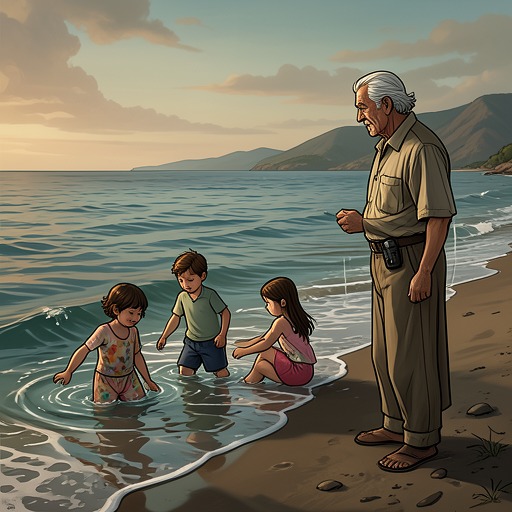
At the Baltic Sea, the webbed paws and the narrator’s classroom explanation give way to the spectacle of Aika swimming. When the family parks on a meadow converted into a car park, the dog can hardly contain himself on the back seat. As soon as the door opens, he squeezes out, runs to the sea, and dives in headfirst. He disappears beneath the surface and rises again, moving through the rippled water not with clumsy paddling but, in the narrator’s comparison, like a dolphin. The breed’s reputation is confirmed in a scene of unforced action: Aika does not merely tolerate the water; he hurries toward it.
Shared Swimming and Narrative Significance
Once the narrator has put on a swimsuit and diving mask, he follows Aika out to the first sandbank. They swim together. Underwater, the narrator sees the large dog looking back, his floppy ears spread from his head like fins and his expression seeming to widen into a grin. The scene makes the bond reciprocal in its immediate terms: the narrator goes into the water after Aika, and Aika is there, visible and companionable beneath the surface. The dog’s body, so conspicuously suited to swimming, creates a place where the narrator can join him rather than simply watch or care for him.
Across the account, Aika is approached through several different kinds of evidence: breed history, a disputed biological fact, a classroom demonstration, domestic routines, and remembered encounters after death. These details keep the dog specific even as the narrator makes him an emblem of loyalty. He is phlegmatic enough to endure a line of curious children, responsive enough to become the object of training, and so drawn to the sea that he bolts toward it as soon as he can. The narrator’s love does not erase those independent traits; it gathers them into a portrait of the companion whose closeness is sought at home, at school, and in the water.