Laramie
Wann wird es endlich wieder so, wie es nie warLaramie is the central setting of the narrator’s year in Wyoming, an American exchange that begins as a wished-for escape from Schleswig and becomes the place where he learns of his second-oldest brother’s death. Its wolves, immense distances, and ordinary school routines frame a sharp contrast: the narrator returns to the life he had built there even as his family is gathered in grief at home.
A remote setting
The narrator had imagined going to California or a large city such as New York or Chicago, but instead landed in Laramie. The town stood within Wyoming, where half a million people lived across an area as large as Germany; only Alaska had a smaller population. The narrator’s high school had its own landing strip because some students flew in every morning. Even his host family lived beyond the town itself, in what he described as being outside of outside: a green oasis in dusty prairie, its garden crossed from morning to evening by crawling sprinklers.
At night, wolves howled near Laramie. The narrator liked that sound, which recalled the howling and screaming of patients he had known in Schleswig. That association makes the unfamiliar landscape both distant from home and unexpectedly connected to it. Laramie is not presented as a simple break with the narrator’s past: a sound from the prairie brings one of its most distinctive parts back into earshot.
School and host-family life
The narrator’s new household seemed, in one respect, uncannily like the one he had left: it had three brothers and a dog. He liked his host parents, Stan and Hazel, describing them as patient and kind. Don, their youngest son and the narrator’s age-mate, was less welcoming. He corrected the narrator’s English closely and, when his parents were absent, called him “The German Robot.” The exchange year thus began with both a hospitable home and a daily reminder of the narrator’s foreignness.
A casual choice on the exchange questionnaire had practical consequences. Asked whether he was not religious, religious, or strictly religious, the narrator had checked the strict category. In Laramie he therefore had to attend church three times a week—not only for services, but also to sweep the church and polish the altar. He found the obligation miserable, a marked contrast to the activities he chose for himself at school.
Those choices gave his days a life of their own. At six each morning a school bus collected him for rock climbing in the Rocky Mountains; while the climbers waited for the rocks to dry in the sun, they ate breakfast. In German class he became, for the first time in his life, the top student. In woodworking, the class built rustic birdhouses of intimidating size. These routines show the narrator settling into Laramie through specific pursuits, even while language, religion, and his host brother’s mockery made adjustment uneven.
News of death and the Yellowstone journey
Several weeks into the exchange, the narrator was in his room, lying on a waterbed and listening to music, when an unexpectedly timed call came from home. His father told him that his second-oldest brother had been killed in a car accident. When Janet opened the door to ask what had happened, the narrator could not find the English words. He tried to explain in German, then reached for a dictionary and assembled the sentence word by word, including the phrase for car accident. The news had made the language of his new life suddenly unusable; the dictionary became the means by which he could tell another person what had happened.
The call came shortly before a planned trip to Yellowstone National Park. Because the narrator’s complicated return flight was still four days away, the group went ahead. He travelled through long stretches of road and looked out at the landscape, including buffalo herds and geysers. The grandeur that might otherwise have defined the trip could not relieve its desolation. Laramie is therefore not only the setting of his growing independence: it is also the point from which he moves through a remarkable landscape while carrying news that has made it feel bleak.
Return to Laramie and postponed grief
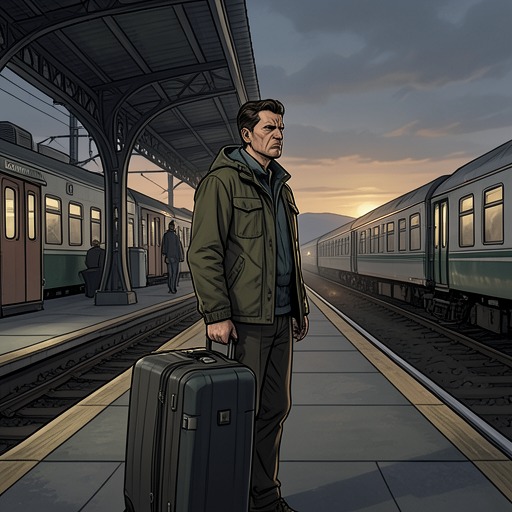
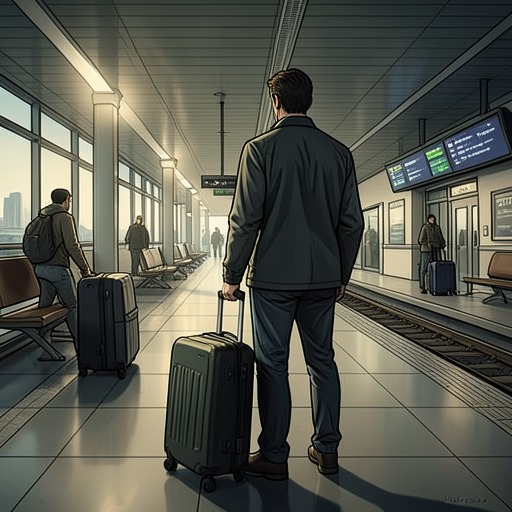
The narrator flew back to Schleswig for the funeral. After thirty-four hours and four changes of plane, he reached Frankfurt, where his second-oldest brother had once taken him to the airport; he had last seen him there. At the Hamburg airport, his parents and surviving brother waited together. The narrator saw them sitting motionless behind a large pane of glass while other travellers ran to greet returning family members. Their stillness made the homecoming unlike the triumphant return he had imagined before the exchange. His family was glad to see him, and they held one another amid the crowd.
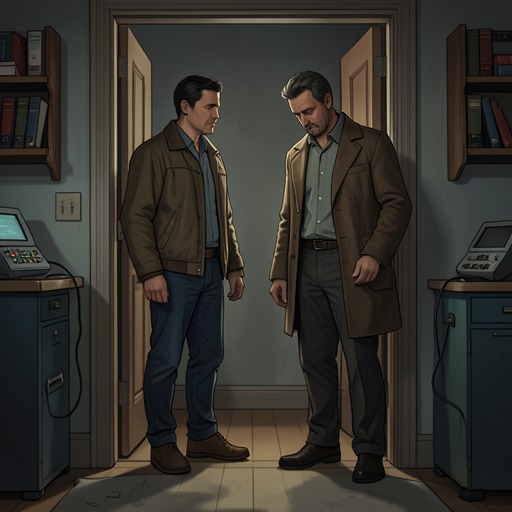
Although he knew his absence made things harder for his parents, the narrator decided to fly back to Wyoming. His father, weeping and bent over an armchair, asked whether he might rather stay at home, but the narrator was determined to return. Fourteen days later he was back in Laramie with his complete host family. At school, no one knew about the accident; outside the host family, no one offered sympathy. The lack of attention hurt less than it might have, because it let him continue living as he had before the death.
In the months that followed, he played basketball, learned to throw a football, and learned to carve a large turkey. He shoveled great quantities of snow, met a girl at a hot-tub party, rode for hours across the prairie, visited a prison and found a pen pal there, and took long trips with his host parents. He says he refused to grieve and thought of his brother mainly after the Sunday telephone calls with his parents. When he left the United States and returned to Schleswig, he weighed ninety-five kilograms, could do a hundred push-ups, and spoke fluent English. Laramie’s significance lies in this double ending: the exchange gives the narrator new physical and linguistic confidence, while his return to its ordinary routines also marks how firmly he set his brother’s death aside.