Rudi
Wann wird es endlich wieder so, wie es nie warRudi is a young patient at the psychiatric hospital whose games can command a crowd and, for a moment, make play indistinguishable from danger. Known as Tarzan for his speed on the climbing tree at the annual summer festival, he is also the boy whose toy-gun challenge sends armed security men crashing onto Gerhard Stoltenberg in the mud. His story turns on the gap between a threat’s appearance and its meaning: the adults see a possible attack, while Rudi is absorbed in a game whose power has suddenly become real to everyone around him.
Identity and Presence
Rudi is one of the psychiatric hospital’s patients, and his familiarity extends beyond the people who work there. The narrator’s father explains that Rudi has ambushed people across the institution’s vast grounds; by the time of the clinic-opening incident, the narrator believes that almost everyone gathered under the entrance canopy has encountered him that way. The prank is recurrent, not a one-off eruption, though this particular occasion produces an unprecedented response.
The narrator first sees Rudi emerge from behind a newly installed, lavishly planted concrete flowerpot. The account fixes him in a few striking details: a reddish shock of hair, a narrow face no wider than a hand, close-set eyes, and scattered teeth. In his hand is a silver Colt. That combination of a vivid, almost theatrical appearance and a child’s plastic weapon gives the scene its unstable quality: what looks alarming from a distance is, as the narrator’s father knows, part of Rudi’s familiar play.
The Toy-Gun Confrontation
The confrontation begins just as Gerhard Stoltenberg is about to enter his waiting limousine. Someone shouts a demand for everyone to raise their hands and threatens to shoot. The security men immediately throw themselves onto the state premier, bringing him down in the mud; as they fall, they open their cases and draw black pistols. The narrator is stunned less by the words than by their effect. The voice is recognizable to everyone present, but this time the familiar call has transformed the scene in an instant.
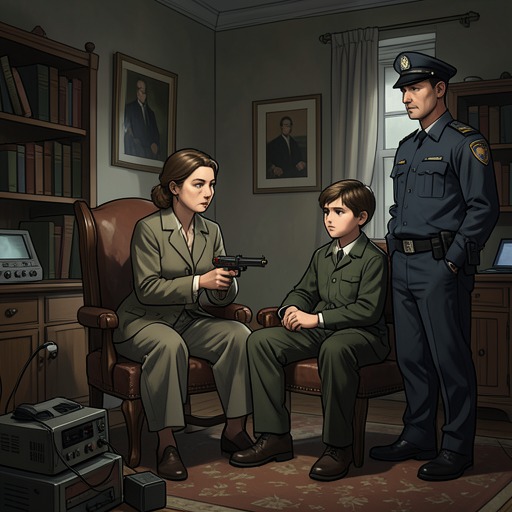
The security men aim toward the source of the shout. The narrator’s father raises his hands and urgently tells them that there is no danger and that the person is one of the hospital’s patients. Rudi appears from behind the flowerpot, smiling with delight at the power his challenge has had. He steps into view, raises his silver Colt, and points it toward the men in the mud. His father tells him that the game is over and asks him to throw the pistol away, but Rudi makes another step instead.
One of the security men threatens to shoot if Rudi comes closer and orders him to drop the weapon. Rudi keeps smiling and advances again. The narrator’s father moves into the line of fire, then changes tack: he tells Rudi that the men are already on the ground, that they have lost, and that Rudi has won. The appeal gives Rudi a way to end the game without surrendering its imagined outcome. After considering it, he throws the revolver into the air. Its unmistakable plastic clatter on the street begins to convince the men in the mud that the father has told the truth.
Recognition and Aftermath
A brief, almost ceremonial silence follows. The security men roll off Gerhard Stoltenberg, while the narrator’s father steps onto the yellow walkway and the narrator’s mother follows. Two attendants run to Rudi and twist his arms behind his back, a response the narrator judges excessive. The incident has ended without the threatened shooting, but its aftermath makes plain how quickly Rudi’s play has drawn institutional force around him: armed men, the patient’s father, and hospital attendants all act upon the same boy in sharply different ways.
Gerhard Stoltenberg remains face down in the mud and does not move at first. The narrator’s parents kneel beside him, reassuring him and telling him that he can get up. A reporter takes photographs in rapid succession, and the narrator’s middle brother quietly marvels at what has just happened. The public scene therefore ends not with a triumphant pose but with the state premier still on the ground, Rudi in the attendants’ grasp, and the adults trying to restore order after a game has briefly acquired dangerous consequences.
Tarzan at the Summer Festival
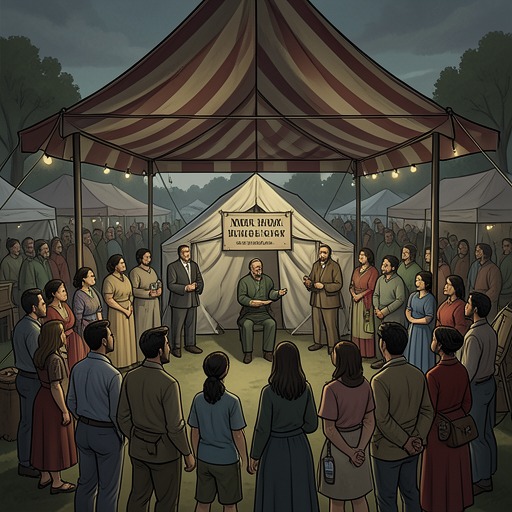
At the psychiatric hospital’s summer festival, Rudi’s physical daring is an attraction in its own right. The festival was designed to welcome local residents and other visitors as well as patients and staff, in the hope of easing the town’s lingering fears about the institution. Among its activities is a tree trunk secured by a rope, with a gong hanging at its bare top. Whoever reaches the summit is meant to strike it, drawing the visitors’ gaze upward as the climber waves from above.
The narrator never makes it beyond the first few metres: fear sets his knees trembling, and he drops back against the safety rope. Rudi, by contrast, is the acknowledged king of the climbing tree. He races up it like a little monkey, carrying his bright red hair to the airy goal. The festival name Tarzan captures a competence that the toy-gun scene does not: on the trunk, Rudi’s boldness is a public spectacle with agreed rules and a clear finish. Under the canopy, the same appetite for dramatic effect meets armed guards who cannot initially know that the weapon is plastic. Across both scenes, Rudi is remembered as a performer whose play gathers an audience, while the consequences depend on whether that audience recognizes the game.