Vierzig Kugeln Sorgfalt
Wann wird es endlich wieder so, wie es nie warVierzig Kugeln Sorgfalt is the name the narrator gives to the meaning of his planned birthday present: forty homemade marzipan potatoes whose careful making would itself be a gift to his father. What begins as a child’s elaborate confectionery project becomes a measure of time, a bid to give something worthy of his father’s fortieth birthday, and finally the occasion for an explosive discovery of his own anger. The sweets matter not simply because they are lost, but because the narrator believes their painstaking preparation proves a capacity for care that others do not expect of him.
The Gift and Its Ambition
The narrator wants, at last, to give his father something more substantial than a coaster. His father loves marzipan potatoes, so the boy devises a present of forty, one for each year of his father’s life. Making them himself is central to the plan: the work will let him meet his brothers on equal terms as a gift-giver. The undertaking is his own, not merely a way to obtain a sweet his father likes.
With the narrator’s mother, he gets the recipe and buys the ingredients: almonds, powdered sugar, bitter-almond oil, cocoa powder, and rose water from a pharmacy. That last ingredient lends the project an almost medicinal quality in the child’s understanding; the marzipan potato seems to him more than a confection. He insists on doing the work without maternal help and weighs the five hundred grams of almonds with extraordinary precision, correcting tiny discrepancies between portions. His exactness is not incidental preparation. It is the first visible form of the care he hopes to give.
When the narrator’s mother points out that the almonds still have their brown skins and offers to show him how to remove them, he initially resists: accepting help threatens his wish to make a gift that cannot be dismissed as a joint effort by mother and son. He eventually lets her pour boiling water over the almonds. The skins loosen, and he squeezes the kernels from their coverings into the bowl, then crushes them and mixes in sifted sugar and bitter-almond oil. He counts exactly thirty drops of rose water before kneading the mixture. The smell of marzipan convinces him that he has found his calling: he imagines becoming the greatest maker of marzipan potatoes.
Counting a Father’s Years
The recipe calls for cherry-sized portions. The narrator follows that instruction, even as he wonders why the recipe does not simply use the familiar size of a marzipan potato. The mismatch between the ordinary sweet and the recipe’s measure becomes part of his childlike attention to the task: each small decision is examined rather than passed over automatically.
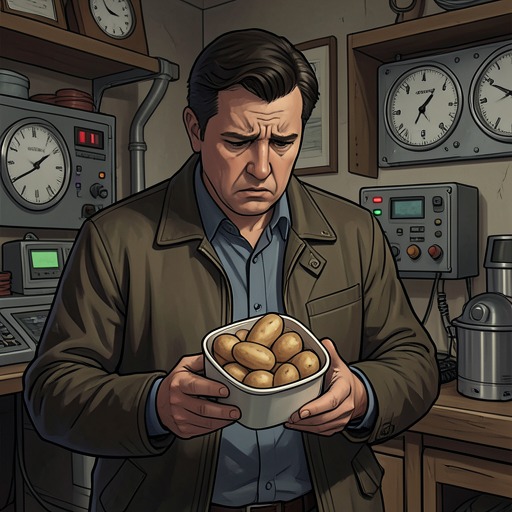
He rolls forty potatoes, one for every year of his father’s life. Counting them changes the arithmetic into a discovery of age. At the first potato, the father becomes, in the boy’s imagination, a one-year-old baby; at the eighth, he reaches the narrator’s own age. Eight seems like a great many years to the child, yet looks like very little when set beside the remaining potatoes on the tray. As he forms each ball between his palms, he feels both the quantity and the smallness of a year. The count gives the gift its emotional scale: the sweets register the distance between father and son while making that distance tangible, one marzipan year at a time.
The narrator imagines a future covered in cocoa as he rolls the balls. He then prepares the cocoa beside the tray and, before going to the toilet, wrings out a wet kitchen towel and spreads it over the sweets to keep them from drying. Even the pause is organized around protecting the work. While sitting in the bathroom, he considers how best to package the present, rejecting individual wrapping as impractical and a cellophane bag as beneath his ambitions. His thoughts remain fixed on presentation and completion: the gift is not yet finished until every potato has received the final treatment he has planned.
The Interrupted Finish
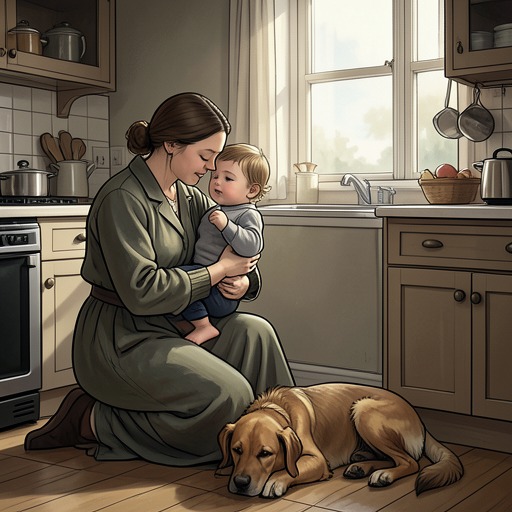
When the narrator returns and lifts the bowl’s lid, he finds the potatoes stacked together, already dark with cocoa. The narrator’s mother has completed the step he had been saving for himself. She believes the sweets have turned out well, but the narrator experiences the result as the destruction of the very part of the project he most wanted to do. He can no longer begin a sentence; he points at the bowl and cries out in disbelief. The shock is not that the marzipan has been ruined as food. It is that the finishing gesture, which he had imagined as the culmination of his care, has been taken out of his hands.
He seizes the bowl, mashes the potatoes into one mass, carries it into the bathroom, and shuts himself in. The action reverses the painstaking formation of forty separate gifts: the carefully made pieces become a single lump. Under warm water, he washes away the mixture. The smell of marzipan intensifies as the mass grows smaller, slips through his fingers, and runs down the drain. He tries to retain it and shape it again, but it has become a creamy soup. The sink swallows what remains, giving the loss a physical ending that the narrator cannot undo.
The narrator’s mother apologizes and says she had not known that he wanted to do the cocoa coating himself, while also objecting to the intensity of his response. Those two reactions meet in the scene without cancelling each other: she recognizes that she has hurt him, yet does not understand why this particular mishap feels so serious. For the narrator, the answer lies in the work’s meaning. He had looked forward most of all to turning each potato in cocoa, because he was proud of being careful. He describes himself as someone regarded as flighty and inattentive, unable to finish books, remain in long conversations without drifting away, or sit still at school without distress. The gift was meant to contradict that reputation through a visible, painstaking act.
Care, Anger, and the Expression’s Meaning
The intended present is therefore not merely forty sweets but, in the narrator’s own understanding, forty demonstrations of care. The cocoa-coated balls were to make his diligence visible: a promise to his father and a counterexample to the image of a boy who cannot sustain attention. His mother’s premature help destroys the evidence he had hoped to offer. That gap between her loving intention and the effect on him recalls the earlier family anecdote in which she relocates a Picasso drawing her eldest son had given her, assuming that lending it back will settle the matter. In both instances, her affectionate impulse misses what the gift means to the giver; here, however, the narrator’s response is far more extreme, and the consequences unfold in the bathroom as the work dissolves.
After grieving the loss of all forty potatoes, the narrator’s sorrow gives way to anger. He imagines fists and blood, then looks up and meets his own reflection. His eyes are red, his lower lip trembles, and the furious boy staring back seems unknown to him. The moment does not resolve the conflict or restore the present. Instead, it makes the narrator witness his own capacity for unrestrained rage. The expression Vierzig Kugeln Sorgfalt holds together the project’s two outcomes: an imagined gift built from careful, separate acts, and the sudden collapse of that order into a single mass, a drain, and a face the child has not recognized before.