Kinder- und Jugendpsychiatrie Hesterberg
Wann wird es endlich wieder so, wie es nie warKinder- und Jugendpsychiatrie Hesterberg is more than the institution where the narrator’s father works: the family home stands within its grounds, so the clinic’s wards, patients, emergencies, and changes in psychiatric practice are woven into the narrator’s everyday life. The location moves between public showcase and private refuge, while its boundaries determine what the child may see and what his father must keep confidential.
Setting and institutional role
The clinic occupies a large enough site for the narrator to encounter it on his way to school and to visit his father there after school. The father has an office, a secretary’s anteroom, an administrative office, a waiting room for private patients, and a practice room that becomes the narrator’s favorite place. The grounds also include a park with Spiegelteich, a dark woodland pond where the child tries to catch small fish. These connected spaces make the institution part of the family’s physical surroundings rather than a distant workplace.
The arrangement does not mean that the narrator has unrestricted access. His father will not let him see patients, explaining that some might be children from the narrator’s school or children of teachers. The child is not permitted to wait in the patients’ waiting room, even when his questions show how curious he is about whom his father treats. When he visits while his father is working through files, he waits in the office; only when the work is finished does his father accompany him into the practice room. The clinic is thus familiar to him, but its professional boundaries remain deliberately in force.
A public promise of therapeutic change
At the opening of a new building for child and adolescent psychiatry, the clinic presents itself as an institution changing its purpose. Before entering, the visitors and patients are soaked by rain. A patient choir sings a sailor’s song, and the state premier, Gerhard Stoltenberg, remarks on the scene to the narrator’s father. The delay has reached about an hour by the time the party enters the new facility.
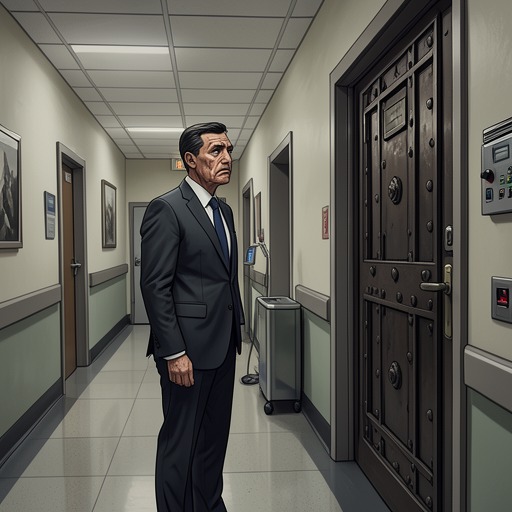
The father describes the building as the definitive departure from purely custodial psychiatry, with therapy and patient welfare now at the center. Doctors and nurses give brief explanations of their work in the different wards. Visitors see patients drawing, making things, or playing music in the music and art-therapy rooms; even the swimming pool, presented as a major feature for movement and body therapy, contains only a small, quiet group. The apparent calm, however, is not simply evidence of an easygoing institution. The narrator’s brother observes that the most difficult patients have been kept out of view, and the father acknowledges that the wards can sometimes be loud. In a group discussion with four adolescents experiencing psychological problems after years of drug use, one teenager abruptly leaves to use the toilet. The interruption punctures the ceremonial order, while Stoltenberg accepts it with composure.
Secrecy, danger, and the child’s view
The clinic’s protected boundaries become more troubling when the narrator’s bell-ringing patient acquaintance vanishes from the route to school. The father gives only a guarded answer: the man has to remain on his ward for a while. A few days later, a food-cart worker tells the narrator that the patient struck an attendant with one of his bells and injured him so seriously that his life was in danger. The narrator’s father refuses to provide further details, invoking medical confidentiality. His brothers offer contradictory suggestions, including that the man escaped and was caught or that he had died.
The boy is left with fragments rather than an account he can verify. He overhears his father discussing tighter security and notices that his father is away at the ministry in Kiel for several days. In the absence of reliable information, he imagines the patient’s attack, capture, and escape, and even pictures him appearing at the family’s terrace door. The clinic’s rules protect patient information, but from the child’s perspective they also create a space of unanswered questions in which fear and invention take hold.
The clinic in crisis and at home
During the North German snow disaster of 1978–1979, the institution’s dependence on its staff and supplies becomes stark. Power fails in the central kitchen, medication is short, and many doctors, nurses, and attendants cannot reach the grounds. Snow is cleared across the site, with patients assigned to help. The narrator and his brothers watch a group struggle to clear the family’s driveway, while snowplows are requested from Bavaria. On television, Dr. Gerhard Stoltenberg announces that the school holidays will be extended by two weeks, a declaration the children greet with delight.
The emergency also exposes the risks created by isolation. Michaela Meisner has run out of insulin, is confused, and can no longer get up; the roads are impassable, and calls for help reach only busy lines or waiting queues. The father anxiously tries to find a way to reach her. The episode shows the psychiatric grounds as part of a wider crisis in which ordinary access to staff, medicine, and transport has broken down.
Years later, as the father’s illness advances, the narrator is no longer living at home. After further surgery and treatment, the father leaves the household he had joined in Lübeck and returns to the family house amid the psychiatric institution. He is sick and alone there. In the house, the family’s private experience of terminal illness unfolds beside the institution’s ongoing life. The father’s pain becomes so consuming that the narrator, lying in his former bedroom, feels it as though it passes through the walls; on a warm night, his cries join the cries of patients elsewhere in the institution. The shared sound does not erase the difference between a patient and a family member, but it makes the home and clinic seem acoustically inseparable.
A place remembered through changing boundaries
The institution is associated with several kinds of care, none of them simple. At the opening, its new building embodies an explicit ambition to move beyond custody toward therapy. In the narrator’s visits, however, treatment also requires exclusions: the child cannot enter the patients’ waiting room or learn details about the people his father treats. The bell-ringer’s attack reveals the protective purpose and personal cost of that secrecy, while the snow emergency shows how quickly care can be endangered when the institution is cut off from supplies and workers.
The family home’s position within the grounds gives these institutional changes a lasting personal consequence. After the parents separate and the father moves away, the house stands empty, and there are early plans to turn it into a supported-living ward. The later return of the seriously ill father restores the house as a family dwelling, though now under the pressure of his decline. Kinder- und Jugendpsychiatrie Hesterberg therefore remains both a workplace and a landscape of memory: its wards and rules shape what the narrator knows, while the house within its grounds holds the family’s separations, return, and final care.