«Vive l’Empereur!»
War and Peace«Vive l’Empereur!» is the French imperial army’s cry of allegiance to Napoleon Bonaparte, but in War and Peace it carries an unstable meaning. It can sound like triumph, rallying language, theatrical obedience, or an automatic response to circumstance. Its recurrence helps the narrative distinguish the visible symbols of authority from the immense, largely uncontrolled movements of armies and peoples.
First Appearance in the Enemy Camp
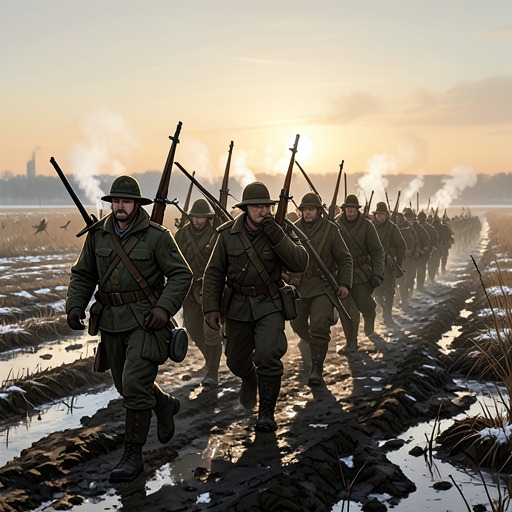
The cry is first heard by Nikolai Rostov at night, when he wakes among the Russian hussars and hears thousands of voices beyond the stream. Fires flare and disappear along the French line on the hill; the noise grows from indistinguishable shouts into the enormous roar of an army. At last Rostov hears the words distinctly: “Vive l’Empereur! L’Empereur!” The lights, the voices, and the restless horses make the French presence feel both near and immense, while the Russian hussar beside Rostov remains cautious and refuses to identify the phenomenon with certainty.
Prince Pyotr Bagration and Prince Mikhail Dolgorukov ride out with their adjutants to observe the lights and shouting. Prince Mikhail Dolgorukov interprets the display as a deception: he believes the French have retreated and ordered their rearguard to light fires and make noise. The cry therefore enters the narrative under the sign of uncertainty. It may be a genuine expression of military confidence, or it may be part of a calculated performance intended to mislead the enemy.
Cry, Proclamation, and Collective Action
The expression returns in the discussion of the Battle of Borodino, where the narrative rejects the idea that Napoleon’s commands alone caused the battle. The French, Italian, German, Polish, and Dutch soldiers are described as hungry, ragged, and exhausted after the campaign, yet the sight of an army blocking their road to Moscow makes combat appear unavoidable to them. Napoleon’s proclamation offers them, in exchange for mutilation and death, the imagined compensation of posterity’s praise for having fought before Moscow. Their response is “Vive l’Empereur!” followed by the advance into battle.
The cry does not prove that the soldiers are mechanically controlled by Napoleon. Instead, it dramatizes how an imperial slogan can gather together many immediate pressures: hunger, exhaustion, military discipline, the promise of conquest, and the expectation of rest and food in Moscow. The soldiers shout the words, but the narrative insists that their decision to fight arises from the collective situation as much as from any order issued by the emperor.
The text sharpens this argument by recalling that the army had cried “Vive l’Empereur!” when shown a portrait of the young Napoleon piercing the terrestrial globe with a toy stick. It adds that the soldiers would have cried the same words in response to any nonsense told to them. The repetition makes the expression seem both powerful and empty: it creates emotional unity, yet its automatic quality reveals how easily imperial enthusiasm can be attached to an image, a proclamation, or an absurd spectacle.
Authority as Appearance
The expression is central to the narrative’s distinction between authority and causation. Napoleon believes that the battle unfolds through his will, but the soldiers who kill and die are acting within a mass movement that exceeds his intentions. The orders are not executed as he imagines, and during the Battle of Borodino he does not know what is happening across the field. “Vive l’Empereur!” thus marks the public surface of imperial power, while the actual course of events emerges from the coinciding wills of hundreds of thousands of participants.
This does not make the cry irrelevant. Its force lies precisely in its ability to convert exhaustion and uncertainty into a shared gesture. The soldiers’ shout gives a recognizable form to a collective impulse that has many causes. Yet the form should not be mistaken for complete command. The emperor is the emblem around which the army gathers, not the single author of everything the army does.
Recurrences Beyond the Battlefield
The expression belongs to a wider network of scenes in which political authority is embodied through crowds, ceremonies, and public language. The movement of the Western European armies toward the Russian frontier culminates in the French invasion of Russia, an event involving millions of people and producing crimes that contemporaries explain through individual diplomatic or political causes. Against such explanations, the narrative repeatedly emphasizes accumulated social forces and the convergence of innumerable wills.
At the gathering in the Sloboda Palace, the presence of nobles and merchants, uniforms from different reigns, and the expectation of consultation with Emperor Alexander I similarly turns political power into a spectacle performed by a crowd. Unlike the French battle cry, however, this assembly exposes the contradiction between solemn patriotic expectation and ordinary concerns such as card games and domestic affairs. In both settings, public forms of loyalty coexist with private motives and wider historical pressures.
The contrast becomes still more consequential during the evacuation and burning of Moscow. The French attribute the Fire of Moscow to Count Fyodor Rostopchin’s fierce patriotism, while the Russians attribute it to French barbarity. The narrative rejects both attempts to assign the whole catastrophe to one person or group, explaining the burning through the conditions of a deserted wooden city occupied by soldiers who smoke, kindle fires, and cook meals. As with “Vive l’Empereur!”, the visible explanation is less adequate than the material and collective situation beneath it.
Meaning and Thematic Function
The expression therefore carries an ironic double meaning. Within the French army it is a cry of enthusiasm and allegiance, an audible sign that Napoleon’s image still binds the soldiers together. Within the historical argument of War and Peace, it demonstrates how symbols of supreme authority can conceal the independent energies that produce events. The soldiers invoke the emperor, but hunger, fatigue, military momentum, the blocked road to Moscow, and the shared desire for victory shape their action just as decisively.
Its recurrence also links battlefield emotion to the novel’s broader concern with historical necessity. The cry is not treated as a transparent statement of belief. It is a repeated sound that travels through different circumstances: the night camp, the proclamation before Borodino, the memory of a toy portrait, and the analysis of imperial power. Each recurrence preserves the words while changing their force. What first seems like the voice of a conquering army becomes evidence that history cannot be reduced to the will of the ruler whose name the army shouts.