Army spirit
War and PeaceThe spirit of the army is the collective readiness of soldiers to fight and face danger, the intangible force that turns an aggregate of bodies into an effective military power. In the novel’s military philosophy, it is not a decorative quality added to strategy but the decisive factor by which numbers acquire force. A large army may retreat, disintegrate, or become a mob, while a smaller and exhausted force may hold its ground when its soldiers still possess the will to resist. The concept therefore shifts attention from heroic commanders and abstract plans to the shared feeling of the men who actually bear the danger of war.
Definition and Military Logic
The concept is introduced against the assumptions of military science, which identifies an army’s strength primarily with its numbers. That view resembles defining momentum by mass alone, while the novel argues that military strength is the product of mass and an unknown factor. Military theory tries to name this factor through formations, equipment, or the genius of commanders, but none of these explanations consistently accounts for historical reversals in which smaller detachments defeat larger ones. The missing quantity is the greater or lesser readiness of the soldiers themselves to fight and face danger.
This readiness cannot be reduced to a commander’s order or to a visible arrangement of troops. Men who want to fight will seek the conditions most favorable to fighting, whether they possess rifles or inferior weapons, whether they stand in two or three lines, and whether they are led by a celebrated strategist or by an ordinary officer. The spirit of the army is consequently defined as a collective disposition rather than an individual emotion: it belongs to all the men composing the force and multiplies the army’s physical mass into its effective power.
The novel gives the idea a deliberately mathematical form without pretending that it has yet been measured. If a smaller force defeats a larger one while suffering fewer losses, the two sides can be treated as having possessed unequal values of the unknown factor. The resulting equations do not reveal the absolute value of military spirit, but they can establish ratios between opposing forces. This imagined science exposes the limitation of conventional military calculation while proposing a more comprehensive object of study: the desire to fight, endure danger, and refuse collapse.
Soldiers, Discipline, and Material Conditions
The spirit of the army does not float free of physical circumstances. At Braunau in October 1805, a Russian regiment had marched roughly seven hundred miles, and more than half the soldiers’ boots were in holes because the Austrian commissariat had failed to issue replacements. After a twenty-mile march, the men were nevertheless kept awake through the night cleaning and mending themselves and their equipment so that two thousand soldiers could appear orderly for inspection. Their shirts were clean and their knapsacks contained the appointed articles, but the damaged boots revealed the material strain hidden beneath military display.
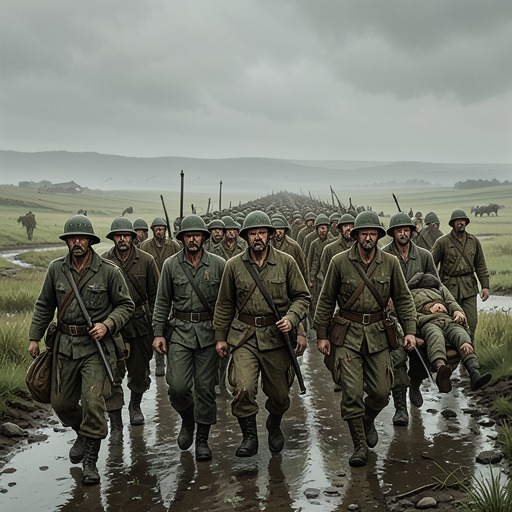
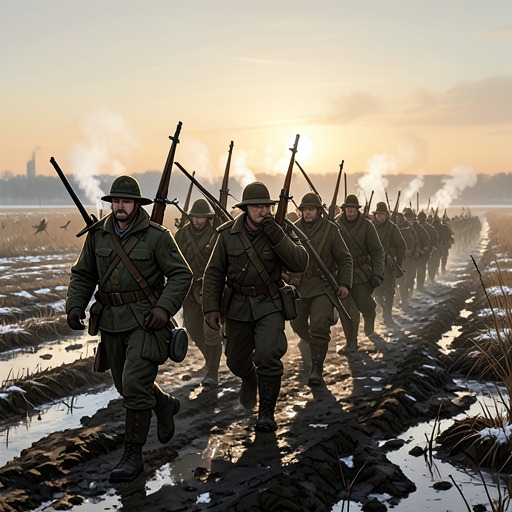
The same tension appears in the retreat along the Danube. Kutuzov’s army, pursued by a French force of one hundred thousand, was reduced to thirty-five thousand men, short of supplies, distrustful of its allies, and forced into rearguard actions merely to preserve its heavy equipment. The actions at Lambach, Amstetten, and Melk showed courage and endurance, yet their practical result was a still more rapid retreat. At Krems, however, the Russians halted after a fortnight, repulsed Mortier’s division, and captured banners, cannon, and two enemy generals. The victory did not erase exhaustion, inadequate clothing, casualties, abandoned sick and wounded, or overcrowded hospitals, but it restored confidence because the army had once again fought, held the field, and prevailed.
The Pavlograd Hussar Regiment demonstrates the cost of ignoring these conditions. Near a ruined German village in spring, thaw and impassable roads prevented provisions and fodder from arriving. Soldiers searched abandoned villages for potatoes, found almost nothing, and sometimes gave their last rations to inhabitants who were even poorer than themselves. Although the regiment had suffered only two men wounded in action, nearly half its men were lost to hunger and sickness. Feverish soldiers preferred to remain on duty rather than enter hospitals where death seemed certain. Such circumstances show that military spirit can sustain endurance, but they also show how hunger, disease, defective transport, and failed supply steadily consume the human substance on which that spirit depends.
Battlefield Manifestations
Prince Andrei Bolkonsky rejects the comparison between war and chess because battle contains no fixed values or unlimited time for reflection. A knight is always stronger than a pawn in chess, whereas a battalion may be stronger than a division in one situation and weaker than a company in another. No staff officer can know the relative strength of bodies of troops with certainty. For him, the outcome depends neither on position, equipment, nor numbers, but on the feeling present in the commander, in Captain Timokhin, and in every soldier.
His reflection turns the lesson of Austerlitz into a question of collective expectation. The Russian army lost partly because its men told themselves early that defeat was inevitable and wanted to leave the battlefield. At the coming battle, Prince Andrei insists, they will not repeat that judgment. The result will be determined by innumerable immediate chances: whether Russian or French soldiers run, whether particular men are killed, and whether one side fights more fiercely and spares itself less. Staff arrangements and personal advancement appear secondary beside the shared decision, made repeatedly in moments of danger, either to stand or to flee.
The everyday behavior of the troops before battle gives this principle a concrete form. Near the French lines, Russian soldiers build shelters, dry shirts and leg bands, mend boots, wait for porridge, and crowd around a keg of vodka. Their faces remain serene as if they were preparing for a peaceful encampment, although at least half of them may soon be left on the field. The scene is not simple cheerfulness: it is a collective composure that makes proximity to death bearable. Yet the same army enforces discipline through bodily punishment, as when soldiers beat a thief while a major repeats that a soldier must be honest, honorable, and brave. The spirit of the army is therefore formed through both shared courage and coercive regulation, not through an uncomplicated ideal of fellowship.
Kutuzov and the Transmission of Morale
Kutuzov understands the spirit of the army as the force that a commander can observe and guide but cannot manufacture by issuing perfect instructions. During the Battle of Borodino, he sits exhausted and gives few independent orders, listening less to the literal content of reports than to the expressions and tones of the men who bring them. Long experience has taught him that one man cannot direct hundreds of thousands struggling with death. The result of battle is not decided simply by the commander in chief, troop positions, cannon, or the number of dead, but by the army’s intangible collective force.
His leadership therefore consists in recognizing the moment at which the army’s feeling must be sustained. When the Russian forces retake the fleches but Prince Bagration is wounded, Kutuzov responds to the changing situation while remaining attentive to the army’s temper. After General Raevski reports that the troops are holding their ground and the French no longer attack, Kutuzov orders that the army attack the following day. The order spreads through an indefinable bond from one end of the army to the other, though the words become distorted as they pass from mouth to mouth. Its meaning survives because it expresses a feeling already present in the commander and in the soldiers.
The order comforts exhausted and wavering men because it confirms what they want to believe: that the army is still capable of action and that the next day will not be governed by retreat. Kutuzov’s authority is thus less a matter of imposing a design from above than of giving common feeling a recognizable direction. The transmission of the order is itself an image of military spirit: imperfectly verbal, collectively carried, and powerful because it is shared.
Collapse, Occupation, and Historical Significance
The French occupation of Moscow shows the reverse movement. The French entered the city in good marching order despite being tattered, hungry, worn out, and reduced to a third of their original number. Once the regiments dispersed into deserted houses, however, the army ceased to exist as an army. The soldiers became marauders, neither citizens nor soldiers, and their purpose changed from conquest to the possession and preservation of loot. Five weeks later they left Moscow as a mob carrying whatever seemed valuable or useful. The loss of military spirit appears here as a change in common purpose: discipline and collective direction give way to private acquisition.
The subsequent French retreat makes the process visible on a continental scale. From Moscow to Vyazma, the French force fell from seventy-three thousand men, excluding the Guards, to thirty-six thousand, although fewer than five thousand had died in battle. The army continued to melt away from Vyazma to Smolensk, the Berezina, and Vilna, while after Vyazma it abandoned its separate columns and huddled into one mass. Soldiers went off independently in search of food and escape from discipline, demonstrating that physical numbers without the readiness to fight and obey no longer constituted an army.
The concept also clarifies the novel’s broader rejection of great-man history. The beginning of the 1812 war is presented not as the simple product of Napoleon’s ambition, Emperor Alexander I’s firmness, diplomatic mistakes, or the Continental System, but as an immense convergence in which millions moved toward conflict and committed crimes they did not regard as crimes at the time. In the same way, battles cannot be adequately explained by attributing success to one commander’s genius. The spirit of the army relocates historical agency in the interaction between countless people, their material circumstances, their expectations, and their willingness to face danger. It is the novel’s name for the living, unstable force that makes an army fight—and for the absence of which an army, however numerous, finally ceases to be one.