Battle of Borodino
War and PeaceThe Battle of Borodino was fought on August 26, 1812, after the Battle of the Shevardino Redoubt on August 24 and a day without firing on August 25. Its decisive significance lies in the tension between its apparent military irrationality and its historical force: the Russian army lost roughly half its strength and left Moscow exposed, while the French army suffered immense losses and lengthened an already dangerous line of communication. The battle therefore appears not as the triumph of a single commander’s design, but as the violent convergence of retreat, exhaustion, geography, collective obedience, and forces that no individual could fully control.
Causes and Strategic Conditions
The battle emerged from the French invasion of Russia and the Russian retreat toward Moscow. The French advance had already carried Napoleon Bonaparte thirteen hundred miles into Russian territory, while the Russian army sought to preserve itself and block the road to the capital. The immediate strategic result of a Russian defeat was the destruction of the position protecting Moscow; the immediate result for the French was the further weakening of an army already endangered by distance and extended communications. In this sense, both sides entered the battle under conditions in which victory threatened to become another form of ruin.
The preceding loss of the Shevardino Redoubt fundamentally altered the battlefield. The redoubt had been the Russian left-flank position, and its loss forced the Russians on August 25 to bend that flank back and entrench hastily wherever a new position could be found. The resulting defenses were weak and unfinished. Russian commanders also failed fully to recognize that the whole field of the coming battle had shifted from right to left, so they retained an extended position from Novoe to Utitsa and had to move troops across the field during the fighting. The French consequently attacked the Russian left with approximately twice as many men as the defenders at the main point of contact.
The numerical situation made the decision to fight appear mathematically senseless. Before the battle, the Russian and French forces stood at approximately one hundred thousand and one hundred twenty thousand respectively, a ratio of about five to six. Afterward, the Russian force had fallen to little more than fifty thousand against roughly one hundred thousand French troops, a ratio of less than one to two. The narrative therefore rejects the conventional picture of a carefully chosen, entrenched position contested by armies only slightly unequal. Borodino was fought on an open, almost unfortified position under circumstances in which even preventing complete disintegration seemed nearly impossible.
Course of the Battle
The principal action occupied the roughly seven thousand feet between Borodino and Bagration's Fleches. Separate actions took place elsewhere: Russian cavalry under Uvarov demonstrated on the right, while Poniatowski collided with Tuchkov beyond Utitsa. These movements belonged to the battle’s wider field but remained detached and comparatively weak beside the central struggle.
The battle opened with a cannonade from several hundred guns. Once the field filled with smoke, Campan's and Dessaix's divisions advanced from the French right, while Murat's troops moved against Borodino from the French left. From the Shevardino Redoubt, where Napoleon Bonaparte observed, the Fleches lay two thirds of a mile away and Borodino more than a mile away in a straight line. Smoke and mist made the battlefield unreadable: advancing troops disappeared into a hollow, and only uncertain black shapes or flashes of bayonets could sometimes be seen. Even the emperor’s elevated viewpoint could not turn the battle into a transparent sequence of commands and results.
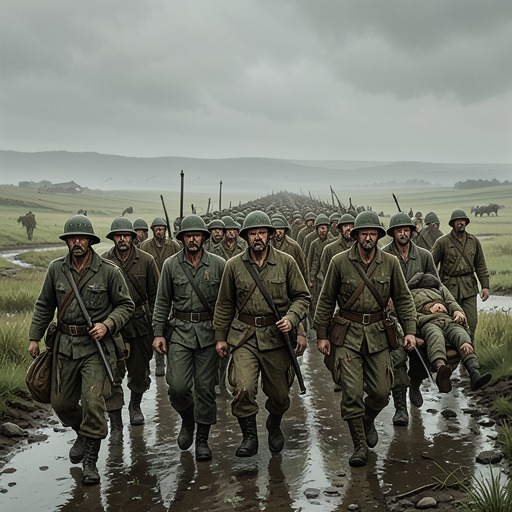
The fighting continued through exhaustion rather than through a clear decision. Men on both sides were worn down by hunger and lack of rest; the artillery suffered especially heavily, with only one artilleryman in three surviving. Cannon crews nevertheless continued to bring up charges, load, aim, and fire while stumbling through fatigue and blood. The battle’s mechanical repetition makes violence strange again: what might be described from a distance as an operation directed by strategy is experienced on the ground as bodies laboring under an incomprehensible power.
By evening, the men of both armies had begun to feel the horror of their work. They questioned the purpose of killing and dying, and many might have abandoned the field if that impulse had prevailed. Yet the firing continued. The Russian and French armies each appeared to need only one final effort to destroy the other, but neither possessed the strength to make it. The battle’s flame consequently burned out rather than ending in a clean tactical resolution.
Losses and Immediate Consequences
The Russians still blocked the road to Moscow at the end of the day, as they had at the beginning, but their army had lost half its men. The French had not achieved the annihilation of their opponent, nor had they secured a result capable of ending the campaign. Borodino thus produced a paradoxical outcome: the Russian army was gravely weakened and Moscow was brought nearer to destruction, while the French army was also brought nearer to the destruction of its entire invasion force.
The battle’s consequences became clearer in the later retreat. The French army’s advance had already depended on supplies, transport, and the ability to maintain cohesion across extraordinary distances. During the subsequent flight from Moscow, the army’s losses continued independently of any single explanation such as cold, pursuit, or a particular engagement. From Moscow to Vyazma, the French force of seventy-three thousand, excluding the Guards, fell to thirty-six thousand, although no more than five thousand had been lost in battle. The later disintegration therefore illuminates what Borodino had begun: battlefield casualties mattered, but exhaustion, hunger, movement, and the collapse of organization were equally decisive.
The wider war likewise exposes the limits of a purely heroic account. In the 1805 campaign, Russian forces under Mikhail Kutuzov had retreated along the Danube while pursued by a French army of one hundred thousand; after actions at Lambach, Amstetten, and Melk, their purpose was largely to preserve the army and its heavy equipment. At Braunau, a regiment could present two thousand immaculate men after a twenty-mile march only because the soldiers had spent the night cleaning and repairing their equipment, even though more than half their boots were already in holes after a march of about seven hundred miles. Such details provide the material context in which later battles must be understood: armies do not fight as abstract numbers, but as bodies dependent on footwear, food, roads, transport, and rest.
Historical Interpretation
The narrative refuses to assign Borodino’s meaning to Napoleon Bonaparte or Mikhail Kutuzov alone. It treats the battle as part of a broader criticism of historical explanation, according to which historians seize upon the most visible person and call that person the cause. The same error appears in accounts of the 1812 war that attribute events to Napoleon’s ambition, Alexander’s firmness, the Continental System, diplomatic mistakes, or a conveniently phrased memorandum. Such explanations convert a vast convergence of conditions into a single intelligible intention.
The argument is not that commanders had no commands or that decisions were irrelevant. It is that commands cannot produce events unless other conditions already make those events possible. The movement of historical persons is compared to a ship and the wave before it: the wave appears to anticipate and govern the vessel, yet its motion is occasioned by the ship’s movement. In the same way, commands seem to explain a battle when examined after the fact, while closer attention to the continuity of events and the connection between leaders and masses shows that commanders and their orders are themselves dependent on the movement of the historical whole.
Borodino is therefore a study in historical defamiliarization. The familiar image of a great battle—genius directing formations toward a calculable victory—is made strange by smoke, mistaken positions, exhausted bodies, inadequate defenses, and soldiers who continue firing after they have lost the will to kill. The battle’s grandeur is not denied, but relocated. Its significance belongs less to a commander’s brilliance than to the collective force of armies and populations, to the material conditions that constrain them, and to the obscure necessity produced by millions of separate actions.
Place in the War of 1812
Borodino did not end the war. It led toward the abandonment and burning of Moscow, an outcome presented as inevitable after the battle and as part of a pattern already visible in Russian towns and villages beginning with Smolensk. Wealthier inhabitants departed with what they could carry, while poorer residents remained and burned or destroyed what was left. The destruction of the capital was thus not reduced to the initiative of Count Fyodor Rostopchin; it arose from a broader social response to invasion and occupation.
For the French, entering Moscow after Borodino offered no stable culmination. The occupation was followed by the city’s destruction and then by the French retreat, during which the army’s movement changed from organized columns to a single huddled mass. From the onset of frost after October 28, soldiers froze, burned themselves at campfires, or abandoned their standards in search of food and escape from discipline. Borodino’s apparent indecision consequently became a turning point in a campaign whose deeper result was the progressive dissolution of the invading army.
The Battle of Borodino thus stands between two forms of historical illusion. Before it, strategic reasoning suggests that neither side should accept the battle; afterward, retrospective history turns the battle into a necessary step toward outcomes that had not been fully visible to those who fought. The event matters precisely because it resists both explanations. It was a military encounter with concrete dates, positions, guns, losses, and movements, but also an emblem of the larger principle that history is made through the interdependence of individual decisions and mass action rather than through the will of one celebrated man.