Battle of Enns crossing
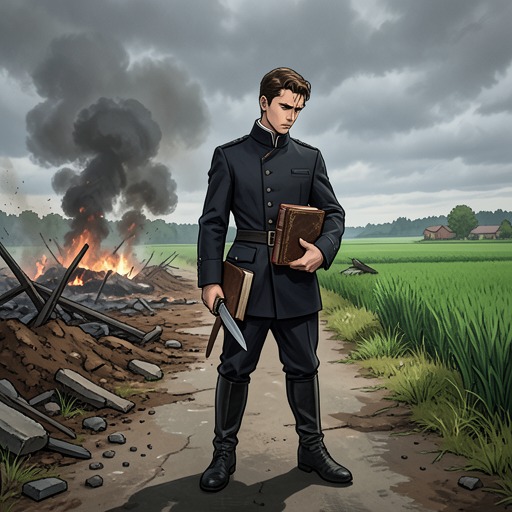
War and PeaceThe Battle of Enns crossing is the October 23, 1805 passage of the Russian army across the Enns River during Mikhail Kutuzov’s withdrawal toward Vienna. Its decisive significance lies in the contrast between the immense apparatus of an army—baggage trains, artillery, columns, bridges, horses, and rear guards—and the vulnerable individuals caught inside it. The crossing is not presented as a clean triumph or a commander’s self-contained achievement: it is a pressured movement sustained by discipline, transport, sacrifice, and the willingness of a rearguard to remain exposed while the main body escapes.
Retreat and Strategic Background
Mikhail Kutuzov had fallen back toward Vienna, destroying the bridges over the Inn at Braunau and the Traun near Linz. The Russian army was being pursued by a French army of about one hundred thousand men under Napoleon Bonaparte, while Kutuzov commanded roughly thirty-five thousand exhausted troops. The actions at Lambach, Amstetten, and Melk had shown Russian courage and endurance, but their practical result was a still more rapid retreat. The Russian command therefore no longer aimed at defending Vienna or carrying out the offensive plan prepared by the Austrian Hofkriegsrat; its narrower and urgent objective was to join the forces advancing from Russia without suffering the destruction that had overtaken Mack at Ulm.
The crossing at Enns belongs to this larger pattern of withdrawal. The river was both a physical obstacle and a temporary line of separation between the retreating army and its pursuers. On October 23, Russian baggage, artillery, and columns of troops streamed through Enns on both sides of the bridge. The movement had the appearance of an immense administrative operation, yet every wagon and gun had to pass through a confined point while French forces approached. The army’s survival depended less on a spectacular offensive than on the successful coordination of roads, bridges, vehicles, animals, and time.
The River Crossing
The scene is set on a warm, rainy autumn day. From the heights where Russian batteries guarded the bridge, the landscape repeatedly disappeared behind slanting rain and then emerged in sudden sunlight: the small town with its white, red-roofed houses, its cathedral, the bridge crowded with Russian troops, and the meeting of the Enns and the Danube with its vessels, island, castle, pine-covered bank, convent turrets, and blue gorges. This shifting visibility gives the crossing an unstable character. The landscape seems peaceful and almost enchanted, while enemy horse patrols can already be discerned in the distance.
The army’s movement is therefore framed by a tension between stillness and pressure. Officers near the field guns watched the country through field glasses while others rested on gun carriages, sharing pies and doppelkummel on wet grass. Such ordinary gestures coexist with the knowledge that the bridge is the army’s vulnerable passageway. The food, artillery, baggage, and men are not incidental details: they show the material body of the army being squeezed through a narrow route under threat.
The Rearguard and First Contact
The last infantry crossed hurriedly, compressing as it approached the bridge. When the crush eased and the baggage wagons had passed, only Vasily Denisov’s hussar squadron remained on the farther side, facing the French. The enemy appeared on the crest of the high ground in blue uniforms, and the Cossack scouts began retiring at a trot. Though the hussars tried to talk of other matters and look elsewhere, their attention remained fixed on the patches of troops appearing along the skyline.
Only scattered skirmishers stood between the squadron and the French. About seven hundred yards of empty ground separated the hostile forces, and the narrative turns that distance into a boundary between life and death. The men fear what lies beyond it and simultaneously desire to know it, even though crossing the boundary means entering uncertainty, suffering, and death. The battlefield thus becomes more than a military position: it is a perceptual threshold that the soldiers can see clearly but cannot understand until they enter it.
The hussars set the bridge on fire and withdrew toward their horses while the French batteries fired upon them. The French had time to discharge three rounds of grapeshot. Two shots went too high; the last struck a group of hussars and knocked three men down. The action’s immediate tactical purpose was to deny the bridge and cover the Russian withdrawal, but its cost was measured in bodies rather than in abstract movements on a map.
Rostov’s Encounter with War
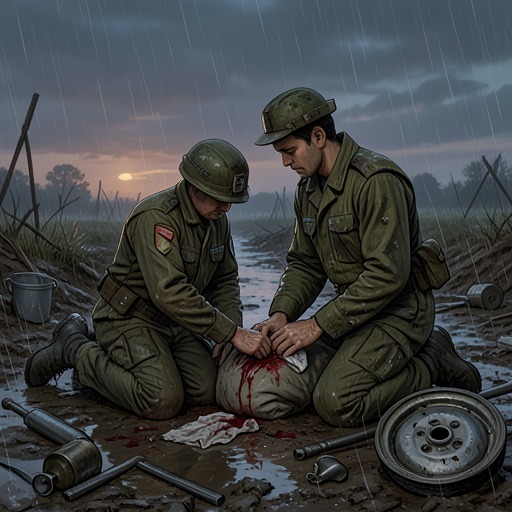
Nikolai Rostov, delayed on the bridge by his conflict with Bogdanich, did not find the battle he had imagined. There was no isolated enemy for him to cut down, and he lacked the burning straw needed to help ignite the bridge. Instead, he heard grapeshot rattling across the bridge, saw the nearest hussar fall against the rails, and watched four men lift the wounded soldier onto a stretcher despite his cries to be left alone.
Rostov then turned away and looked toward the Danube, the sky, the setting sun, the distant mountains, the nunnery, and the pine forests. The calm beauty of the scene becomes a sharp counter-image to the groans, suffering, fear, and confusion around him. His imagined war of action and personal courage gives way to the reality of helplessness: the soldier is wounded, the bridge is under fire, and Rostov can do little beyond witness the consequences. The crossing thereby defamiliarizes violence. Instead of allowing battle to become an automatic spectacle of commands and valor, it slows perception until the wounded body and the peaceful landscape occupy the same field of attention.
Nesvitski voices the moral recoil implicit in this spectacle when he says that, if he were Tsar, he would never go to war. His reaction punctures the official language of declarations and alliances that had preceded the campaign. The crossing makes visible the distance between political explanations and physical experience: proclamations speak of imperial safety and the sanctity of alliances, while grapeshot knocks men down on a bridge.
Consequences and Wider Significance
The Enns crossing is part of the Russian army’s retreat rather than an isolated victory. The pursuit by Napoleon’s forces, the loss of Austrian support after Ulm, inadequate supplies, exhaustion, and the need to preserve heavy equipment all determine the form of the campaign. The Russian army repeatedly fights only as far as necessary to withdraw without losing its matériel. In this context, the bridge action succeeds insofar as the main body passes and the rearguard buys time, but it cannot reverse the strategic retreat.
The same material pressures recur later in the campaign. The Pavlograd Hussar Regiment, which had exchanged fire with the enemy and once captured Marshal Oudinot’s carriages, later lost nearly half its men to hunger and sickness despite having only two men wounded in action. In hospitals, soldiers with fever or swelling from bad food sometimes preferred to remain on duty, because death seemed almost certain there. These later conditions clarify what the Enns crossing already implies: armies are weakened not only by battlefield casualties but also by broken supply systems, poor roads, inadequate clothing, exhausted animals, and prolonged exposure.
The event also anticipates the book’s larger treatment of war. The 1812 invasion begins with millions crossing the Russian frontier and producing crimes that contemporaries do not regard as crimes, while the French retreat later reduces a force of seventy-three thousand men to thirty-six thousand between Moscow and Vyazma, with no more than five thousand lost in battle. The Enns crossing belongs to the same anti-heroic logic. Its real subject is not the isolated brilliance of a leader but the collective mechanics of movement and survival, and the human price paid whenever an army must pass through a narrowing space while another army closes in.