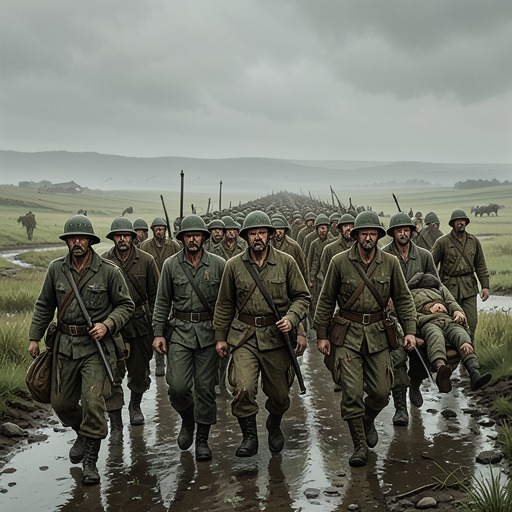
Battle of Smolensk (1812)
War and PeaceThe Battle of Smolensk (1812) was fought when the Russian army’s retreat became impossible to continue without a major defensive action. The engagement did not save the city, but it preserved the Russian lines of communication long enough for the retreat to proceed, while the abandonment and burning of Smolensk transformed a military withdrawal into a broader social and patriotic resistance to the French invasion of Russia.
Causes and Strategic Circumstances
The battle arose from the failure of the Russian command to establish a secure defensive position before the French arrived. Disputes and intrigues divided the commanders, while Russian forces searched for the French after losing contact with them. A general who opposed Mikhail Barclay de Tolly condemned a proposed battlefield without having inspected it, and the preparations made to fight before Smolensk were consequently overtaken by events. The French reached the city after encountering Neverovski’s division, forcing the Russians to fight an engagement that had not been arranged on their preferred terms.
The wider military situation made the battle a struggle for survival rather than a bid for decisive victory. In 1812, millions of men had moved toward the Russian frontier, and the crossing of that frontier by the forces of Western Europe on June 12 began a war whose scale exceeded the explanations offered by diplomatic histories. The Russian army’s movements were shaped by exhaustion, uncertainty, communications, and the need to avoid being destroyed while withdrawing. Smolensk therefore became necessary because the army had to protect its route and preserve its ability to continue the campaign.
Course and Immediate Result
The battle was fought unexpectedly after the French reached the walls of Smolensk. Thousands were killed on both sides. The Russian army abandoned the city despite the wishes of Emperor Alexander I and of the Russian people, a decision that revealed the distance between patriotic expectations and the practical demands of retreat. The engagement did not produce a clear tactical triumph for the defenders: Napoleon Bonaparte advanced farther, while the Russian army continued to withdraw.
Yet the abandonment was not equivalent to simple surrender. The battle had served the immediate military purpose of saving the Russian lines of communication. Its result belonged to the logic of a defensive retreat, in which a position was held only long enough to prevent the army from being cut off or stripped of its heavy equipment. The Russian command’s choices remained bitterly contested, but the retreat itself eventually led Napoleon’s army toward the conditions that would contribute to its destruction.
Smolensk and the Civilian Population
Smolensk was burned by its own inhabitants, who had been misled by their governor. The ruined population then moved toward Moscow, carrying not only the losses produced by evacuation but also an intensified hatred of the enemy. The city’s destruction thus extended the battle beyond the armies: civilians became participants in the retreat, abandoning property, witnessing the collapse of local security, and turning devastation into a form of resistance.
The experience at Smolensk anticipated the wider social pattern of the campaign. As the French approached Russian towns and villages, wealthy inhabitants generally withdrew with what they could carry, while poorer people remained and destroyed what was left. This conduct was presented not as a theatrical patriotic gesture but as an instinctive and collective response to occupation. Smolensk became an example for other Russians because its inhabitants’ losses and flight helped convert military defeat into popular hostility toward the invader.
The Battle Seen from the Road
The battle’s consequences are also shown through Yakov Alpatych’s arrival at Smolensk on August 4. He encountered baggage trains and troops, heard distant firing, and was struck most forcefully not by the cannonade but by soldiers mowing down a splendid field of oats for fodder. His attention remained fixed on Prince Nikolai Bolkonsky’s orders, yet the ruined harvest revealed how military necessity was consuming the ordinary resources on which civilian life depended.
At Ferapontov’s inn, the city’s impending evacuation became unmistakable. Carts loaded with household goods moved through the streets, women lamented their departure, and Ferapontov angrily resisted his wife’s pleas to leave with the children. When Alpatych reached the governor’s office, he found officials frightened and helpless as the firing drew nearer. A written assurance from Mikhail Barclay de Tolly still declared that Smolensk was not in danger and that the forces of Barclay and Prince Pyotr Bagration would unite to defend the province, but the surrounding flight and gunfire made the document’s confidence untenable.
Command, Loss, and Historical Significance
Prince Pyotr Bagration’s subsequent letter expressed the army’s fury at the abandonment. He claimed that with fifteen thousand men he had held the enemy for thirty-five hours, argued that Smolensk could have been defended longer, and condemned the retreat as disgraceful. He estimated Russian losses at roughly four thousand while insisting that the French had suffered heavily, and he warned that continued divided command and further retreats might bring the enemy to Moscow. His anger shows that Smolensk was not remembered merely as an unavoidable maneuver: it became a crisis of military authority, national honor, and confidence in the leadership.
The battle’s larger meaning lies in the contrast between immediate appearance and historical consequence. At the time, the Russian army seemed to be retreating from one failure to another: Smolensk was abandoned, the city was burned, and Napoleon advanced. Later developments made the retreat appear to have produced the very circumstances that destroyed the French army. The Battle of Smolensk (1812) therefore stands as a decisive example of the novel’s anti-heroic account of war: no single commander can explain the outcome, and the battle’s significance emerges from the interaction of military necessity, exhausted logistics, divided authority, civilian evacuation, and the growing force of popular resistance.