Borodino
War and PeaceBorodino is the open battlefield on which the Battle of Borodino was fought on August 26, 1812, after the Battle of the Shevardino Redoubt two days earlier. Its decisive significance lies in the gap between tactical appearance and historical consequence. The French gained the field in a battle that Napoleon Bonaparte offered and Mikhail Kutuzov accepted, but the engagement brought the French army nearer to ruin while leaving Russia unconquered. The landscape thus becomes the clearest setting for the novel’s challenge to heroic history: neither the battlefield nor the decisions attributed to great commanders can explain the fate of nations by themselves.
Setting and Approach
Borodino stood within the Russian countryside through which the armies had advanced toward Moscow. The battle of August 26 was preceded by the fighting at the Shevardino Redoubt on August 24 and by a day on August 25 when neither side fired a shot. Pierre Bezukhov traveled toward the army through Perkhushkovo after hearing that a great battle had taken place there; the earth had trembled from the cannonade, yet no one could tell him who had won. Approaching Mozhaysk, he found soldiers, Cossacks, wagons, caissons, and cannon everywhere, and the deepening sea of troops awakened in him a new desire to sacrifice the comforts of life, wealth, and even life itself for something he could not define.
The principal action occupied the roughly seven thousand feet between Borodino and Bagration's Fleches. Other operations took place beyond this central space: Russian cavalry under Uvarov demonstrated at midday, while Poniatowski collided with Tuchkov beyond Utitsa. These actions were detached and comparatively weak beside the struggle in the center. The battlefield's importance therefore comes not from a single uniform line of combat but from the concentration of the day's main violence in a limited, exposed area visible in part from both armies.
Course of the Battle
The fighting began with cannon fire from several hundred guns. Once smoke covered the field, Campan's and Dessaix's divisions advanced from the French right, while Murat's troops approached Borodino from the French left. From the Shevardino Redoubt, where Napoleon was standing, the fleches were two thirds of a mile away and Borodino more than a mile away as the crow flies. Smoke mingled with mist and concealed the ground, so that even Napoleon could not see the battle clearly.
The advancing soldiers of Dessaix's division disappeared into the hollow between the French position and the fleches. After they descended, the smoke of cannon and musketry became so dense that the whole approach vanished. From the redoubt, observers could catch only intermittent glimpses of something black, probably men, and occasional flashes of bayonets. They could not determine whether the figures were moving or standing still, or whether they belonged to the French or the Russians. The scene dismantles the image of the commander surveying a battlefield as a readable design: Napoleon looked toward the fleches with the sun shining directly into his face, while smoke made the decisive action inaccessible to his vision.
The battle was fought under conditions in which its apparent logic was already contradicted by its likely results. For Russia, the immediate consequence was to bring the army nearer to the destruction of Moscow, the loss most feared by the Russians. For France, the battle brought the army nearer to the destruction of the whole invading force, which the French had even more reason to fear. Before the engagement, the Russian strength was about one hundred thousand against one hundred and twenty thousand French; afterward, the Russian army had little more than fifty thousand against roughly one hundred thousand French. The Russian army had therefore been reduced in proportion from about five-sixths of the French strength to little more than one-half.
The Battlefield Aftermath
The physical result of Borodino was not a clean triumph but a field transformed by mass death. Several tens of thousands of dead lay in different postures and uniforms across fields and meadows belonging to the Davydov family and to crown serfs. These were the same lands where, for centuries, peasants from Borodino, Gorki, Shevardino, and Semenovsk had harvested crops and pastured cattle. At the dressing stations, blood soaked the grass and earth for an area of about three acres. The ordinary agricultural landscape had become a military cemetery without ceasing to be identifiable as worked land.
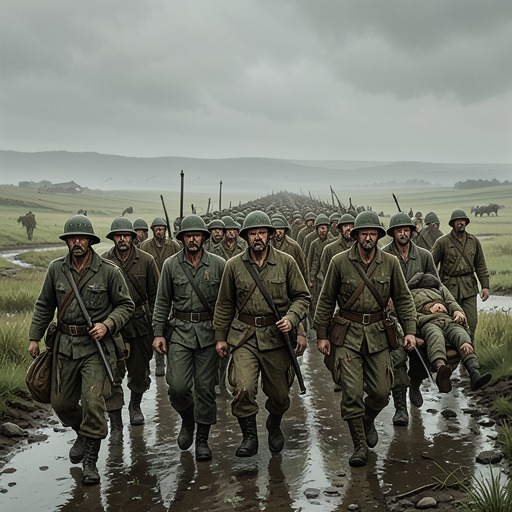
The movement across the field after the fighting was equally divided between persistence and collapse. Wounded and unwounded men dragged themselves toward Mozhaysk from one army and toward Valuevo from the other; exhausted and hungry soldiers moved forward under their officers; others remained where they were and continued firing. The morning field, previously bright with bayonets and clouds of smoke under the sun, was covered by damp mist and gun smoke, carrying the sharp smell of saltpeter and blood. Borodino therefore records not only the clash of formations but the exhaustion of the human bodies that had sustained them.
From Victory to Ruin
The French victory at Borodino was followed by the occupation and destruction of Moscow, but not by the conquest of Russia. After Moscow was taken, there was no further general engagement, nor any battle serious enough to account conventionally for the destruction of Napoleon's army. Yet the Grande Armée of six hundred thousand eventually ceased to exist, followed by the collapse of Napoleonic France's power. The Russian state did not disappear when its army lost the field and its capital was occupied; the invading army disappeared instead.
This reversal makes Borodino a test case against the conventional rule that victory in war increases the rights and political strength of the victor while defeat subjugates the defeated nation. The battlefield seemed to confirm the rule, but the campaign that followed disproved it. The French army's later flight from Moscow became a process of disintegration: from Moscow to Vyazma, its seventy-three thousand men, excluding the Guards, were reduced to thirty-six thousand, with no more than five thousand lost in battle. The army continued melting away from Vyazma to Smolensk, from Smolensk to the Berezina, and from the Berezina to Vilna, so that Borodino's apparent outcome became the opening condition of a wider military and political failure.
Historical and Narrative Significance
The novel treats the battle as an event that cannot be explained by the intentions of Napoleon Bonaparte or Kutuzov alone. If reason had governed their conduct, Napoleon should have recognized that an advance of thirteen hundred miles followed by a battle risking a quarter of his army led toward destruction, while Kutuzov should have understood that accepting battle risked Moscow. Nevertheless, Napoleon gave the battle and Kutuzov accepted it. The battlefield exposes the weakness of explanations that convert decisions made amid uncertainty into deliberate designs reconstructed after the fact.
Borodino also embodies the novel's broader account of history as the product of innumerable human actions rather than the will of a single hero. Historians may attribute the battle's decisions and the later Russian flank movement toward the Tarutino camp to individual genius, but the narrative insists that the actions of prominent figures are continually controlled by the mass activity of those who take part in events. The armies' movement, exhaustion, supply difficulties, fear, and persistence matter as much as formal commands. Borodino is consequently both a place and an argument: a visible field where military glory is overwhelmed by blood, and where a tactical victory fails to become political conquest.