Braunau
War and PeaceBraunau is an Austrian town occupied by the Russian army in October 1805 and the headquarters of Mikhail Kutuzov. It functions less as a secure base than as a revealing military threshold: Russian regiments arrive after exhausting marches, local inhabitants bear the burden of quartering them, and the army’s outward discipline conceals shortages that will shape the campaign.
Setting and Military Function
Braunau lies within the Archduchy of Austria, surrounded by fruit gardens, stone fences, tiled roofs, and distant hills rather than the familiar landscape of Russia. Yet the Russian regiment assembled outside the town resembles a regiment preparing for inspection anywhere in Russia. The town therefore joins foreign geography to Russian military routine, making the army’s movement westward visible without dissolving its institutional identity.
In October 1805, Braunau serves as Kutuzov’s headquarters while additional regiments newly arriving from Russia settle in the surrounding villages and towns. Their presence burdens the inhabitants among whom they are quartered. The location is consequently both an operational center and a point where the costs of mobilization fall directly upon a civilian population that is curious about, but separate from, the foreign soldiers.
The Inspection and the Hidden Cost of Order
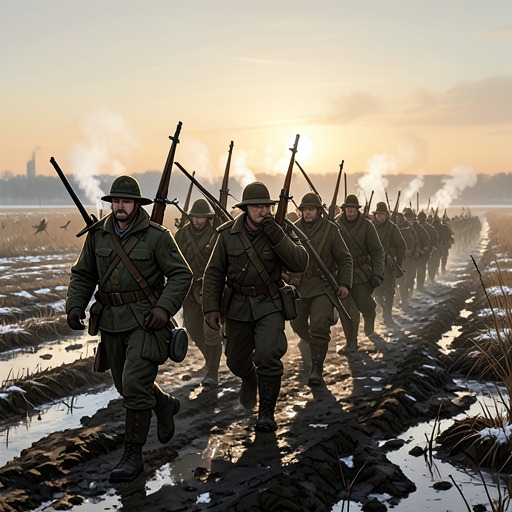
One infantry regiment halted half a mile from Braunau on October 11, after a twenty-mile march, expecting inspection by the commander in chief. An ambiguous order led its officers to decide that the regiment should appear in parade order. The soldiers spent the entire night mending and cleaning instead of sleeping, while adjutants and company commanders calculated arrangements. By morning, two thousand men stood in exact formation, each knowing his place and duty, with buttons and straps in order and the prescribed articles in their knapsacks, including the soldiers’ customary reference to an “awl, soap, and all.”
The display was impressive but materially deceptive. More than half the soldiers’ boots were in holes, and the regiment had marched approximately seven hundred miles without receiving replacements from the Austrian commissariat, despite repeated demands. The army’s apparent readiness thus rests on exhaustion, sleepless labor, and meticulous maintenance performed over a damaged material foundation.
The deception is exposed when an aide-de-camp arrives to clarify Kutuzov’s order. He wants to see the regiment exactly as it was on the march: in greatcoats, carrying packs, and without preparation. Kutuzov intends to use the regiment’s poor condition as an argument against proposals from a member of the Hofkriegsrat that he join the forces of the Archduke Ferdinand and Mack. The worse the troops look, the stronger his case will be. The regimental commander’s crestfallen reaction shows how completely the labor of presenting military order has been overturned by the commander in chief’s larger purpose.
When Kutuzov finally arrives in a light blue Viennese caleche with an Austrian general beside him, the regiment presents arms in a silence broken by its formal greeting. Kutuzov walks between the ranks, and the regiment is judged to be in splendid condition compared with other units that reached Braunau, with only 217 sick and stragglers. The boots remain the conspicuous exception. Braunau thus stages a central contradiction of military organization: discipline can arrange bodies, clothing, equipment, and gestures, but it cannot manufacture supplies that have not been issued.
From Braunau to Retreat
Braunau is also the point from which the wider strategic crisis becomes clear. Pursued by a French army of 100,000 men under Napoleon Bonaparte, Kutuzov commands only about 35,000 Russians. The army faces an unfriendly population, unreliable allies, shortages, and conditions unlike those anticipated by its planners. After actions at Lambach, Amstetten, and Melk, the Russians retreat, fighting rearguard actions only when necessary to preserve their heavy equipment.
The Austrian troops that had escaped capture at Ulm and joined Kutuzov at Braunau later separate from him, leaving the Russian commander with weak and exhausted forces. The defense of Vienna is abandoned as an objective, and the immediate aim becomes a junction with reinforcements advancing from Russia without allowing the army to be destroyed as Mack’s force had been at Ulm. Braunau therefore marks not a launching point for a confident offensive but the beginning of a retreat governed by roads, equipment, supplies, and the preservation of military cohesion.
Braunau in the Novel’s Material History of War
The town’s significance extends beyond its named military headquarters. The Russian army’s condition at Braunau anticipates the novel’s recurring emphasis on logistics and bodily endurance. Later campaigns show troops searching ruined villages for potatoes, losing men to hunger and sickness, and continuing on duty because hospitals seem more dangerous than the front. The contrast clarifies what the inspection scene has already demonstrated: the army’s fate is determined not only by orders or strategic theories but by boots, food, roads, transport, shelter, and the capacity of exhausted bodies to continue moving.
Braunau also establishes the novel’s resistance to heroic explanations of war. Kutuzov’s inspection is outwardly ceremonial, yet its practical purpose is argumentative and logistical: the commander uses visible weakness to resist an ill-advised junction. The regiment’s splendid appearance is produced by subordinate zeal, while the commander in chief understands that the unvarnished marching condition is more politically and militarily truthful. Braunau consequently becomes a compact image of the campaign itself, where disciplined forms, foreign alliances, and grand plans are repeatedly tested against the stubborn realities of fatigue, scarcity, and distance.