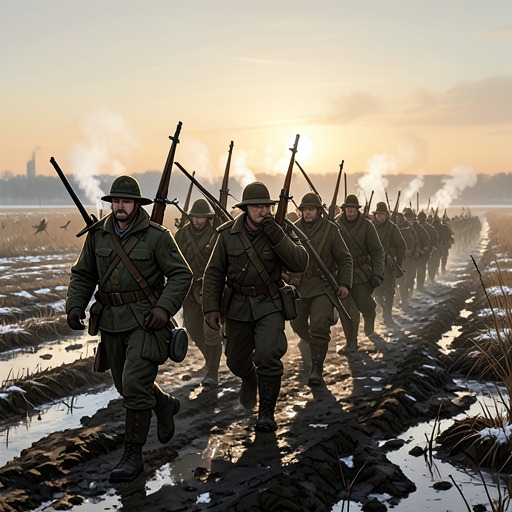
Captain Timokhin
War and PeaceCaptain Timokhin is a Russian infantry officer first introduced during the inspection of a regiment at Braunau in October 1805. His importance lies less in rank or rhetorical brilliance than in the way the narrative repeatedly places him at the meeting point of military discipline, personal vulnerability, and practical courage. He appears awkward before authority, yet under fire he preserves the order that others lose; the same officer who seems ridiculous in parade becomes one of the figures who prevents a battlefield panic from becoming a rout.
Identity and Introduction
Timokhin commands the third company of a regiment arriving after a march of roughly twenty miles. The regiment has spent the night cleaning itself for inspection, and its two thousand men present an immaculate appearance despite having marched some seven hundred miles and despite the fact that more than half their boots are worn through because the Austrian commissariat has failed to issue replacements. In this setting, Timokhin is summoned when the regimental commander notices that one of his soldiers is wearing a bluish greatcoat unlike the rest. Timokhin’s arrival exposes the human cost beneath the regiment’s polished surface. A middle-aged man who is unaccustomed to running, he trots awkwardly toward the general, panting, with the uneasiness of a schoolboy called upon to repeat an unlearned lesson. Red spots appear on his nose, his mouth twitches, and his intemperance is visible in his face. The regimental commander rebukes him for allowing a soldier to appear in a “fancy” coat and threatens to teach him how men should be dressed for parade. Timokhin can offer little resistance: his eyes remain fixed on his superior, and his embarrassment becomes part of the spectacle of discipline.
Kutuzov’s Recognition
Mikhail Kutuzov sees more in Timokhin than the parade error. When the commander in chief reaches the third company, he recognizes the red-nosed captain and addresses him by name. Timokhin draws himself up with such exaggerated force that he seems unable to sustain the posture while Kutuzov continues looking at him. Kutuzov, understanding the situation, turns away with a barely perceptible smile and calls him another “Ismail comrade,” recalling a brave officer. The exchange changes Timokhin’s position without pretending that his weaknesses do not exist. Kutuzov asks whether the captain satisfies the regimental commander, who immediately answers that he is highly satisfied. Kutuzov then remarks that everyone has weaknesses and recalls Timokhin’s former predilection for Bacchus. His response is neither sentimental absolution nor formal condemnation. By recognizing the captain’s drinking and awkwardness while still affirming his value, Kutuzov separates personal imperfection from military worth. Timokhin is not made admirable by becoming flawless; he is understood as a flawed, ordinary man whose courage remains real.
Courage in the Battle
Timokhin’s decisive proof comes during a battle in which the Russian left flank begins to collapse. The regimental commander gallops through bullets to discover what has happened and finds soldiers running downhill, firing into the air, talking, and disregarding orders. His furious shouts and saber have no effect. The moment becomes a crisis of morale: the soldiers may either recover the authority of command or continue their flight, and the battle appears nearly lost. The reversal comes from Timokhin’s company, which alone has maintained its order in the wood. Hidden in a ditch, the company waits until the French attack and then strikes unexpectedly. Timokhin, armed only with a sword, rushes at the enemy with a desperate cry and a mad, drunken determination. The French, taken by surprise, throw down their muskets and flee. His action restores the fugitives’ confidence, enables the battalions to reform, and temporarily repulses the force that had nearly cut the Russian left flank in two. Timokhin’s conduct is paired with that of Fyodor Dolokhov, who runs beside him, kills a Frenchman at close quarters, and seizes a surrendering French officer. Yet the narrative gives Timokhin a distinctive function: Dolokhov’s act produces trophies and a claim to recognition, while Timokhin’s company restores collective order. His courage is therefore both physical and structural. He does not merely perform an individual feat; he preserves a formation when formal authority has failed.
Relations with Command and the Wounded
After the fight, Timokhin’s company helps make possible the return of the fugitives and the re-formation of the battalions. The episode also clarifies why his earlier humiliation before the regimental commander should not be mistaken for incompetence. The captain who cannot comfortably answer for a blue greatcoat is the captain whose men remain steady in the wood when the surrounding force panics. Timokhin later encounters Prince Andrei Bolkonsky near the battlefield’s medical station. Prince Andrei has been struck in the abdomen and is being carried by peasant militiamen toward dressing tents crowded with bloodstained, groaning, and delirious wounded men. Timokhin runs up to the stretcher and addresses him as “Your excellency! Eh, Prince!” Prince Andrei opens his eyes and looks toward the familiar voice before his eyelids droop again. The brief exchange carries the memory of shared military experience into a scene where rank is overshadowed by injury and mortality. Timokhin’s relation to authority is consequently double. He is anxious beneath the gaze of his regimental commander, but he is also recognized by Kutuzov and remembered by Prince Andrei as a brave officer. He can be made small by parade discipline, yet his battlefield conduct gives him a value that ceremony cannot manufacture.
Narrative Role and Significance
Timokhin helps dismantle the distinction between outward military correctness and genuine military effectiveness. The Braunau inspection prizes spotless uniforms, correct straps, complete knapsacks, and uniform appearance, while the soldiers’ ruined boots reveal the material neglect concealed by the display. Timokhin’s blue-coated soldier makes that contradiction visible, and Timokhin himself becomes its human counterpart: outwardly awkward and vulnerable to reprimand, inwardly capable of sustaining his men under extreme pressure. His story also belongs to the novel’s anti-heroic account of war. Russian troops repeatedly endure exhaustion, inadequate clothing, hunger, sickness, and confused orders; in the Pavlograd regiment, nearly half the men are lost to hunger and disease despite only two being wounded in action. Against this background, Timokhin’s courage does not appear as isolated glamour. It is an eruption of collective endurance from within a damaged military system. The French are repulsed not because a commander’s plan proceeds perfectly, but because one company remains ordered in a ditch and its captain acts at the instant when panic seems decisive. Timokhin therefore stands for a form of heroism that is socially modest, physically immediate, and inseparable from the men around him. His repeated contrast with parade authority, his recognition by Kutuzov, his charge with only a sword, and his later concern for the wounded Prince Andrei make him a compact embodiment of the novel’s belief that military history is carried not only by commanders and plans but by ordinary people whose courage appears in moments that official systems neither predict nor fully understand.