Council of Fili
War and PeaceThe Council of Fili is the council of war at which Kutuzov formally ordered the Russian army to retreat and leave Moscow undefended. Convened in a peasant hut after the campaign had already made the city’s abandonment increasingly inevitable, it turns a strategic necessity into an explicit command: Russia must risk losing its ancient capital or preserve the army with which the war can continue. The council’s drama comes from the gap between the language of patriotic defense and the material conditions that have already narrowed the available choices.
Causes and Military Background
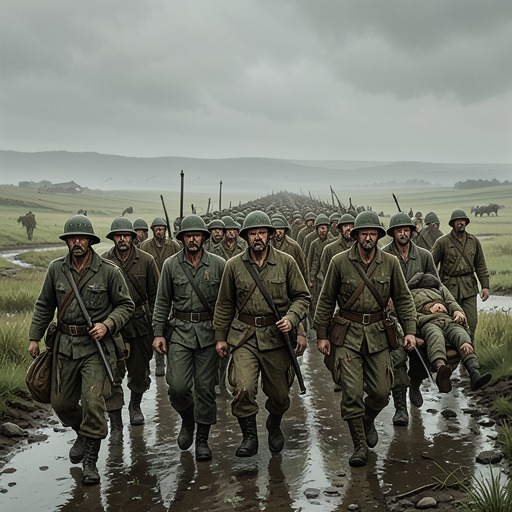
The council followed a long retreat under conditions that made an uncomplicated defense of Moscow impossible. In October 1805, the Russian army had already revealed how much military action depended on material preparation: a regiment arriving at Braunau had marched roughly seven hundred miles, more than half its men had boots in holes, and the soldiers had spent a night cleaning and repairing themselves for inspection because supplies had failed them. In 1812 the same conflict between plans and material reality became larger and more destructive. Millions of men crossed toward the Russian frontier, and war began amid an immense movement of troops, transport, food, and equipment. The Russian army’s subsequent decisions were therefore shaped not only by commanders’ intentions but by exhaustion, roads, supplies, losses, and the possibility of preserving a coherent force.
Kutuzov’s army had already learned this lesson in its earlier retreat along the Danube. Pursued by a French army of a hundred thousand under Napoleon Bonaparte, a Russian force of thirty-five thousand fought rearguard actions at Lambach, Amstetten, and Melk only so far as necessary to save its heavy equipment and continue withdrawing. After the action at Krems, even a victory had not erased the army’s losses: the troops were ill-clad and exhausted, a third of their number had been lost through death, wounds, illness, or straggling, and hospitals could no longer contain all the sick and wounded. The Council of Fili belongs to this wider pattern of command under pressure, in which the preservation of an army is itself the condition of future resistance.
By the time of Fili, the question of abandoning Moscow had not suddenly appeared on the first of September. It had been settled progressively at Drissa, at Smolensk, at Shevardino on the twenty-fourth of August, at Borodino on the twenty-sixth, and during every hour of the retreat from Borodino to Fili. The council therefore did not create the strategic situation. It exposed and named a decision that the movement of the army had already imposed.
Assembly and Atmosphere
The council began assembling at two in the afternoon in the larger part of Andrew Savostyanov’s hut. The peasant family crowded into the adjoining room, while Malasha, the six-year-old granddaughter, remained on top of the brick oven and watched the generals enter. Kutuzov sat apart in a dark corner behind the oven, sunk in a folding chair, repeatedly clearing his throat and tugging at the collar of his coat. He even prevented his adjutant from opening the curtain toward him, as though he did not wish his face to be seen.
The room converted ordinary domestic space into the center of national military decision. Maps, plans, pencils, and papers covered the deal table; additional benches had to be brought in for the assembled commanders. Barclay de Tolly, pale, ill, feverish, and shivering, sat beneath the icons. Uvarov spoke rapidly to him; Dokhturov listened with raised eyebrows and folded arms; Ostermann-Tolstoy rested his broad head on his hand; Raevski repeatedly glanced toward Kutuzov and the door; and Konovnitsyn’s expression softened when he met Malasha’s eyes. The child’s position on the oven gives the gathering an unusual scale: the fate of Moscow is observed not only by generals and maps but by a peasant household and a little girl who understands the personal antagonism more readily than the military abstractions.
The generals waited from four until six for Bennigsen, who was finishing dinner under the pretext of inspecting the position. Only after his arrival did Kutuzov move from his corner toward the table, still keeping far enough away from the candles for his face to remain in shadow. Bennigsen opened by asking whether Russia’s ancient and sacred capital should be abandoned without a struggle or defended. The question produced a prolonged silence, broken only by Kutuzov’s angry grunts and coughs. The solemnity of the room makes the council resemble a funeral before the final decision has been spoken.
Debate and Decision
Kutuzov rejected the patriotic phrasing of Bennigsen’s opening. For him, the real question was not whether Moscow was sacred, but whether the Russian army should be risked along with the city. Bennigsen proposed moving troops during the night from the right flank to the left and attacking the French right wing the following day. Ermolov, Dokhturov, and Raevski supported the proposal, whether because they believed a sacrifice was required before abandoning the capital or for other personal reasons. Other commanders concentrated instead on the army’s direction of retreat and understood that the council could not reverse the course already established by the campaign.
Kutuzov defeated Bennigsen’s proposal through a pointed reference to the Battle of Friedland. Moving troops close to an enemy, he observed, was always dangerous, and Friedland had been unsuccessful because the troops had been rearranged too near the enemy. The remark was calm, but its effect was sharp: Bennigsen reddened and paced angrily, while the discussion gradually lost its momentum. Malasha interpreted the exchange as a personal struggle between her “Granddad” and the general she called “Long-coat,” and her child’s perception isolates the human contest beneath the official language of strategy.
At last Kutuzov sighed, rose slowly, and told the generals that he would have to pay for the broken crockery. He then declared that, by the authority entrusted to him by his sovereign and country, he ordered a retreat. The decision transformed uncertainty into command. The generals dispersed with the solemnity and guarded silence of people leaving a funeral, while Malasha climbed down from the oven and slipped between their legs. Kutuzov remained behind, asking when the abandonment of Moscow had become inevitable and who was responsible for the fact that it had happened.
Consequences for Moscow and the Army
The council’s decision meant that Moscow would be left to the French rather than defended at the cost of the Russian army. When the French entered the city, they found no masters in the houses and were not billeted on inhabitants in the usual manner; they lived in Moscow as in a camp. Though tattered, hungry, worn out, and reduced to a third of their original number, they entered in good marching order. Yet dispersion among the deserted wealthy houses destroyed the army’s remaining cohesion. Regiments dissolved into lodgings, and the soldiers became marauders, neither citizens nor soldiers, carrying away whatever seemed valuable or useful.
The council therefore produced a consequence that exceeded the immediate loss of a capital. The French entered Moscow as a fighting army but left it five weeks later as a mob burdened by its own loot. Their aim changed from conquering to keeping what they had acquired. The army that had seemed capable of occupying the city was gradually undone by occupation, dispersion, hunger, plunder, and the inability to abandon stolen goods. From seventy-three thousand men between Moscow and Vyazma, not counting the Guards, the French force was reduced to thirty-six thousand, although no more than five thousand had fallen in battle. The retreat continued to destroy the army at a rate shaped by disintegration as much as by combat.
The Russian decision also belongs to the social and logistical history of the campaign. A regiment could appear orderly while its men lacked boots; an army could win an action yet lose a third of its strength to wounds, sickness, and straggling; and an occupying force could possess a city while ceasing to function as an army. These contrasts explain why Kutuzov’s choice cannot be measured simply as the surrender of Moscow. It preserved the military body whose continued existence made the later collapse of the French occupation possible.
Narrative and Historical Significance
The council is presented as a scene in which deliberation reveals the limits of deliberation. The generals debate as though a final choice were still open, but the narrative places their meeting after a chain of retreats and battles that has already narrowed the field of action. The formal council is consequently less the origin of the decision than its visible culmination. Its suspense arises from whether the commanders will recognize the necessity that circumstances have produced.
The scene also challenges the idea that history is made by a single unconstrained will. Kutuzov commands, but the command is shaped by the army’s condition, the preceding retreat, the losses at Shevardino and Borodino, and the danger of sacrificing the force needed for future resistance. The surrounding narrative repeatedly shifts attention from heroic intention to transport, footwear, food, illness, roads, and the capacity of soldiers to remain together. In this framework, the retreat from Moscow is neither simple cowardice nor a triumph of abstract strategy. It is an act of preserving a collective military reality under conditions in which defending the city would endanger the army itself.