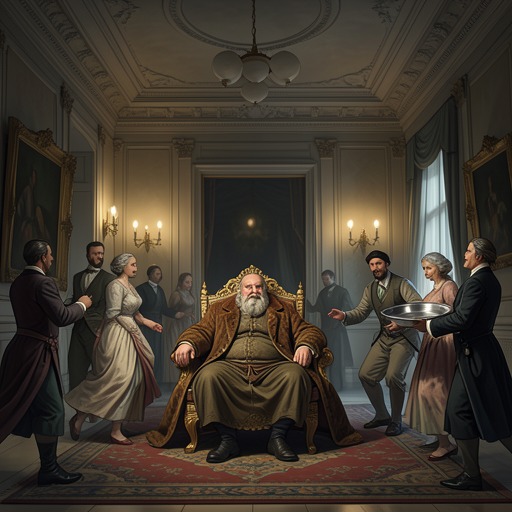
Count Bennigsen
War and PeaceCount Bennigsen is a senior Russian military figure whose importance lies less in a private biography than in the institutional conflict surrounding command of the Russian army. During the 1812 campaign, he stands opposite Mikhail Kutuzov as chief of staff and becomes the focus of a faction that argues for his authority. His career is therefore presented through the politics of headquarters, the rival interpretations of retreat and battle, and the widening gap between what commanders believe they direct and what the army actually does.
Identity and Position
Count Bennigsen appears within the Russian high command during a period when the army has no settled supreme authority. In Vilna, the Emperor of Russia remains at headquarters without assuming direct responsibility for all the forces, while the three armies retain separate commanders. Plans multiply and vacillate rather than forming a single coherent strategy. This unsettled structure creates the conditions in which a chief of staff can become a possible center of power, and Bennigsen is one of the figures around whom that possibility gathers.
His position is supported by a reputation for activity and experience. The party loyal to him argues that, whatever his faults, no one is more active or experienced, and that the army will eventually have to turn to him. His supporters invoke his record in 1807 and claim that Napoleon himself had done justice to his abilities. Their argument is not simply that Bennigsen is personally gifted; it is that military success requires an authority whose orders will be willingly recognized. Against the advocates of Mikhail Barclay de Tolly, they insist that the army needs a commander with established prestige rather than continued dependence on a minister whose authority remains contested.
Rivalry with Mikhail Kutuzov
Bennigsen’s defining relationship in the supplied narrative is his rivalry with Mikhail Kutuzov. When Kutuzov commands the army, the staff divides into two sharply marked parties: Kutuzov’s and Bennigsen’s. The division is not merely a difference of military opinion. It is a contest over which man will control the interpretation of events and receive the rewards attached to command.
The rivalry is especially visible before the Battle of Borodino. Count Bennigsen is positioned as the commander whose headquarters offers the best vantage point for visitors, while Boris Drubetskoy serves him and presents himself as a partisan of the chief of staff. Boris tells Pierre Bezukhov that the left flank is not arranged as Bennigsen had intended, implying that the actual position reflects a decision made against Bennigsen’s judgment. Yet, when questioned by Kutuzov’s adjutant, Boris immediately describes the left flank as extremely strong. His changing presentation shows how Bennigsen’s position operates through staff politics, selective information, and the cultivation of influence rather than through open command alone.
The decisive battle intensifies the stakes. The expectation in headquarters is that Kutuzov may be destroyed politically if the battle goes badly and that power may pass to Bennigsen; even if Kutuzov wins, the rival faction is prepared to claim that the victory was achieved through Bennigsen. Promotion, rewards, and future authority are thus attached to the same action that places thousands of soldiers in danger. Bennigsen’s significance lies in this fusion of military necessity and personal advancement: the battle is simultaneously a national crisis and a contest over who will control its meaning.
Headquarters Politics and the Illusion of Control
The narrative places Bennigsen within a larger system of intrigue in which officers repeatedly attempt to displace one another. After the abandonment of Moscow, the Russian staff is reorganized, and the vacancies left by Prince Pyotr Bagration’s death and Mikhail Barclay de Tolly’s departure must be filled. Appointments are debated through elaborate permutations, as though changing one letter in an administrative scheme could determine the course of the war. In the midst of hostility between Kutuzov and Bennigsen, imperial representatives, staff transfers, and competing factions, one officer undermines another in every possible combination.
Bennigsen is therefore part of a structure that imagines war as an object of administrative mastery. The officers believe they are directing the campaign, and their intrigues concern the conduct of the war, but the war proceeds independently of their designs. The army’s movement arises from the attitude and pressure of the masses rather than from the plans devised at headquarters. In this framework Bennigsen is neither presented as an isolated villain nor granted the stature of an all-powerful strategist. He is a vivid example of the command system’s belief that historical events can be controlled by rearranging authority at the top.
His political position also depends on the difference between public appearance and private calculation. At Borodino, faces around headquarters express both apprehension about life and death and excitement about personal success. Bennigsen’s faction belongs to the latter atmosphere: the impending action promises rewards and the arrival of new men at the front. The contrast does not erase the military importance of the decisions being discussed, but it exposes the personal interests operating inside patriotic and strategic language.
Relation to the Material Reality of War
Bennigsen’s claims to authority are set against a war governed by exhaustion, supply, movement, and the physical condition of armies. In 1805, the Russian army reaches Braunau after a march of roughly seven hundred miles, with more than half the soldiers’ boots worn through because the Austrian commissariat has failed to issue replacements. The regiment can be made immaculate for inspection, with buttons, straps, shirts, and knapsacks in order, but its damaged boots reveal the distance between administrative display and military reality.
The same tension appears in the retreat commanded by Mikhail Kutuzov. Pursued by a French army of one hundred thousand men, Kutuzov’s thirty-five thousand Russians withdraw along the Danube, fighting rearguard actions only as far as necessary to preserve their heavy equipment. The engagements at Lambach, Amstetten, and Melk display courage, but their practical consequence is a still faster retreat. At Krems, the Russians finally halt, defeat Mortier’s division, and capture banners, cannon, and two enemy generals, yet the army remains ill-clad, exhausted, and reduced by killed, wounded, sickness, and straggling.
These details establish the limits within which any commander must act. The later disintegration of the French army in Moscow makes the same point from the opposite direction: once soldiers disperse into deserted houses, an army becomes a population of marauders, and when the men leave they are no longer an army but a mob carrying away what they have taken. Against such evidence, the struggle between Bennigsen and Kutuzov is part of the novel’s broader refusal to treat command decisions as sufficient explanations for historical outcomes.
Narrative Significance
Count Bennigsen embodies the politics of military authority in a narrative that distrusts the great-man explanation of history. The 1812 invasion begins with millions crossing the Russian frontier, followed by crimes and acts of destruction whose scale cannot plausibly be reduced to a single diplomat’s note or one ruler’s intention. Napoleon Bonaparte, Emperor Alexander I, generals, soldiers, diplomats, and businessmen each identify a different cause, but their explanations describe only fragments of a vastly larger movement.
Bennigsen’s story belongs to this critique of power. He is influential because he occupies a strategic institutional position and because others use his name to organize a faction, not because the narrative grants him independent control over the army’s destiny. The question of whether he or Mikhail Kutuzov should prevail becomes a visible form of the deeper question of what power is. Power cannot be explained simply as physical strength or moral genius; it must be understood through the relation between the man who appears to wield it and the people whose actions make that power effective.
For that reason, Bennigsen remains important even where the evidence gives no private scenes or conclusive personal ending. He is the chief of staff around whom a competing command structure forms, the prospective successor whose supporters read retreat as proof of incompetence and victory as an opportunity for credit, and the representative of headquarters politics confronting an army whose course is shaped by conditions no individual can fully command. His narrative function is to make visible the ambition, uncertainty, and institutional self-deception inside military leadership.