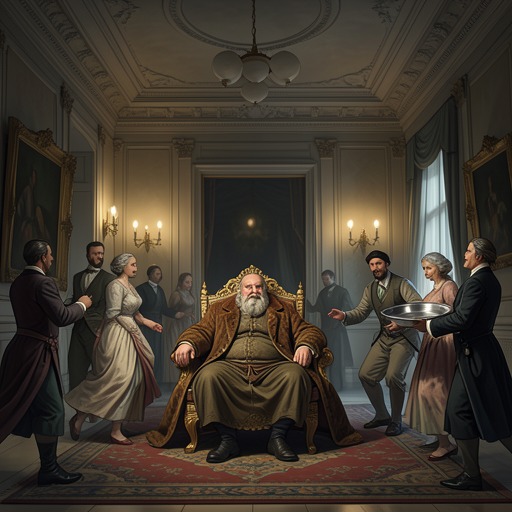
Count Fyodor Rostopchin
War and PeaceCount Fyodor Rostopchin is the governor and public spokesman of Moscow during the French advance in 1812. He presents himself as the man who can preserve order, summon patriotic sacrifice, arm the population, and defend the city’s honor, yet his conduct reveals a much less powerful figure: he reacts to events already determined by the army’s retreat and the inhabitants’ flight, repeatedly trying to make an unavoidable catastrophe appear the result of his own deliberate action. His decisive significance lies in this contradiction. Rostopchin is not the author of Moscow’s abandonment and burning, but a theatrical administrator who turns fear, confusion, and the need for a victim into public violence.
Public Authority and Patriotic Performance
Rostopchin’s authority rests heavily on proclamations, rumors, ceremonies, and displays before the crowd. At the Moscow English Club, the initial news of the Russian defeat at the Battle of Austerlitz is met by silence, while influential men withdraw into private circles and ordinary Moscovites, including Count Ilya Rostov, wait for an acceptable explanation. Once the city’s opinion-makers return, the defeat is explained through familiar accusations against the Austrians, the French, and military circumstances. This atmosphere helps establish the political world in which Rostopchin operates: public confidence is less a response to facts than a story organized by those who claim to interpret them.
In 1812 he speaks in the same register of mobilization and reassurance. At the meeting of the Moscow nobility and gentry, he enters briskly in a general’s uniform and sash and announces that Emperor Alexander I will arrive shortly. He tells the assembled nobles that millions will come from the merchants and that their own duty is to supply men without sparing themselves. The formal resolution is that Moscow’s nobility will provide ten fully equipped men for every thousand serfs, following the example of the Smolensk gentry. Rostopchin thus converts aristocratic discussion into a measurable patriotic obligation, but the scene also exposes the narrowness of official deliberation: after the preceding noise, the magnates merely repeat that they agree, producing a mournful imitation of collective decision.
Broadsheets, Weapons, and the Coming Occupation
Rostopchin’s printed notices become increasingly important as the French approach. One broadsheet denies that he has forbidden departures from Moscow and claims that he is glad ladies and tradesmen’s wives are leaving because there will be less panic and gossip. Yet the same declaration insists that the enemy will not enter the city. For Pierre Bezukhov, the contradiction makes the French entry into Moscow clear for the first time. The proclamation attempts to regulate public feeling, but its very wording betrays the danger it seeks to conceal.
A second notice states that Russian headquarters are at Vyazma, that Count Wittgenstein has defeated the French, and that weapons are available cheaply at the arsenal for inhabitants who wish to arm themselves. The promise of sabers, pistols, and muskets gives the population an image of agency while the military situation deteriorates. Rostopchin’s public language therefore oscillates between denial and preparation: Moscow is supposedly secure, yet its residents are invited to equip themselves for a struggle that official statements refuse to name plainly.
His administration becomes still more contradictory as the crisis deepens. He removes government offices, distributes largely useless weapons to a drunken crowd, stages processions with icons, and at other moments prevents the removal of sacred relics. He seizes private carts to move Leppich’s unfinished balloon, expels French residents while permitting Madame Aubert-Chalme to remain, and orders the arrest and exile of the old postmaster Klyucharev without any particular offense. He alternately orders the people to catch spies and reproaches them for doing so. These reversals are not a coherent policy but a succession of gestures through which Rostopchin tries to appear active while the city moves beyond administrative control.
The Retreat and the Abandonment of Moscow
Rostopchin knows that Moscow cannot be defended before he publicly acknowledges it. After the Battle of Borodino, the generals who came to the city unanimously reported that another battle was impossible; government property was removed nightly, and half the inhabitants had already left with Rostopchin’s permission. Nevertheless, when a letter from Mikhail Kutuzov arrives requesting police officers to guide the retreating troops along the Ryazan road, Rostopchin is astonished and irritated. The information is not new, but its appearance as a simple order makes the abandonment official and deprives him of the opportunity to control its presentation.
His wounded pride is central to the ensuing drama. He has returned from his interview with Mikhail Kutuzov mortified because he was not invited to the council of war and because Kutuzov ignored his offer to participate in the city’s defense. The military command has treated Moscow’s tranquillity and patriotic fervor as secondary to the army’s movements, a judgment Rostopchin experiences as a personal humiliation. He understands that the city will be abandoned, but he cannot accept a historical decision in which his own performance has no determining force.
The narrative consequently places Rostopchin’s actions beside the actual movement of the population. Moscow’s inhabitants leave individually, concerned with their own families and property, without fully grasping that their departure will make the city vulnerable to destruction. Their flight, rather than Rostopchin’s proclamations, helps accomplish the larger national consequence: the abandonment of a vast wooden city makes its burning almost inevitable and becomes a source of Russian glory. Rostopchin’s problem is that he wants to claim mastery over an event produced by countless people and by the retreat of the army. He tries first to hasten and then to restrain the popular current, but his efforts remain small gestures against a force he does not understand.
Vereshchagin and the Manufacture of a Victim
On the night before the evacuation, a crowd gathers outside Rostopchin’s house, angry because it believes the gentry and merchants have abandoned Moscow and because it has been summoned, according to official orders, to fight the French. Rostopchin watches from the balcony, furious and desperate to find someone responsible for the catastrophe. The crowd’s demand for treachery coincides with his own desire for a victim, allowing his private rage to take the form of public justice.
When the adjutant asks what should be done with Vereshchagin, Rostopchin seizes on the name as if it were an unexpected recollection. He goes onto the balcony and tells the crowd that they must first settle with the villain who caused Moscow’s ruin. The announcement reassures the mob that authority still possesses an object and a procedure. Rostopchin promises that the supposed culprit will be punished, then withdraws while the crowd murmurs approval, believing that the governor will restore law and expose the source of its suffering.
Vereshchagin is brought between two dragoons. He is a young man in a worn blue coat lined with fox fur, convict trousers, and heavy chains that hinder his movements. His head has been half shaved; he stands submissively on the porch step, holding his hands together and lifting his coat collar away from his chafed neck. The physical detail makes the accusation inseparable from the body on which power is about to act. Rostopchin calls him the scoundrel responsible for Moscow’s ruin and claims that he betrayed his Tsar and country by going over to Napoleon Bonaparte. Yet he avoids meeting Vereshchagin’s eyes, while the prisoner’s timid, hopeless expression briefly awakens expectation in the crowd rather than confirming guilt.
Rostopchin finally declares that the people may deal with Vereshchagin as they think fit and hands him over to them. The crowd does not immediately act; it compresses, falls silent, and waits in an atmosphere described as unknown, incomprehensible, and terrible. The scene shows how official language manufactures the conditions for violence while preserving the appearance that the crowd itself has chosen the punishment. Rostopchin’s command is both an abdication and an act of direction: he refuses to kill Vereshchagin openly, but he identifies the victim, defines the crime, and releases the collective force that will destroy him.
Historical Function and Narrative Judgment
Rostopchin’s conduct is repeatedly marked by reversals. He taunts those who leave Moscow, then facilitates departures; he removes government property, then stages patriotic spectacles; he hints that he will burn the city, claims credit for the idea, and later repudiates the deed. He writes a solemn proclamation to the French about the destruction of his Orphanage, alternately orders and restrains the pursuit of spies, and gathers people at the Three Hills to fight the French before escaping by a back gate in order to get rid of them. The sequence is not presented as strategic flexibility but as the behavior of a man compelled to do something personally astonishing at every turn.
His later explanations claim that two aims governed him: maintaining tranquillity in Moscow and hastening the inhabitants’ departure. Those aims could make his measures appear defensible, but they cannot explain the repeated theatrical contradictions or the killing of Vereshchagin. The narrative instead treats Rostopchin as a person who mistakes motion for power. He does not create the abandonment and burning of Moscow; he makes a spectacle of himself within an event generated by the army’s retreat, the population’s departure, and the wider historical movement of the war.
The contrast with Pierre Bezukhov sharpens this judgment. Pierre encounters official broadsheets, the preparations for Leppich’s balloon, and the flogging of suspected Frenchmen while trying to decide whether to join the army. He is horrified by punishment enacted before a crowd and senses that a system, rather than a single visible individual, is destroying human lives. Later, when the prisoners are led to a post and pit before French troops, the same machinery of classification, confinement, and execution appears in another form. Rostopchin’s importance therefore extends beyond his personal character: he embodies the political fantasy that catastrophe can be mastered by proclamations and sacrificial punishment, while the novel exposes how institutions and crowds convert that fantasy into suffering.