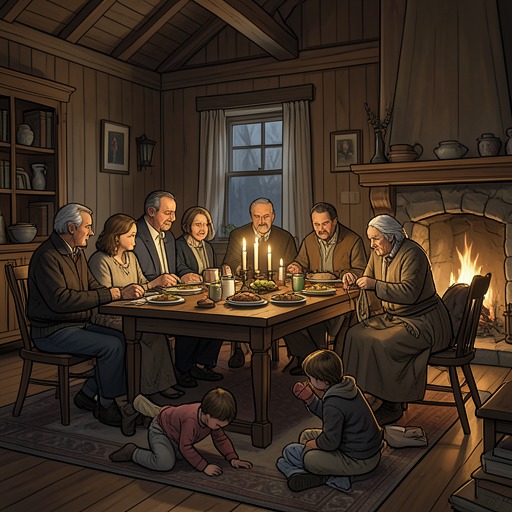
Countess Natalya Rostova
War and PeaceCountess Natalya Rostova is the mother and emotional center of the Rostov family, a figure whose household warmth cannot shield those she loves from war, romantic uncertainty, financial collapse, or death. Introduced as a woman worn by twelve childbirths yet still commanding respect, she embodies both the abundance and the fragility of aristocratic family life. Her story is not one of public action but of anxious attention: she receives visitors, interprets her children's desires, fears for their safety, and finally survives the deaths that have made her former domestic world impossible to recover.
Identity and Household Authority
Countess Natalya Rostova is about forty-five when the Rostovs celebrate St. Natalia's day in their Moscow house on Povarskaya. Carriages arrive continually, and she sits in the drawing room with her eldest daughter, receiving visitors who come to offer congratulations. The narrative describes her face as thin and Oriental in type, visibly worn by childbearing, while her languor of movement and speech gives her a distinguished air that inspires respect. Physical weakness therefore does not remove her authority; it marks the bodily cost of the maternal role on which the household depends.
Her authority operates through intimacy rather than command. While the Count receives guests with indiscriminate warmth, Countess Natalya Rostova speaks from a mother's accumulated experience of anxiety. She admits that the family has endured much suffering so that it can now rejoice in its children, yet insists that anxiety has become greater than joy, especially when boys and girls reach an age dangerous for both feeling and independence. Her maternal vigilance is affectionate, but it is also a form of constant emotional labor.
Parenting, Confidence, and Romantic Anxiety
The Countess believes that she has always been her children's friend and possessed their full confidence. The belief is partly self-deception, since the young people plainly keep matters from their elders, but it also expresses her preferred method of protection. She thinks severity would only drive youthful desire underground. In discussing Natasha Rostova's attachment to Boris Drubetskoy, she reasons that forbidding the relationship might make the young couple act secretly, whereas openness allows Natasha to return in the evening and tell her everything. She recognizes that this permissiveness may spoil her daughter, but regards it as safer than repression.
Her response to Natasha Rostova's later encounter with Denisov shows both the limits and the tenderness of this maternal confidence. Natasha rushes to her mother in agitation, announcing that Denisov has made her an offer of marriage. The Countess initially assumes that the report must be nonsense, since Natasha is still so young, and answers with irritated practical advice: if Denisov has proposed, Natasha should reject him; if she truly loves him, she should marry him. When Natasha protests that she is not in love, the Countess tells her to say so plainly. The exchange is comic on the surface, but it also shows the Countess trying to convert emotional confusion into a manageable decision while remaining close enough for her daughter to seek counsel.
The contrast with Countess Vera Rostova deepens this portrait. Vera remarks that she was brought up differently and suggests that her mother was stricter with her. The visitors and the Countess alike respond awkwardly, as though Vera's accurate statement exposes an uncomfortable truth. The Countess's parenting is therefore not uniform: she has learned, or believes she has learned, to treat Natasha's impulsive temperament with openness rather than the greater severity used with the eldest daughter. Her family ideal depends less on abstract discipline than on preserving access to the child's private feelings.
Maternal Fear Under War
War transforms the Countess's habitual anxiety into a physical terror. After Petya Rostov joins a Cossack regiment and leaves for Belaya Tserkov, she realizes with cruel clarity that both sons are now exposed to death. She tries to bring Nikolai Rostov back and wishes either to join Petya or secure him a position in Saint Petersburg, but neither wish can be fulfilled. Nikolai is away with the army and has not written since his detailed account of meeting Princess Marya Bolkonskaya; Petya cannot simply return while his regiment remains in service.
The Countess consequently stops sleeping, or dreams that her sons are dead when sleep comes. The Count devises a compromise by transferring Petya from Obolenski's regiment to Bezukhov's, which is training near Moscow. Petya remains a soldier, but the transfer offers his mother the consolation of seeing at least one son near her and the hope that he might be kept away from battle. Her fears also alter her sense of maternal preference. While only Nikolai seemed endangered, she imagined that she loved her firstborn most and reproached herself for it; once Petya is threatened, that distinction collapses. War makes every child equally vulnerable and exposes the impossibility of protecting any of them through domestic authority.
This private fear belongs to a larger material world in which military suffering is repeatedly caused by exhaustion, hunger, poor equipment, and disintegration rather than by heroic decisions alone. Russian troops at Braunau endure a twenty-mile march and spend the night cleaning themselves for inspection, while more than half their boots are already full of holes after marching hundreds of miles. Kutuzov's army retreats before a much larger French force, and the Pavlograd Hussar Regiment loses nearly half its men from hunger and sickness despite suffering only two men wounded in action. Farther east, the French army contracts from seventy-three thousand men to thirty-six thousand between Moscow and Vyazma, with only a small fraction of the losses attributable to battle. These military facts give the Countess's fear its historical scale: the sons whom she imagines lying dead are caught in a system where bodies are consumed by movement, deprivation, and weather as much as by combat.
Shock, Grief, and the Death of Petya Rostov
The news of Petya's death breaks through the ordinary world of the Rostov household. When Countess Natalya Rostova hears that he has been killed, she refuses to accept the fact, crying that it is not true and accusing those around her of lying. Her grief is rendered as bodily disorientation: she lies awkwardly in an armchair, beats her head against the wall, pushes away Sonya Rostova and the maids, and laughs hysterically while repeating that Petya is not dead.
Natasha Rostova becomes the immediate witness and caretaker of this collapse. She runs into the room, kneels on the armchair, embraces her mother, raises her, turns her face toward herself, and holds her with unexpected strength. Natasha tears open the Countess's dress, demands a pillow and hot water, and repeats endearments while kissing her mother's head, hands, and face. The daughter's care reverses the earlier direction of family dependence: the mother who had organized emotional safety for her children now requires the child's body and voice to keep her from disintegrating entirely. The Countess briefly becomes quiet, presses Natasha's hand, and asks in a soft, trusting whisper whether Natasha loves her.
The scene gives maternal grief a form more powerful than explanation. The Countess cannot absorb Petya's death as information; she repeats, denies, beats, cries, and clings. Natasha's response does not correct the denial with argument. Instead, it supplies touch, warmth, and continuous speech. The family survives the first shock not by understanding it but by holding the shattered mother within another relationship.
Bereavement and Later Life
The Countess's devastation continues after Petya's death and after the Count's decline. By the later period, she has lost her son and husband in rapid succession. She sits over the dying Count for a fortnight in an armchair without undressing, giving him medicine as he sobs and kisses her hand. The Count dies after asking forgiveness for dissipating the family property, and the Countess is left with the emotional and financial consequences of a household whose hospitality and generosity have exceeded its means.
Her bereavement is inseparable from the family's economic crisis. The Rostovs' debts have increased during their years at Otradnoe, and the Count had gone to Saint Petersburg seeking an official post while also hoping to give the girls one last period of enjoyment. After the Count's death, the debts are revealed to be double the value of the property. Nikolai Rostov refuses to reject the inheritance because he considers doing so an insult to his father's memory; the estate is sold for half its value, thirty thousand rubles are accepted from Pierre Bezukhov toward debts regarded as genuinely due, and Nikolai enters government service partly to avoid imprisonment and partly because the Countess now clings to him as her last hold on life. Her emotional survival thus directly shapes her son's career, forcing him away from the army and into a service he dislikes.
When Pierre Bezukhov and Natasha Rostova visit her later, Countess Natalya Rostova is over sixty, gray-haired, shriveled, and dressed in a cap with a frill around her face. She plays grand-patience with her companion Belova, but her existence has lost its former external purpose. After the deaths of her son and husband, she feels accidentally forgotten in the world, without an aim or object. She eats, sleeps, speaks, weeps, and works, yet the narrative insists that she no longer truly lives; only the continuation of bodily functions remains, and she longs for the tranquillity that death alone could provide.
Narrative Significance
Countess Natalya Rostova gives the novel's large historical movements a domestic measure. Military campaigns appear in her sleepless nights, her attempts to retrieve her sons, and her desperate hope that a transfer can place Petya beyond the reach of battle. Financial mismanagement appears not as an abstract balance sheet but as the pressure that makes Nikolai abandon the army to preserve his mother's life. Death is not completed at the moment of a soldier's fall; it returns through the survivor's body, household rituals, inheritance, and altered future.
Her changing position also reveals the gendered structure of family power. She possesses influence within the household through welcome, confidence, emotional interpretation, and maternal care, but she cannot command armies, halt regimental movement, settle debts, or reverse death. Her most consequential actions are therefore protective and relational: she tries to keep her sons near, maintains channels of trust with her daughters, and receives care when grief destroys her ability to act. The narrative treats these forms of labor as central rather than ornamental. Countess Natalya Rostova begins as the host at the center of a crowded house and ends as an aged survivor whose life has been emptied by the very family attachments that once gave it meaning.