Fire of Moscow
War and PeaceThe Fire of Moscow is the decisive urban catastrophe of the 1812 campaign, but its meaning lies precisely in the refusal to reduce it to an act of individual intention. After the Battle of Borodino, the evacuation and burning of Moscow appear as unavoidable as the Russian army’s withdrawal beyond the city. The event converts Moscow from a capital into an abandoned battlefield, exposes the destructive consequences of military occupation, and prepares the disintegration of the French army that has entered it.
Causes and Background
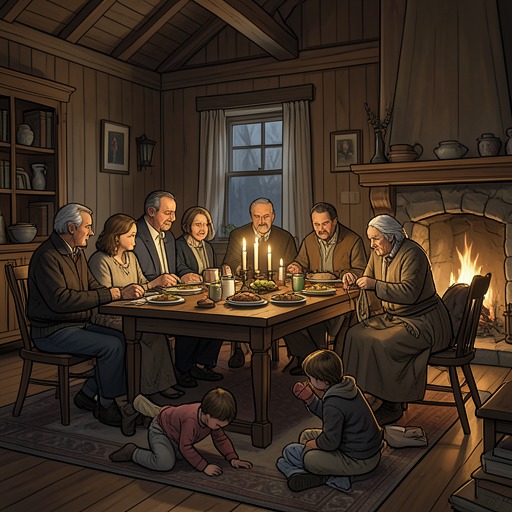
Moscow’s destruction follows a broader pattern established across the Russian campaign. From Smolensk onward, Russian towns and villages face the approach of the enemy by evacuation, abandonment, and the destruction of what cannot be carried away. Wealthier inhabitants leave with as much property as they can save, while poorer residents remain and destroy what is left. This conduct is described not as the result of official persuasion but as an unobtrusive, organic form of patriotism. Although Count Fyodor Rostopchin’s broadsheets call departure shameful and associate it with cowardice, those who leave understand that abandoning the city is necessary even while they feel ashamed to do so.
The evacuation is therefore not explained by a single decree or by fear of French atrocities. Educated and wealthy residents know that cities such as Vienna and Berlin survived French occupation, yet they still depart, leaving houses and possessions behind. The movement reflects a collective intuition that Moscow cannot safely remain inhabited once the Russian army withdraws and the French approach. The city’s emptying is the social precondition of the fire: property is left without owners, buildings without supervision, and streets without the civilian order that normally limits the hazards of occupation.
The event also belongs to the novel’s larger critique of conventional historical explanation. The opening of the 1812 narrative treats war itself as an immense convergence of crimes, movements, and decisions that cannot be adequately attributed to one diplomatic note or one ruler’s ambition. The same logic governs Moscow’s destruction. French observers attribute the fire to Rostopchin’s fierce patriotism, while Russian explanations blame French barbarity, but both accounts seek a single responsible agent where the circumstances themselves provide the stronger explanation.
Occupation and the Empty City
The French enter Moscow after the city has been almost entirely abandoned. Only perhaps a fiftieth of its former inhabitants remain, and the city is compared to a hive that has lost its queen: outward signs of activity survive, but the organizing life has disappeared. The comparison emphasizes that Moscow is not merely quiet or sparsely populated. Its social center has vanished, leaving disconnected movements, irregular sounds, and an atmosphere of emptiness and decay.
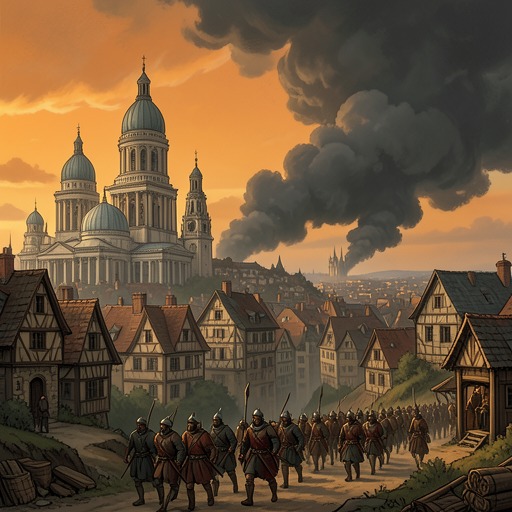
The French army arrives in good marching order despite being tattered, hungry, worn out, and reduced to a third of its original number. It occupies the Kremlin and spreads through the city’s streets, including Vozdvizhenka, Nikolski, Tverskoy, Moroseyka, Lubyanka, and Pokrovka. Because no householders are present, the soldiers are not billeted on residents in the normal manner. They live in Moscow as though it were a camp, without the domestic structures that ordinarily separate military occupation from uncontrolled possession.
That separation collapses almost immediately. Once soldiers disperse into wealthy and deserted houses, the army ceases to function as an army and becomes a population of marauders. Men search cellars, storerooms, yards, stables, and carriage shops; cavalrymen claim houses for their horses; soldiers mark properties with their names and quarrel over the best quarters. Officers attempt to restrain the men but are drawn into selecting carriages and taking possessions for themselves. The city’s abundance turns military discipline into competition for valuables.
Moscow thus consumes the army even before the fire fully destroys the city. The soldiers’ objective changes from conquering Moscow to retaining what they have taken. The army’s collective purpose gives way to individual possession, and the deserted city becomes a rich environment in which military cohesion dissolves. The invasion produces not a stable occupation but a predatory disorder that undermines the force occupying the capital.
How the Fire Begins
The fire is explained through material conditions rather than through a decisive act of arson. Moscow is largely built of wood, and even in peacetime wooden towns experience frequent conflagrations while their owners, inhabitants, and police are present. Once the residents have fled and foreign soldiers occupy the houses, the probability of fire increases sharply. Soldiers smoke pipes, build campfires, and cook meals twice a day in buildings they do not own and have no reason to protect.
The most concrete sources of danger are ordinary practices of occupation. In the Senate Square, French soldiers throw chairs from the Senate House onto the ground and use them as fuel. Fires burn in and around the quarters, kitchens operate in deserted properties, and soldiers move carelessly through a city without its civilian guardians. The text compares Moscow to a heap of shavings exposed to falling sparks for several days: under such conditions, combustion does not require a single mastermind.
The possibility of deliberate arson is treated as doubtful, and neither Rostopchin’s alleged patriotism nor French barbarity is sufficient as a complete cause. Even if individual acts of burning occurred, they would not alter the fundamental explanation. The city burns because an abandoned wooden city has been filled with soldiers, fires, cooking, smoking, disorder, and combustible property. Responsibility is dispersed across the circumstances of evacuation and occupation.
Consequences for the French Army
The fire is inseparable from the French army’s transformation. Before entering Moscow, the French remain a battered but recognizable military force. Within the city, they disperse among houses and possessions until the army’s structure is lost. The occupation generates looting and fires simultaneously, and both the army and the wealthy city are damaged by the encounter.
The destructive process anticipates the French retreat. When the soldiers eventually leave Moscow, they no longer resemble an army advancing toward conquest. Each man carries articles he considers valuable or useful, and his immediate aim is to preserve what he has acquired. Possession becomes a burden that cannot be surrendered, even when carrying it away contributes to ruin. The army’s material gains therefore become instruments of its collapse.
This consequence connects the fire to the later retreat and disintegration of the French forces. After the frosts begin, the French army contracts catastrophically on the road from Moscow toward Vyazma, Smolensk, the Berezina, and Vilna. Between Moscow and Vyazma alone, the force described as numbering seventy-three thousand men, excluding the Guards, falls to thirty-six thousand, although no more than five thousand have died in battle. The campaign’s decisive destruction is therefore not explained by combat losses alone; hunger, cold, dispersion, disease, exhaustion, and the accumulated effects of occupation erode the army’s existence.
Historical and Narrative Significance
The Fire of Moscow embodies the novel’s rejection of the great-man explanation of history. Rostopchin is usually represented as the instigator, while French accounts blame his patriotism and Russian accounts blame French cruelty. Yet the event resists both narratives. Moscow burns through a chain of social and material conditions: the population leaves, property is abandoned, the city is wooden, soldiers occupy houses, fires are continually lit, and discipline breaks down.
The event also gives physical form to the contrast between organized military power and uncontrolled popular or environmental force. Armies may issue orders and historians may assign causes, but the actual result emerges from actions that no individual fully directs. The French enter the capital as conquerors and become marauders; the city that should have rewarded victory instead destroys the cohesion of the victorious army. The fire therefore reverses the apparent meaning of conquest: occupation produces not possession but contamination, not stability but disintegration.
Finally, the event extends the social history of the war beyond commanders and battles. Nobles, merchants, poor residents, soldiers, officers, and absent householders all contribute to the conditions under which Moscow burns, whether through departure, abandonment, occupation, appropriation, or carelessness. Its significance lies in that collective structure. The Fire of Moscow is both a national catastrophe and an impersonal historical process, a destruction no single person can claim to have created and no single person can fully be blamed for causing.