French invasion of Russia
War and PeaceThe French invasion of Russia is the central military and social catastrophe of 1812: a vast advance into Russian territory that carried Napoleon Bonaparte’s army to Moscow but destroyed it through overextension, inadequate preparation, scorched cities, popular hostility, hunger, cold, and disintegration. Its decisive significance lies in the narrative’s refusal to explain the campaign through heroic command alone. Napoleon Bonaparte, Emperor Alexander I, generals, soldiers, nobles, merchants, and townspeople pursue immediate aims, yet their combined actions produce an outcome none of them foresaw.
Causes and Historical Logic
The invasion follows an immense military concentration begun in late 1811. In 1812, millions of men, including those required to transport and feed the armies, move eastward toward the Russian frontier while Russian forces gather in the opposite direction. On June 12, 1812, Western European forces cross the frontier, initiating a war that the narrative describes as opposed to both human reason and human nature. The campaign unleashes crimes on an extraordinary scale, including theft, false money, burglary, arson, and murder, many of which the perpetrators do not regard as crimes while committing them.
The text challenges explanations that assign the war to a single diplomatic grievance or personal ambition. Historians attribute it variously to the wrongs done to the Duke of Oldenburg, the Continental System, Napoleon Bonaparte’s ambition, Emperor Alexander I’s firmness, diplomatic mistakes, or the wording of official memoranda. Different contemporaries naturally identify different causes: Napoleon Bonaparte blames English intrigue, English parliamentarians blame his ambition, the Duke of Oldenburg blames violence against him, businessmen blame the Continental System, generals seek employment, legitimists seek the restoration of established principles, and diplomats blame concealed alliances and awkward documents. These explanations reveal the limited viewpoint of each participant rather than a complete account of the event.
The narrative instead presents the invasion as a convergence of personal characteristics, habits, circumstances, fears, vanities, and aims. Napoleon Bonaparte goes to Dresden because he cannot resist the homage offered there, puts on a Polish uniform, responds to the excitement of a June morning, and loses his temper before Kurakin and Balashev. Emperor Alexander I rejects negotiations because he feels personally insulted. Mikhail Barclay de Tolly attempts to command properly because he wishes to fulfill his duty and win fame. Nikolai Rostov charges the French because he cannot restrain his desire to gallop across an open field. Each actor believes that he is exercising free will, while the larger historical process uses those actions for purposes hidden from them.
The Advance Across Russia
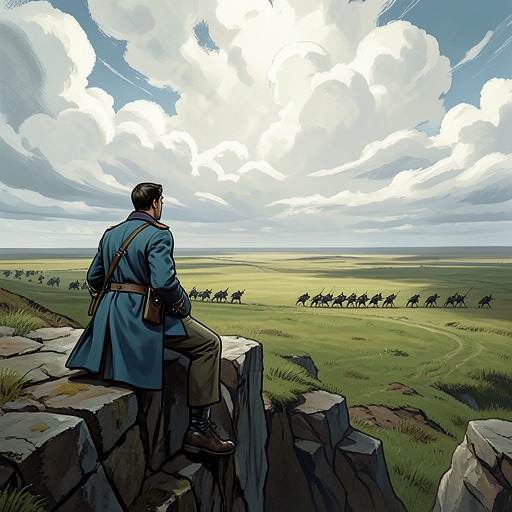
Napoleon Bonaparte personally approaches the Niemen to select a crossing place. From the riverbank, after changing into a Polish uniform, he sees Cossacks and the distant steppes toward Moscow, the holy capital of a realm compared with the Scythian world entered by Alexander the Great. Contrary to strategic and diplomatic considerations, he orders the advance. The following day the army begins crossing the river.
On the morning of June 12, Napoleon Bonaparte watches from the steep left bank as troops stream out of the Vilkavisski forest and cross by three bridges. The soldiers, aware of the Emperor’s presence, raise their caps and shout, "Vive l’Empereur!" The image combines imperial spectacle with physical movement: an apparently inexhaustible army pours eastward, animated by confidence in its commander and by the belief that his personal intervention will make the campaign decisive.
The invasion is nevertheless governed from the beginning by material conditions that heroic language cannot overcome. The Russian army had already learned in the 1805 campaign how marching, supply, clothing, roads, and medical arrangements could determine military effectiveness. At Braunau, Russian soldiers who have marched roughly twenty miles are kept awake through the night cleaning uniforms and equipment for inspection; their regiment presents two thousand orderly men, yet more than half their boots are already full of holes after a march of about seven hundred miles because the Austrian commissariat has failed to issue replacements. The contrast anticipates the broader campaign: surface order and military intention repeatedly confront worn bodies, exhausted transport, inadequate provisions, and the limits of supply.
The same pressure appears in the Pavlograd Hussar Regiment during the later campaign. Stationed for weeks near a ruined German village during the spring thaw, the regiment receives neither provisions for its men nor fodder for its horses. Mud, broken ice, and impassable roads prevent transports from arriving. Soldiers search abandoned villages for potatoes, while the remaining inhabitants are so impoverished that the soldiers often give them their last rations instead of taking anything. Although only two men are wounded in action, nearly half the regiment is lost to hunger and sickness; soldiers with fever or swelling from bad food remain on duty because they believe the hospitals offer certain death. The invasion therefore advances and destroys armies through logistics as much as through battle.
Russian Resistance and the Social War
During the opening phase, the Russian army retreats before the French while conducting rearguard actions only when necessary to preserve its heavy equipment. The French army of one hundred thousand under Napoleon Bonaparte pursues Mikhail Kutuzov’s force of thirty-five thousand along the Danube. Fighting occurs at Lambach, Amstetten, and Melk, but the principal result is a faster Russian retreat. After the Austrians who escaped capture at Ulm separate from Kutuzov, the Russian commander is left with weak and exhausted forces, and the defense of Vienna becomes impossible.
The Russian position briefly improves at Krems. After crossing to the left bank of the Danube, Kutuzov attacks Mortier’s division, breaks it up, and captures banners, cannon, and two enemy generals. For the first time after a fortnight of retreat, Russian troops hold the field after fighting and repulse the French. Yet even this success is inseparable from bodily cost: the Russian force is ill-clad and exhausted and has lost a third of its strength through deaths, wounds, sickness, and straggling. Hospitals in Krems and surrounding houses cannot contain all the wounded, and Kutuzov entrusts some abandoned sick and wounded soldiers to the enemy’s humanity.
In 1812, resistance acquires a national and irregular character. Scattered groups attack soldiers concentrated in masses, withdraw before stronger forces, and strike again when circumstances permit. The narrative identifies this method with the Russian guerrillas, while stressing that the term does not truly explain it. Guerrilla warfare violates the accepted tactical principle that an attacker should concentrate forces to achieve superiority at the moment of conflict. Its effectiveness comes from refusing the orderly forms of conventional battle and from turning dispersed local action into a sustained pressure on the invading army.
The war also mobilizes social groups beyond the regular army. At the Sloboda Palace, nobles and merchants gather in immense numbers in the presence of the Emperor. Uniforms from the eras of Catherine, Emperor Paul, and Alexander I create a strange mixture of historical identities, while the solemn political expectation coexists with ordinary concerns such as card games and household news. The participation of both noble and merchant classes shows the invasion becoming a national crisis rather than a conflict confined to professional soldiers and rulers.
Moscow, Evacuation, and Fire
After the Battle of Borodino, the evacuation and burning of Moscow become inevitable within the narrative’s historical logic. Count Fyodor Rostopchin is often represented as the instigator, but the event is attributed less to his personal policy than to a collective Russian response already visible in towns and villages beginning with Smolensk. Wealthy inhabitants leave, abandoning property and part of their homes, while poorer people remain and destroy what can no longer be preserved. Their patriotism is presented as unobtrusive and organic rather than as a theatrical act of sacrifice.
The evacuation is difficult to interpret through public slogans. Residents are told that leaving Moscow is disgraceful and that only cowards are running from danger; Count Fyodor Rostopchin’s broadsheets reinforce this shame. Nevertheless, people depart because they understand that departure is necessary. Their actions are not adequately explained by fear of French atrocities or by official propaganda. The wealthy abandon possessions, while the poorer population and those unable to leave participate in the destruction of the city’s resources, making occupation materially and morally more difficult.
When the French enter Moscow, the army disperses through the deserted city as water spreads through dry ground. Soldiers occupy abandoned houses, compete for better quarters, mark buildings with their names, and quarrel over them. They rush into the streets in search of valuables, while officers who attempt to restrain them are drawn into the same process. In Carriage Row, generals select coaches left in shops; remaining inhabitants invite officers into their homes in the hope of protection from plunder. The city’s wealth deepens the army’s disorder instead of satisfying it.
The Fire of Moscow cannot be assigned wholly to either Count Fyodor Rostopchin or French barbarity. The city burns because a largely wooden town has been deserted by its inhabitants and filled with soldiers who smoke, light fires, and cook twice a day. Fires that would have been controlled in peacetime become uncontrollable in an occupied city lacking its residents and ordinary police force. The French attribute the catastrophe to the fierce patriotism of Count Fyodor Rostopchin, while the Russians attribute it to French barbarity; the narrative rejects both simplified explanations and presents the fire as the consequence of an entire situation.
Retreat and Destruction
The invasion’s destruction becomes unmistakable during the French retreat. The French army’s advance into the heart of Russia late in the season, without preparation for a winter campaign, combines with the burning of Russian towns and the hatred aroused among the population. In retrospect, these conditions appear sufficient to explain how a force of eight hundred thousand men, regarded as the best army in the world and led by the best general, could be destroyed while opposing a Russian army half its size under inexperienced commanders. At the time, however, neither side understands that its own efforts are helping produce this result.
The retreat is not reduced to a single battle or a single weather event. After October 28, when frosts begin, men freeze or burn themselves at campfires while carriages carrying stolen property pass by in furs. Between Moscow and Vyazma, the French army falls from seventy-three thousand men, excluding the Guards, to thirty-six thousand, although no more than five thousand have fallen in battle. The army continues to melt away from Vyazma to Smolensk, from Smolensk to the Berezina, and from the Berezina to Vilna, with the process proceeding independently of the precise intensity of cold, pursuit, obstruction, or other local conditions.
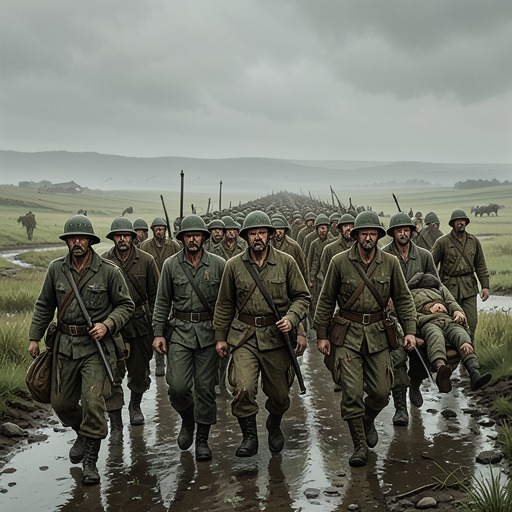
Beyond Vyazma, the army abandons its former arrangement in three columns and moves as one crowded mass. Berthier reports that the corps are almost disbanded, that scarcely a quarter of the soldiers remain with their regimental standards, and that the rest disperse in search of food and escape from discipline. This final image reverses the triumphant crossing of the Niemen. The army that once flowed across three bridges in an organized imperial spectacle has become a starving, scattered body whose soldiers no longer remain attached to their units.
Significance and Historical Interpretation
The invasion exposes the limits of the great-man theory of history. Napoleon Bonaparte’s personal decisions matter, but they do not independently create the campaign’s outcome. Emperor Alexander I, Mikhail Barclay de Tolly, Mikhail Kutuzov, ordinary soldiers, peasants, merchants, nobles, and city residents all act from immediate motives that are partly conscious and partly habitual. Their actions become historical forces only in combination, and the decisive result remains concealed from the participants until after it has occurred.
The event also shifts the meaning of warfare from formal battle to social endurance. Russian military resistance depends on retreat, preservation of equipment, local deprivation, irregular attacks, evacuation, destruction of supplies, and hostility toward occupation. The French army is not destroyed solely by battlefield defeat; it is consumed by the distance it has crossed, the resources it cannot replace, the population it cannot pacify, the city that becomes a trap, and the bodily collapse of men and animals. The French invasion of Russia is therefore both a military campaign and a war of society against occupation, in which ordinary acts of withdrawal, refusal, deprivation, and dispersed attack acquire strategic power.
Its ultimate irony is that the invasion advances according to the intentions of its commanders while moving toward an outcome those intentions cannot control. Napoleon Bonaparte pushes toward Moscow at the end of summer despite the danger of extending his line; Russian efforts frequently hinder the very conditions that will save Russia; and later historians discover apparent plans in notes and letters that did not function as coherent plans when events were unfolding. The invasion becomes intelligible only by separating what people believed they were doing from what their combined actions accomplished. That separation is the foundation of the work’s account of historical necessity.