French retreat from Russia
War and PeaceFrench retreat from Russia marks the reversal of the invasion of 1812: the army that had crossed into Russia with immense momentum reached Moscow, lost the purpose that had sustained its advance, and then dissolved into a starving, burdened crowd fleeing westward. Its decisive significance lies in the novel’s rejection of the heroic explanation of military history. The retreat appears less as the execution of Napoleon Bonaparte’s master plan than as the visible result of accumulated physical conditions—distance, exhausted supplies, ruined roads, winter, pursuit, and the army’s own loss of cohesion.
Causes and Background
From the close of 1811, the forces of Western Europe and Russia concentrated toward the frontier. On June 12, 1812, millions of men and the vast apparatus required to transport and feed them crossed into Russia, beginning a war that the narrative describes as a vast eruption of crimes that contemporaries did not recognize as crimes. The usual explanations—Napoleon Bonaparte’s ambition, Emperor Alexander I’s firmness, the Continental System, diplomatic mistakes, or disputes involving the Duke of Oldenburg—are treated as partial viewpoints rather than sufficient causes. The invasion is instead presented as the outcome of innumerable interacting circumstances, not as the simple decision of one ruler.
The French advance itself generated the conditions of its later destruction. The Russian army withdrew first toward Smolensk and then toward Borodino, refusing to offer the invader the decisive encounter it sought. With every mile, the French moved farther from their supplies and deeper into hostile country. The narrative compares the advance to a falling body gathering velocity as it approaches the earth: the closer the army came to Moscow, the more strongly its own momentum carried it forward. Behind it stretched seven hundred miles of hunger-stricken, hostile territory; ahead lay only a few dozen miles to its goal.
The Russian retreat did not mean passivity. It allowed hatred of the enemy to intensify and helped consolidate the Russian army and people. Beyond the regular army, the conflict acquired a national character. Scattered groups attacked concentrated forces, withdrew before superior strength, and struck again when circumstances allowed. This form of guerrilla warfare violated the conventional tactical rule that an attacker should concentrate forces at the decisive point, yet the narrative presents precisely this dispersed resistance as a successful response to the invasion.
Advance, Moscow, and the Reversal
The collision at Borodino did not destroy either army. The Russian army retreated again, while the French continued to Moscow, but the battle deprived the invasion of the force that had carried it forward. The Russians withdrew eighty miles beyond Moscow; the French entered the city and came to a standstill. For five weeks, no battle occurred. The army that had crossed so much territory was now immobilized inside its apparent prize, likened to a wounded animal remaining still while it licked its wounds.
The abandonment and burning of Moscow formed part of the same reversal. The wealthy classes had already begun to leave, abandoning houses and property, while poorer inhabitants burned or destroyed what remained. The narrative resists assigning the Fire of Moscow to a single instigator. It argues that a deserted wooden city occupied by soldiers, deprived of its inhabitants and police force, exposed to smoking, campfires, and cooking fires, was placed in conditions in which burning was almost inevitable. The event therefore belongs to the larger logic of occupation and evacuation rather than to the intention of one celebrated individual.
The French entered Moscow in good marching order despite being tattered, hungry, worn out, and reduced to a third of their original number. Yet the army ceased to function as an army when its soldiers dispersed among the wealthy and deserted houses. They became marauders, neither citizens nor soldiers. The aim of each man changed from conquering Russia to preserving the objects he had acquired. In Carriage Row, generals selected coaches and caleches; soldiers searched cellars, storerooms, yards, and abandoned houses; officers who had come to restrain them were drawn into the same appropriation. The city’s wealth absorbed the army, producing looting, fires, and the destruction of both the force and the city it had occupied.
Course of the Retreat
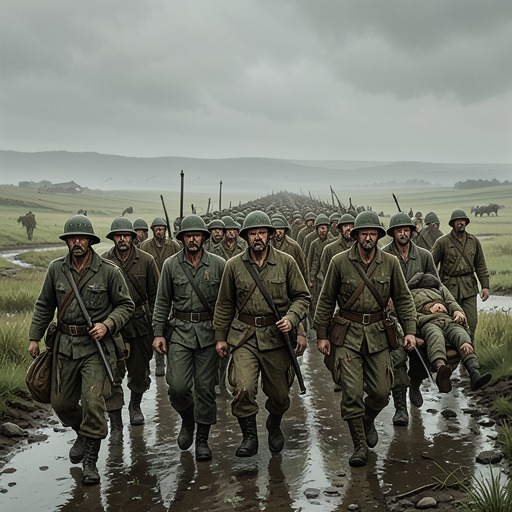
After five weeks in Moscow, the French suddenly moved toward the Kaluga road. They had won at Malo-Yaroslavets, but the victory did not restore the invasion’s earlier power. Instead of taking a well-supplied route, they retreated along devastated roads, passing back toward Smolensk, beyond the Berezina, beyond Vilna, and still farther west. The movement is described as a flight rather than a controlled withdrawal: the army’s direction and speed emerged from its accumulated condition, not from a coherent design imposed from above.
The material losses reveal the scale of the collapse. From Moscow to Vyazma, the French army fell from seventy-three thousand men, excluding the Guards, to thirty-six thousand, although no more than five thousand had been killed in battle. The same rate of disappearance continued from Vyazma to Smolensk, from Smolensk to the Berezina, and from the Berezina to Vilna, independently of the particular intensity of cold, pursuit, blocked roads, or other local circumstances. Beyond Vyazma, the three columns contracted into one mass. Men left their standards in search of food and escape from discipline, while the army’s formal organization became increasingly nominal.
The retreat was also a logistical catastrophe. The French abandoned heavy baggage and artillery, lost men who could no longer march, and carried away possessions stolen in Moscow. At the Berezina, many drowned and many surrendered; those who crossed continued fleeing. The supreme leader put on a fur coat, entered a sleigh, and galloped away alone, while others who could travel drove off and left those unable to move to surrender or die. The physical image of flight thus becomes inseparable from the abandonment of comrades, equipment, discipline, and military purpose.
The wider history of the Napoleonic Wars supplies an earlier pattern of the same material constraints. In 1805, the Russian army under Mikhail Kutuzov had retreated along the Danube while pursued by a much larger French force, fighting rearguard actions only as far as necessary to preserve its heavy equipment. At Krems, after weeks of retreat, the exhausted Russians finally held the field and repulsed the French, though they were ill-clad, depleted, and burdened with overcrowded hospitals. In another campaign, the Pavlograd Hussar Regiment lost nearly half its men from hunger and sickness despite having suffered only two men wounded in action. These episodes establish the novel’s recurring military principle: marching distance, boots, provisions, fodder, disease, transport, and the treatment of wounded men can decide a campaign as decisively as formal battle.
Consequences and Aftermath
The retreat transformed the French from an invading army into a disorganized multitude. Its soldiers had entered Moscow as a weary but still fighting force; they left as marauders carrying whatever they considered valuable or useful. Loot became a burden that could not be relinquished, binding the fugitives to objects acquired during the occupation even when those objects obstructed survival. The retreat therefore punishes not only defeat in battle but the army’s conversion from a disciplined collective into a collection of competing individual interests.
Russian society also experienced the war through evacuation, destruction, and irregular resistance. The departure of Moscow’s inhabitants was not simply obedience to official proclamations or fear produced by Count Fyodor Rostopchin’s broadsheets. The narrative presents it as an unobtrusive form of patriotism: people abandoned property because the circumstances demanded it, while those who remained helped create the conditions in which the occupying force could not comfortably possess the city. The retreat consequently follows a broader social struggle in which civilians, soldiers, and scattered fighters all contribute to the invader’s exhaustion.
The suffering reached prisoners and suspected civilians as well. Pierre Bezukhov, arrested by French soldiers after the occupation, was treated first as a potentially important man and then reduced by the next guard to No. 17 among captured Russians. He was questioned for alleged incendiarism by officials whose formal questions were designed to direct him toward conviction rather than reveal the truth. Led with other prisoners to a post and a freshly dug pit, Pierre experienced war as a system that could deprive a person of life without any single individual appearing to be its author. His experience extends the retreat’s meaning beyond battlefield movement: the collapse of an army also exposes the bureaucratic and arbitrary violence of occupation.
Historical and Narrative Significance
The narrative directly challenges accounts that explain the retreat through Napoleon Bonaparte’s profound arrangements, the maneuvers of his marshals, or their supposed genius. The unnecessary movement from Malo-Yaroslavets along a devastated road, the withdrawal from Smolensk to Orsha, and the final flight are repeatedly dressed by historians in the language of deliberate strategy. Even Marshal Ney’s escape by night through forest and across the Dnieper, after abandoning standards, artillery, and most of his corps, is converted into evidence of greatness. The novel treats such explanations as an after-the-fact effort to attribute the movement of a mass to the will of one man.
This critique reaches its sharpest point in the contrast between historical rhetoric and visible conduct. Napoleon’s reported declaration at Krasnoe, "J'ai assez fait l'empereur; il est temps de faire le general," is followed not by a restoration of command but by another flight, while the departure of the Emperor from his army is presented by historians as an act of genius despite its ordinary moral appearance as abandonment. The episode exposes the gap between what leaders do and what later narratives say they did.
French retreat from Russia therefore functions as a demonstration of historical inevitability understood materially rather than mystically. The invasion began with millions of men, immense momentum, and a destination that seemed to draw the army forward. It ended with freezing soldiers, abandoned equipment, drowned fugitives, stolen property, and a leader departing alone. The movement from Moscow toward Vilna is the novel’s great anti-heroic image: an army does not perish because a single plan fails at one dramatic instant, but because hunger, distance, occupation, resistance, disease, weather, and the erosion of collective purpose finally make continued military existence impossible.