Fyodor Dolokhov
War and PeaceFyodor Dolokhov is one of the novel’s most volatile figures: a man of small means and no connections who nevertheless commands the respect of wealthy companions, survives disgrace, and repeatedly forces his way into positions of danger and visibility. His defining qualities are physical courage, calculating intelligence, insolent self-possession, and an ability to treat social, erotic, and military life as contests in which nerve and timing matter more than rank.
Identity and Introduction
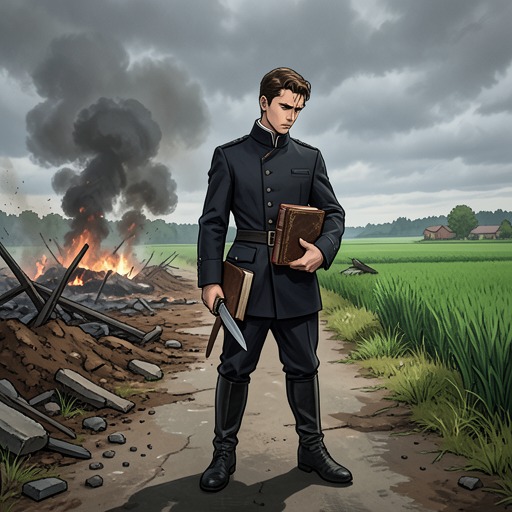
Dolokhov first appears in a Petersburg drinking circle as an officer of the Semenov regiment living with Anatole Kuragin. He is immediately distinguished from the surrounding drunken voices by the sober ring of his own. About twenty-five, of medium height, with curly hair and clear blue eyes, he has a finely formed mouth whose sharply wedged upper lip and firm lower lip give his face an impression of both elegance and aggression. His eyes and habitual half-smiles make him impossible to overlook. The narrator emphasizes the contradiction between his poverty and his authority: although Anatole spends tens of thousands of rubles, Dolokhov lives with him, and everyone who knows them, including Anatole, respects Dolokhov more than the richer man.
His reputation rests on mastery rather than inheritance. He can play every game and nearly always wins; even when he drinks heavily, he does not lose his clearheadedness. Alongside Anatole, he is notorious among the rakes and scapegraces of Saint Petersburg, but he is not merely another careless pleasure-seeker. His intelligence remains active inside the revelry, measuring people, stakes, and opportunities.
Risk, Gambling, and the Performance of Nerve
At Anatole’s gathering, Dolokhov bets an English naval officer that he can drink a bottle of rum while sitting on the outer ledge of a third-floor window with his legs hanging out. He carefully repeats the terms of the wager, then climbs onto the sill, drinks the bottle, and throws it to the Englishman, who catches it. He returns pale but radiant, smelling strongly of rum, while the company celebrates the feat and the Englishman counts out the money. The episode establishes his characteristic method: danger is not an interruption to his social life but the means by which he dominates it.
Pierre Bezukhov is drawn into the same atmosphere and, after drinking, attempts to imitate Dolokhov. When others seize Pierre to stop him, Dolokhov smiles and permits the challenge to become part of the spectacle, while Anatole tries to redirect Pierre. The contrast is revealing. Pierre’s recklessness is a drunken impulse; Dolokhov’s is controlled, legible, and profitable. He makes risk look like freedom because he has already calculated how to inhabit it.
His advice to Nikolai Rostov before the duel with Pierre reveals the lethal logic behind that performance. A man who prepares a will, writes affectionate letters, and imagines his own death has already lost, Dolokhov explains; the duelist must enter with the firm intention of killing his opponent quickly and surely. The statement turns courage into a discipline of imagination. Dolokhov suppresses vulnerability by refusing to grant death a psychological presence before it occurs.
Degradation and the Recovery of Honor
Dolokhov’s military career includes a formal fall in status: he has been reduced to the ranks. At a review near Braunau, the regimental commander notices a soldier in a bluish coat unlike the regulation uniforms and angrily demands an explanation. The captain identifies him as the officer Dolokhov, reduced to the ranks, and adds that the commander himself had permitted the unusual clothing on the march. The scene places Dolokhov inside the machinery of military discipline while also showing that his individuality cannot easily be erased by it.
When Kutuzov asks where Dolokhov is, he steps forward from the ranks in a gray greatcoat and presents arms. Kutuzov tells him that the degradation should be a lesson, orders him to do his duty, and promises not to forget him if he deserves well. Dolokhov responds in a firm, deliberate voice that he wants an opportunity to atone for his fault and prove his devotion to the Emperor and to Russia. Kutuzov turns away with weary skepticism, treating such declarations as conventional words rather than as the substance of service. Dolokhov’s answer is nevertheless important: he understands that military institutions require a public language of repentance and loyalty, and he uses that language to reopen the path toward recognition.
The novel later shows how effectively he acts on that promise. During the battle, when panic threatens the Russian left flank, Dolokhov runs beside Timokhin. Timokhin’s desperate attack throws the French into confusion; Dolokhov kills a Frenchman at close quarters and becomes the first to seize the surrendering French officer by the collar. Afterward he approaches the regimental commander wearing a bluish coat, without a knapsack or cap, his head bandaged, and a French munition pouch over his shoulder. He presents the captured sword and pouch as trophies, reports that he has taken an officer prisoner, and insists that the whole company can bear witness that he stopped the company. When the commander tries to move on, Dolokhov unwraps the handkerchief from his head and displays the congealed blood from a bayonet wound, repeating that he remained at the front and asking to be remembered. His courage is real, but so is his insistence that courage be recorded.
Relationships, Intrigue, and Conflict
Dolokhov’s relationship with Anatole is founded on unequal resources and reversed authority. Anatole supplies wealth and access, while Dolokhov supplies judgment, daring, and practical organization. This balance is especially clear when Anatole moves into Dolokhov’s house and the plan to abduct Natasha Rostova is prepared there. Dolokhov arranges the operation several days in advance, prepares the witnesses, calculates payments, and records the accounts while Anatole paces restlessly and attends to packing. The plan involves a troyka, a forty-mile drive to Kamenka, an unfrocked priest, relays of horses, the Warsaw highroad, and flight abroad. Anatole has a passport and money, including funds taken from his sister and money borrowed with Dolokhov’s help; Dolokhov also controls the practical details, even specifying the payment due to Khvostikov.
The scene makes Dolokhov more than Anatole’s companion in vice. He is the scheme’s logistics officer, accountant, and enabler, converting Anatole’s impulsive desire into an executable plan. The operation’s failure does not erase his responsibility: his intelligence is placed at the service of an act that threatens Natasha’s reputation and attempts to bypass every social and moral consequence through a fraudulent marriage.
His connection with Pierre Bezukhov becomes openly hostile at the Moscow English Club. After recovering his former position following the campaign, Dolokhov had returned to Saint Petersburg, accepted Pierre’s hospitality and money, and lived in Pierre’s house. Helene Kuragina had objected to his presence, while Dolokhov cynically praised her beauty and remained close to the household. By the time Pierre sits opposite him at dinner, anonymous hints and a letter have made Dolokhov’s intimacy with Helene appear potentially adulterous. Pierre cannot accept the accusation intellectually, yet every meeting with Dolokhov’s handsome, insolent eyes awakens something terrible in him.
When Dolokhov snatches a paper from Pierre’s hand and begins reading it, Pierre’s suppressed suspicion becomes physical confrontation. Pierre demands to know how Dolokhov dares take it, then challenges him as a scoundrel. At the instant of the challenge, Pierre experiences the question of Helene’s guilt as finally answered and feels permanently separated from her. Dolokhov’s conduct therefore functions as both provocation and revelation: whether or not every suspicion is established, his manner makes trust impossible. Nikolai Rostov agrees to serve as Dolokhov’s second despite Denisov’s warning, and Dolokhov treats the approaching duel as another contest requiring absolute aggression rather than reflection.
Military Opportunism and Narrative Function
Later, before a decisive battle, Dolokhov appears at Kutuzov’s headquarters as a militiaman. Others describe him as someone who can wriggle in anywhere, a degraded man trying to rise again. He has proposed a scheme and crawled into the enemy’s picket line at night, an act recognized even by those who distrust him as evidence of bravery. Speaking to Kutuzov, he offers himself as a man who will not spare his skin and asks to be remembered if a useful and self-sacrificing man is needed.
This return to the military sphere repeats the pattern established at Braunau. Dolokhov’s status may be lowered, but he treats every marginal position as a temporary platform from which to regain importance. He does not wait for institutions to restore him; he enters their most dangerous spaces and makes his usefulness difficult to ignore. His courage is therefore inseparable from ambition. He seeks service, but he also seeks the public proof that service can provide.
During the later fighting near the landowner’s house, Dolokhov commands men amid smoke and confusion, shouting that they should go round and wait for the infantry. When Petya Rostov gallops forward instead, Dolokhov and the Cossacks follow into the courtyard. French soldiers surrender or flee, and the scene confirms his continuing role as a combat leader whose authority arises from immediate action rather than secure rank. Yet his presence is also shadowed by the death of Petya, who rides into the firing and is killed by a bullet through the skull. Dolokhov belongs to the same violent machinery that produces heroism, capture, and sudden death, and his command cannot prevent the cost of reckless momentum.
Character Significance
Dolokhov is a sharply drawn but not merely flat embodiment of bravado. His recognizable core is the gambler-duelist’s confidence, yet the evidence repeatedly places that confidence in changing systems: the Petersburg drinking room, the military parade, the battlefield, the duel, the abduction plot, and the headquarters before battle. In each setting he translates the local code into a weapon. He understands gambling as calculation, military honor as a language of rehabilitation, friendship as access, and war as an arena in which trophies and witnesses can restore a damaged reputation.
The novel also uses him to expose the bodily and institutional foundations of authority. His face, drinking, wound, captured sword, French pouch, gray greatcoat, and place among the ranks make status visible as something performed and imposed upon the body. Military discipline reduces him to a private, while battlefield action gives him the means to demand recognition again. In the social world, wealth belongs to Anatole, but practical power belongs to Dolokhov; in Pierre’s domestic crisis, a rumor becomes dangerous because Dolokhov’s presence gives it a human shape; in war, a degraded soldier becomes indispensable by seizing an enemy officer.
He is therefore neither a conventional hero nor a simple villain. His bravery is genuine, but it is entangled with vanity, cruelty, and opportunism. He can confront danger with extraordinary steadiness, yet he also organizes an abduction and exploits the trust of Pierre Bezukhov. His repeated survival and reappearance make him a dark counterpart to characters whose moral development depends on humility or inward change. Dolokhov changes position more readily than he changes principle: the world around him shifts from revelry to discipline and from private scandal to national war, while his governing faith remains that nerve, intelligence, and decisive action can force recognition from any hostile order.