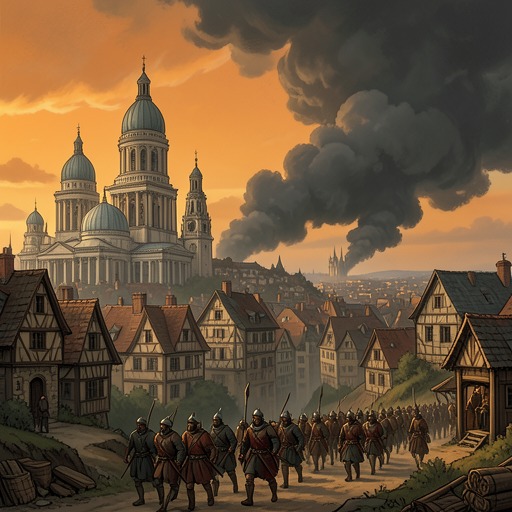
Kremlin
War and PeaceThe Kremlin is the central architectural and symbolic stronghold of Moscow, and its significance changes sharply when the French enter the abandoned city in 1812. From a distance it appears to Napoleon as the seat from which he might govern Russia with dignity and magnanimity; on the ground, its barricaded gates, gunfire, and military occupation expose the gap between imperial imagination and the realities of war.
The Kremlin as Moscow’s Visible Center
From Poklonny Hill on the morning of September 2, Napoleon looks across Moscow and sees the Kremlin within a city that appears to possess a life of its own. The clear autumn air, glittering cupolas, river, gardens, and churches make Moscow seem less like a conquered settlement than a living body. The Kremlin therefore presents itself not merely as a military position but as the visible center of a culture and political world unfamiliar to the French commander.
This view stimulates Napoleon’s uneasy curiosity and his confidence in symbolic power. He imagines that possession of the Kremlin will allow him to convert military victory into political authority, as though the city’s central monument could provide the stage on which conquest would become legitimate rule.
Napoleon’s Imagined Conquest
Napoleon expects Russian notables to come to him at the Kremlin. In his imagination, he will address them with clarity, dignity, and majesty, declare that he never desired war, and offer peace worthy of himself and his people. He pictures assemblies at the palace of the Tsars, a governor winning the people’s hearts, charitable institutions receiving favors, and the conquered city being administered through a carefully staged display of beneficence.
The fantasy depends on the Kremlin as a theater of imperial reconciliation. Napoleon treats architecture, ceremony, and speech as instruments capable of reorganizing political reality. His order, "Qu'on m'amene les boyars," expresses his expectation that Moscow’s ruling class will appear before him and complete the ritual of submission. Yet no deputation comes. The Kremlin offers no audience through which his imagined magnanimity can take effect, and the silence of the city begins to undermine the political meaning he has assigned to the building.
From Citadel to Battlefield
When the French advance toward the Kremlin, the citadel’s gates are barricaded and an ambush is suspected. Kremlin bells ringing for vespers unsettle the French, who mistake the sound for a call to arms. Musket shots then come from beneath the gate, one striking a French soldier in the foot, and the place is immediately reclassified in the soldiers’ perception: familiar Moscow streets become a new battlefield where serious violence may occur.
Murat orders four light guns forward against the gates. Artillerymen prepare their linstocks, and canister shot strikes the stone gates, wooden beams, and screens. The episode strips the Kremlin of the ceremonial and administrative role Napoleon had imagined for it. Its first direct encounter with the occupying army is not a diplomatic reception but an armed resistance that turns a historic citadel into a tactical obstacle.
After the way is cleared, French troops enter and establish a camp in Senate Square. Soldiers throw chairs from the Senate House windows to use as firewood, while other detachments occupy streets around the Kremlin, including the Moroseyka, Lubyanka, Pokrovka, Vozdvizhenka, Nikolski, and Tverskoy Streets. With the inhabitants absent, the French are not billeted in ordinary households; they live in Moscow as in a camp, and the Kremlin becomes part of an occupation landscape rather than the seat of a functioning government.
Occupation and the Collapse of Military Order
The French enter Moscow hungry, worn out, and reduced to roughly a third of their original number, but they still arrive in good marching order. The Kremlin initially helps sustain the appearance that the invaders remain an army capable of conquest. Once the soldiers disperse into deserted houses, however, that army loses its coherence. Men who had entered the city as soldiers become marauders, and the occupation of the Kremlin is absorbed into a wider process of looting and disorder.
This transformation reveals that possession of a central fortress does not equal control of a city. The French can occupy the Kremlin, camp in its square, and move through its gates, but they cannot make Moscow answer the political purpose for which the occupation was undertaken. The citadel remains materially occupied while the social and civic life that would make occupation governable has withdrawn.
The Kremlin and the Failure of Imperial Plans
Napoleon’s later plans for Moscow include fortifying the Kremlin and even destroying the church of Basil the Beatified, which he calls the Mosque. These measures prove detached from the actual conditions of the campaign. The fortification is useless, while the mining of the Kremlin merely contributes to Napoleon’s wish to blow it up when he leaves Moscow, an act compared to a child striking the floor on which he has hurt himself.
The Kremlin thus gathers the novel’s contrast between imagined mastery and historical consequence. Napoleon treats it as a platform for law, peace, administration, religion, and imperial spectacle; the narrative shows that none of these intentions can overcome the military, political, and material conditions created by the occupation. The citadel survives in the text as both a real fortified place and a measure of the conqueror’s misjudgment: he can enter its gates, but he cannot make the Kremlin—or Moscow—perform the role his imagination has prepared for it.