Mikhail Barclay de Tolly
War and PeaceMikhail Barclay de Tolly is a Russian commander whose role in the 1812 campaign embodies the conflict between rational military administration and the emotional, national force of a country under invasion. He is neither treated as a traitor nor reduced to an incompetent officer. Instead, his strengths—careful calculation, disciplined planning, and attention to military necessities—become inadequate when the Russian army and people demand a leader who can express their own sense of defending Russian soil.
Identity and Position
Mikhail Barclay de Tolly appears as a senior Russian military authority during the crisis surrounding the French invasion of Russia. At the Drissa camp, where Emperor Alexander I and the first army were stationed, Prince Andrei Bolkonsky is assigned to Barclay de Tolly. Barclay receives him stiffly and coldly, saying that he will mention him to the Emperor for a decision about his employment while asking him to remain on the staff in the meantime. His position is therefore connected both to the formal machinery of command and to the court-centered military administration surrounding the Emperor.
The novel places Barclay within a Russian army already divided by uncertainty. The second army is retreating and attempting to join the first, while the generals and courtiers are scattered among villages around Drissa. No one yet expects the Russian provinces to be invaded; many believe the war will remain confined to the western provinces. Barclay’s command consequently operates within a system that has not fully recognized the scale of the danger it faces.
Strategic Method and the Retreat
Barclay de Tolly is associated with a deliberate, systematic approach to war. The Russian armies are initially divided, and their immediate aim is to unite. The enormous fortified camp at Drissa is formed according to Pfuel’s plan, and the Emperor has joined the army to encourage the defense of every inch of Russian soil rather than withdrawal. The historical narration insists that the Russian side did not begin with a secret intention to lure Napoleon into the depths of the country. The Emperor reproached commanders for retreating, could not bear the thought of the French reaching Smolensk, and was still more distressed when Smolensk was abandoned and burned without a general engagement beneath its walls.
This presentation directly challenges later historical explanations. Russian writers are said to have attributed a deliberate Scythian strategy to various planners, including Pfuel, Toll, a French adviser, and Alexander himself. Yet such plans appear convincing only because later events made them seem prophetic. Before the outcome was known, countless contrary expectations existed; after the event, only the suggestions that happened to fit it were remembered. Barclay belongs to this field of contested interpretation, where actions made under pressure are retrospectively reorganized into a coherent plan.
The practical difficulties of command further complicate any picture of pure strategic intention. In the earlier campaign of 1805, the Russian army under Mikhail Kutuzov was pursued by a French army of one hundred thousand while the Russians, numbering thirty-five thousand, faced hostile populations, unreliable allies, inadequate supplies, and unfamiliar conditions. Their actions at Lambach, Amstetten, and Melk enabled retreat but produced no decisive reversal. In the 1812 narrative, the same material reality undermines the belief that a commander could simply impose a design on events: armies move through shortages, roads, exhaustion, separation, and the pressure of superior forces as much as through orders.
Smolensk and the Conflict over Command
Prince Andrei Bolkonsky’s judgment of Barclay is harsh but not equivalent to an accusation of treachery. He argues that Barclay had judged correctly that the French might outflank the Russian forces because they possessed larger numbers. The failure, in his view, was that Barclay could not understand what had changed at Smolensk: the army was fighting for Russian soil, and the men possessed a spirit that had multiplied their strength. They had held the French for two days, yet Barclay ordered a retreat, making their efforts and losses seem futile.
Prince Andrei explains the problem through the image of a German valet serving a healthy father. Such a valet may be competent and efficient, but when the father is mortally ill, his child’s unpracticed and awkward care is more appropriate because it comes from kinship. Barclay, in this comparison, is a skilled foreign servant who may have served Russia well while the country was secure. In mortal danger, however, Russia requires one of its own kin: a leader whose authority is rooted in national feeling rather than in technical competence alone.
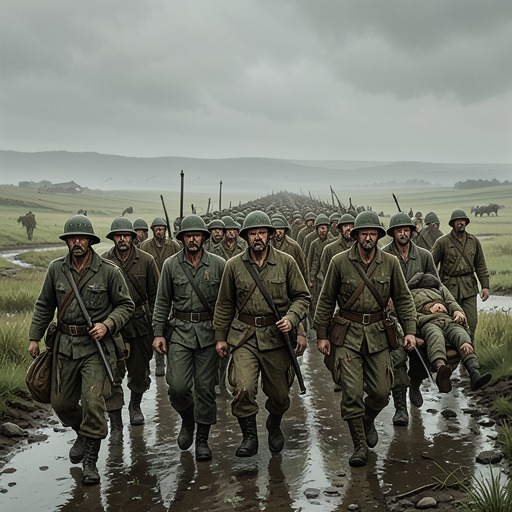
The contrast is intensified by the soldiers’ physical presence. When Prince Andrei sees men bathing in a dirty pond, he thinks of them as “Flesh, bodies, cannon fodder!” The scene makes the human cost of military systems brutally strange: living bodies are simultaneously individual men and material to be expended by command. Barclay’s calculations may be militarily defensible, but they cannot answer the emotional transformation that occurs when the army understands itself as fighting for its homeland.
Reputation, Blame, and the Limits of the Great Commander
Barclay’s reputation deteriorates because public judgment converts strategic disagreement into moral suspicion. Prince Andrei remarks that Barclay did not intend to betray Russia and tried to do the best he could. His very thoroughness, however, makes him unsuitable for the emergency as Prince Andrei understands it. The reforming or patriotic circles turn a complex military decision into a question of loyalty, and Barclay becomes the object of accusations that the narrative regards as historically simplistic.
The novel’s broader account of the campaign rejects the assumption that Napoleon Bonaparte or the Russian commanders possessed a complete plan corresponding to the eventual course of events. Napoleon is not portrayed as anxiously fearing an extended supply line and deliberately seeking a decisive battle, while the Russian commanders did not begin by inviting the French into the interior. The facts contradict these retrospective constructions. Barclay’s position is therefore part of an argument against the “great man” explanation of history: the commander gives orders, but the outcome arises from the interaction of armies, populations, geography, supplies, fear, endurance, and countless actions no individual fully understands.
The logistical conditions elsewhere in the war reinforce this point. The Pavlograd Hussar Regiment, attached to Platov’s independently operating division, exchanged fire with the enemy and even captured Marshal Oudinot’s carriages, yet later lost nearly half its men to hunger and sickness while stationed near a ruined German village. Roads became impassable, provisions and fodder failed to arrive, and soldiers searched abandoned villages for potatoes. Military results could not be explained by command decisions alone when bodies, horses, food, transport, and weather determined whether a regiment remained effective.
Historical Function and Significance
Barclay de Tolly’s importance lies less in a fully developed personal biography than in the historical problem he crystallizes. He stands at the boundary between administration and national resistance, between a plan made on paper and a war whose meaning changes as it is lived. His withdrawal decisions are later judged by their consequences, while the circumstances that produced them—divided armies, uncertain intelligence, superior French numbers, and the need to preserve the Russian force—are easily forgotten.
His portrayal also prepares the novel’s larger contrast between Barclay and Kutuzov. Kutuzov is later treated as an obstacle to a new European war because he believes that continuing the conflict after Russia’s salvation may only damage the country’s achievement. The transfer of authority away from him is described as natural and gradual, as though history requires a different performer for the movement of peoples from east to west. Barclay, by contrast, represents the commander whose technical suitability is exposed as insufficient when national feeling demands a different kind of authority.
Mikhail Barclay de Tolly thus becomes a figure through whom the novel questions power itself. Napoleon’s ability to order hundreds of thousands of men into war cannot be explained simply by physical strength or moral genius; it depends on the relation between the man who commands and the people who obey. Barclay’s failure to command the required emotional allegiance does not prove that he lacked military intelligence. It shows instead that historical power is relational: a correct calculation may lose its force when an army no longer experiences the situation in the terms that produced it.